IMA Q&A Summary
Note on The Book of Life and Death:IMAThe Q&A results are for reference only.Select a question from the list, click to navigate to the answer, and then click the green link on the answer to browse the IMA Q&A results. The 【Reference Answer】 under each question is extracted from the IMA Q&A results; the gray table under each question provides extended links to related Q&A content for further reference. page bottom
- Why is the Buddha called "Perfectly Enlightened"?
- When the thousand Buddhas of the Kalpa of Virtuousness were born, what were the corresponding human lifespans? Why did only Shakyamuni Buddha choose to be born when the human lifespan was one hundred years?
- Why were the Buddhas of the three past times all born in the kingdom of Kapilavastu in India?
- Please describe in detail from largest to smallest and from farthest to nearest: the One True Dharma Realm, the Sea of Ten Thousand Worlds (please provide their names), the Sea of the Flower-Adorned World, the Seed of the Blazing Jewel-Light World Illuminating the Ten Directions (please provide the names of the twentyfold worlds and the Buddha names), the Saha World, the Great Thousand World, the Middle Thousand World, the Small Thousand World, a Single World, the Four Great Continents, and the Southern Continent of Jambudvipa.
- What is the relationship between Amitabha Buddha's Western Pure Land and the Flower-Adorned World described in the *Avatamsaka Sutra*?
- How does Buddhism view time?
- Between the Tathagata of Great Universal Wisdom-Victory in the *Lotus Sutra* and the Tathagata of Treasure-Store in the *Sutra of the Jewel Flower*, which Buddha is chronologically earlier and more ancient?
- Please describe in detail the concept of time known as a "Kalpa", as well as the conditions of the "beginning of the kalpa", the "end of the kalpa", and the three great calamities of "fire, water, and wind".
- Based on the *Sutra of the Great Radiant Light Immortal Answering Inquiries*, please explain the causes of the Great Fire at the end of the kalpa and the actions taken by Buddhas and Bodhisattvas. From this, further deduce the Great Flood and the Great Wind at the end of the kalpa.
- During the increasing kalpa, a Wheel-Turning King is born, but no Buddha incarnation appears; during the decreasing kalpa, no Wheel-Turning King is born, but a Buddha incarnation may appear. — Please analyze this statement.
- In the Kalpa of the beginning, how many suns and moons are there? Where are they placed? Who created the sun and the moon?
- The Sun, the Moon, as well as Venus, Jupiter, Mercury, Mars, Saturn, Uranus, Neptune, etc., which Buddha or Bodhisattva's pure land or residence do they respectively belong to?
- Why do the sun and moon appear to be round? What are their actual shapes? How are sunlight and moonlight produced? Please answer according to the Buddhist scriptures.
- What roles did the Buddhas and Bodhisattvas play in the process of the world's formation, stability, destruction, and emptiness?
- What would it be like to watch the sun and moon move from the Trayastrimsa Heaven? Please provide specific passages from the scriptures.(Based on CBETA)
- What would it be like to watch the sun and moon move from the Trayastrimsa Heaven? Please provide specific passages from the scriptures.(Based on the Chinese Buddhist Canon)
- How does Buddhism view solar and lunar eclipses?
- Where is the Asura located?
- Based on Mount Meru, from the perspective of the height of one's location, are the stars higher than the sun and moon?
- Please explain the origin of "Jambudvipa".
- There is a story in the Buddhist scriptures about a man named "Changjing" who wanted to see the "Shanfu tree". Please provide that passage from the scripture.
- Please describe in detail the shape of Jambudvipa (South Yamadhvipa). If the uneven parts such as hills, seas, rivers, and lakes are removed, is the surface of the earth a plane or a curved surface?
- How do Buddhist scriptures explain the following question: "Why is our human sky blue?"
- What descriptions of the microscopic world are found in Buddhist scriptures?
- "The blessings of a full-year Jambudvipa human are not equal to the blessings of a single person from the Western Qutraya", please analyze the blessings or merits of the Four Great Continents, the Six Desire Heavens, the Form Realms, the Eight Bhumi Bodhisattvas, the Ten Bhumi Bodhisattvas, and the Buddhas one by one, following this method of comparison and thinking.
- The *Great Biography of Shakyamuni* records: Other deities also came to Jambudvipa and urged the Pratyekabuddhas there, saying: "In twelve years, a Bodhisattva will dwell in this world, so you should leave this world!" After hearing this, the Pratyekabuddhas in Mount Vepulla of Rajgir left their large footprints on the rocks and then passed into Nirvana. The five hundred Pratyekabuddhas of the kingdom of Baranasi also entered Nirvana, and their sarira fell to the earth, so the place was named Lumbini (Lushayuan). — Please analyze: Why did the heavenly deities urge the Pratyekabuddhas to enter Nirvana?
- Please describe the circumstances of the Buddha's birth from his mother's right side, and why did the Buddha manifest in this way?
- Please generate a comparison table based on the *Sutra of the Elder's Question to the Buddha on the Power of Narayana* to show the power of the Buddha.
- Please first find out how much "one laksha" is equivalent to, then convert the numbers used by the Buddha in *Avatamsaka Sutra, Volume 45* into modern notation (mathematical exponents), number them in order, and summarize them into a table.
- Please generate the topological structure of the "Avatamsaka Sutra" and compare it with the high-dimensional vector space of AI.
- What are the characteristics of the Buddha's voice? Please provide a summary based on the *Avatamsaka Sutra* and the *Sutra of the Inconceivable Secret Mahayana of the Tathagata*.
- Please tell us the wonderful story of the Stupa of Prabhutaratna based on the *Lotus Sutra*.
- In the Lotus Sutra, the Bodhisattva Jizhi, who came along with Prabhutaratna Buddha, told him it was time to return, but was detained by Shakyamuni Buddha. —Please tell the story of the Dragon Girl offering the pearl and her attaining Buddhahood. Is the precious pearl that the Dragon Girl offered to Shakyamuni Buddha from the heart of a Garuda?
- Please tell the story of Master Zhiyi personally witnessing that "the assembly at Vulture Peak had not yet dispersed," as well as the story of Zen Master Huisi's reincarnation as the Japanese Prince Shotoku.
- Is the Medicine King Bodhisattva in the *Lotus Sutra* the same person as the Medicine King Bodhisattva in the *Shurangama Sutra*?
- Please tell the story of the Medicine King Bodhisattva based on the *Lotus Sutra*. Why was the Bodhisattva who rejoices in seeing all beings (the previous life of the Medicine King Bodhisattva) distressed upon seeing the Buddha's passing?
- In the *Lotus Sutra*, is it because "The Bodhisattva who rejoices in seeing all sentient beings said to the Buddha, 'World-Honored One, World-Honored One, why are you still in this world?'" that it led to "The Bodhisattva who rejoices in seeing all sentient beings, upon seeing the Buddha's passing, was filled with compassion and grief"?
- Please explain the Nirvana of the Buddha based on the following scriptures:The *Lotus Sutra* states: "Therefore, although the Tathagata does not truly perish, he is said to attain Nirvana." The *Sutra on the Great Vehicle of Infinite Life, Solemnity, Purity, and Equality of Enlightenment* states: "In the midst of this, he manifests his Nirvana." The *Bardo Thodol* states: "The Tathagata abandons his body and life to attain Nirvana, entering the Bardo to teach sentient beings." — Additionally, is the following understanding correct: "Although Shakyamuni Buddha has manifested his Nirvana, even after countless eons, the merit of reciting 'Namo Shakyamuni Buddha' is the same as when Shakyamuni Buddha was alive." Please explain this using the principles of the "Chapter on the Life Span of the Tathagata" from the *Lotus Sutra*.
- After the Parinirvana of Shakyamuni Buddha, he left behind the Buddha's relics, robes, and alms bowl for the world. Please explain the history of these three sacred objects.
- Please explain the whereabouts of the Buddha's alms bowl after his Parinirvana.
- Hinayana Nirvana vs. Mahayana Nirvana
- What benefits can sentient beings derive from the light of the Buddhas?(The 2026 Nobel Prize in Physiology or Medicine honors the discovery of light-controlled ion channels and related achievements in optogenetics)
- Please compare the Buddha's light with sunlight.
- "The Buddha's light is like a thousand suns," could it burn the human eye? Please explain the Buddha's constant light, the radiating light, and the conditions for the radiating light.

- What is the connection between Jesus and Buddhism?
- How many times does the Bible record Jesus emitting light? How many times do Buddhist scriptures record the Buddha emitting light?
- How does Buddhism view Judaism?
- How does Buddhism view Catholicism?
- How does Buddhism view Islam?
- How does Buddhism view Hinduism?
- How does Buddhism view Japanese Shintoism? What is the connection between Shintoism and Buddhism?
- How does Buddhism view ancient Eastern and Western myths?
- How does Buddhism view the Chinese ancestors such as the Yellow Emperor Xuanyuan?
- How are Laozi and Confucius described in Buddhism?
- Please tell the story of how Master Tanluan transitioned from pursuing the Way of Immortals to exclusively practicing Pure Land Buddhism.
- Please analyze "Yi Zhongtian's comments on Confucianism" from a Buddhist perspective.
- Several celebrities have claimed that many Taoist classics were plagiarized and fabricated from Buddhist scriptures. Is there any basis for this claim?
- Which classics in the Taoist Canon are clearly plagiarized from Buddhist scriptures?
- What was the nature of the debates between Buddhism and Taoism throughout history?
- The Taoist Yin-Yang symbol ☯ vs. the Buddhist Swastika symbol 卍, where the former represents the solar system (a small world) and the latter represents the Milky Way (the three thousand great thousand worlds). Does this understanding make sense?
- Is the Tathagatagarbha really just a copy of Brahman Atman?
- How does Buddhism view science?
- "Buddhism cannot advance society; only science can drive all civilizations forward!" — Please analyze this statement.
- How does Buddhism view mathematics?(July 23, 2026, Wang Hong awarded the Fields Medal)
- How does Buddhism view the Riemann Hypothesis?
- How does Buddhism view entropy increase?(July 23, 2026, Deng Yu wins the Fields Medal)
- How does Buddhism view the Big Bang theory?
- How does Buddhism view artificial intelligence?
- How does Buddhism view quantum theory?
- The 43rd International Conference on High Energy Physics has announced the confirmation of the existence of glueballs. Please comment on this scientific achievement from the perspective of Buddhist doctrine.
- How does Buddhism view psychology?
- How does Buddhism view love?
- There are records of men turning into women or women turning into men in both Buddhist scriptures and history, right? Knowing this fact of reincarnation, what impact will it have on our understanding of love?
- How does Buddhism view philosophy?
- How does Buddhism view the theory of evolution?
- How does Buddhism view materialism?
- How does Buddhism view the phenomenon of dreams sent by the deceased? Please provide some specific examples.
- How does Buddhism explain lightning and thunder in the sky?
- How does Buddhism view natural disasters, such as great floods, summer hailstorms, landslides, tsunamis, major earthquakes, mudslides, tornadoes, and so on?
- How does Buddhism explain volcanic eruptions?
- I saw the following statement on WeChat: "This society is a dead end. Almost every ordinary person is treated poorly, and almost every successful person meets a bad end. After circling for thousands of years, it is always repeating and reincarnating." — Please use the concepts of reducing karma, increasing karma, and the ten wholesome actions to analyze the way to break this deadlock.
- How does Buddhism view UFOs, and is there any connection to the turning of the Dharma wheel?
- It is stated in *Mahaparinirvana Sutra, Volume 3*: "In the world... although there are wholesome dharmas, they are all merely the remnants of the Tathagata's True Dharma." — Please provide a more in-depth, comprehensive, analytical, and argumentative exploration of this viewpoint.
- What kind of virtuous teachers did Sudhana visit during his fifty-three pilgrimages? Were there any heretics among them?
- "All religions are included within Buddhism; no religion can exist outside the scope of Buddhism." — Please analyze this statement.
- Scripture: "The teachings of heretical teachers are as numerous as the sands of the Ganges." — What are the causes of this phenomenon? How can it be reduced or avoided?
- Mahayana is the word of the Buddha.
- Please discuss "Mahayana is the word of the Buddha" in the context of the multiple Buddhist councils.
- Where exactly does the claim "Mahayana is not the word of the Buddha" go wrong? Please deconstruct the fundamental fallacy of "Mahayana is not the word of the Buddha" layer by layer.
- Please find some scriptural passages from the Hinayana sutras to prove that "Mahayana is the word of the Buddha."
- What are the different types of Buddhist doctrinal classifications? Please compare Master Zhiyi's Five Periods with the Three Periods of the Yogacara school.
- Can animals turn into plants?
- Please create a summary table of the various animals mentioned in the sutra based on the "Brief Sutra on the Retribution of Separate Karma".
- According to the legend of the "Waiting Husband Stone", can humans turn into stones?
- "The stone nods at the sermon of Master Sheng," please tell this story.
- Please explain the "Twelve Types of Beings" in detail.
- Three Thousand Realms in a Single Moment of Thought
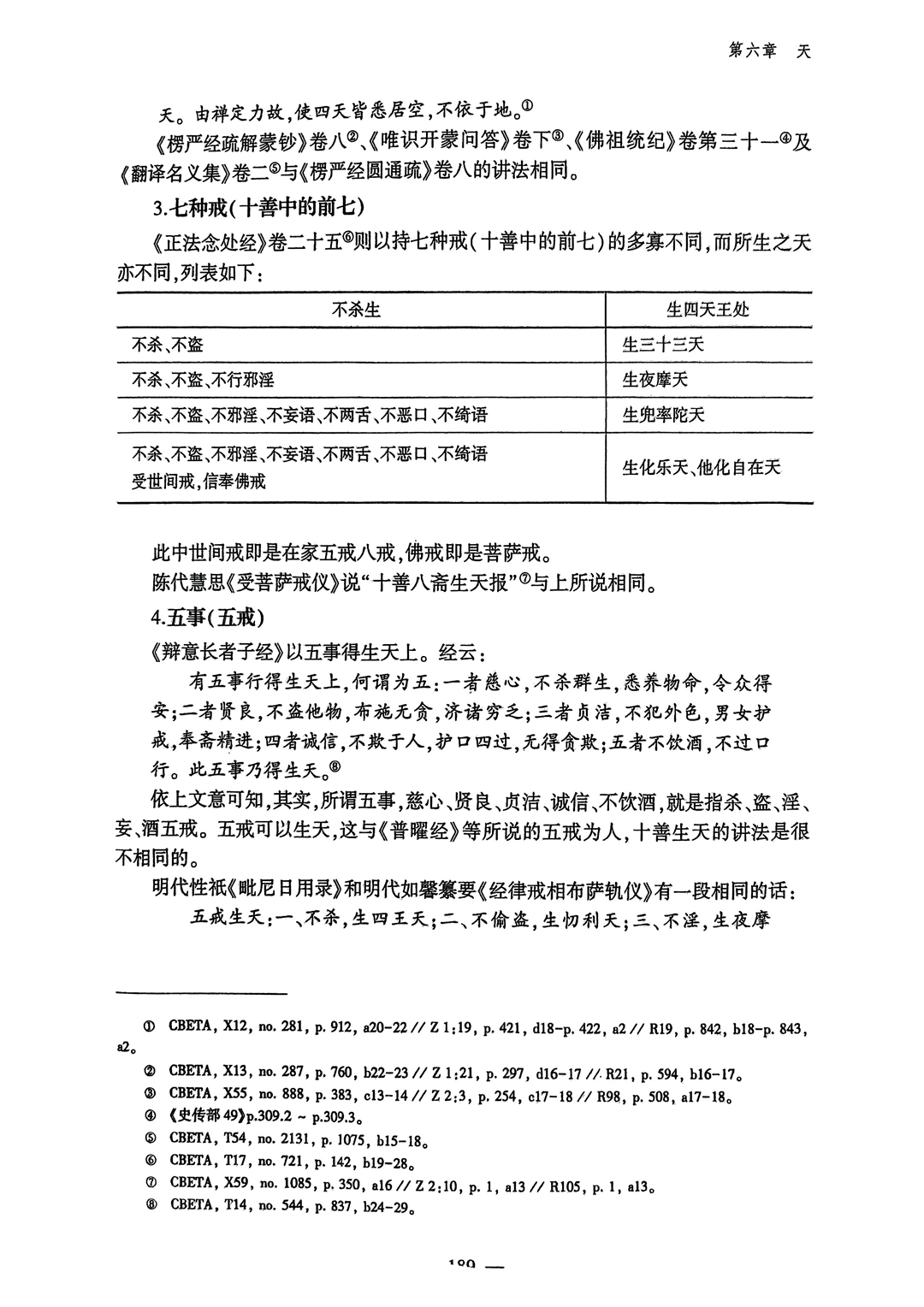
- Regarding the "practice of the ten wholesome deeds," one can be reborn as the Sun Deva, Moon Deva, Star Devas, the Four Heavenly Kings, Trayastrimsa Heaven, and so on. Please analyze the correspondence between the degree of practice and the corresponding rebirths.
- Is there any connection between the Mid-Autumn Festival and Buddhism? Please explain in as much detail as possible.
- Is the image of the rabbit on the moon related to the past life of Gautama Buddha?
- Based on the file hyjqs_01.txt, please summarize the names of the Four Heavenly Kings, their types (for example, the Eastern Heavenly King Caturmaharaja is a Gandharva), their specialties, and the Eight Classes of Beings they govern.
- Based on the file hyjqs_01.txt, please analyze the lifespan of the heavenly beings in the Caturmaharajika Heaven, and how many years it is equivalent to in the human world. Please provide the calculation steps.
- Do the heavenly beings in the Caturmaharajika Heaven have light on their bodies?
- Do the deities in the Color Realm have male genitalia?
- What are the eight faults of Ananda that Mahakasyapa accused him of?
- Is Avalokitesvara Bodhisattva female?
- Please summarize the following information into a report based on "The Sutta of the Mindfulness of True Dharma, Volume 47": Which heaven, name of the heavenly king (if any), what they fall into, and the reason for their fall.
- When the deities of the Radiant Sound Heaven come to the Southern Continent, how do they gradually transform from their "light-born" heavenly bodies into human bodies born of flesh and bone?
- Please describe the origin of humanity based on the Agamas, the Aggañña Sutta, and the Mahā-Loka-Dhatu Sutta, with a focus on the circumstances under which unwholesome karma first began to arise.
- Do people see light when they are reborn?
- Some people complain about their parents giving birth to them. Please use the concept of the "Three Causes of Birth" to deconstruct this resentment.
- How does Buddhism explain "Amyotrophic Lateral Sclerosis (ALS, Lou Gehrig's disease)", such as Stephen Hawking's condition?
- How do celestial beings give birth to children?
- According to the *Samyukta Agama*, please describe what "few sentient beings" are like. Where do they come from? Why can the tree of ignorance and unconsciousness produce few sentient beings?
- What would be the consequences if we humans were to listen to the music of the gods?
- How does Buddhism view the concept of "borrowing a corpse to return a soul"?
- Which jhana corresponds to the cessation of breathing? Which jhana corresponds to the cessation of heartbeat? From the first to the fourth jhana, what are the corresponding physiological phenomena?
- The six sense bases—eye, ear, nose, tongue, body, and mind—have clear referents for the first five: eyes, ears, nose, tongue, and body. So, where is the mind sense base? Is it the heart?
- Why does the physical body remain uncorrupted for a thousand years, such as that of the Sixth Patriarch? What is the reason for this?
- Please tell the story of the eminent monk Dao'ang, who illuminated the *Avatamsaka Sutra* for his audience at night by making his palms glow.
- Can a sound be emitted without a physical body of flesh and bone?
- Which of the four categories of life forms—womb-born, egg-born, moisture-born, or spontaneous-born—does each of the Eight Legions belong to? Where do these eight types of beings reside in the world?
- In which Buddhist sutra is the description of the Great Peng Garuda eating dragons found? Please provide the relevant scriptural passages.
- Where is the Garuda located?Garuda = Golden-winged Bird
- What is the relationship between a mirage and a Gandharva?
- What kind of ghost causes sleep paralysis?
- Where is the Rakshasa (Ghost) Kingdom mentioned in Buddhist scriptures?
- What will ghosts do to those who eat meat?
- In which Buddhist scripture is it mentioned that devas came to Jambudvipa to listen to the Buddha's teachings, but asked for permission to stay in the air to listen because they could not bear the human body odor?
- Is an animal's color related to its karmic obstacles? For example, with dogs, do white dogs have lighter karmic obstacles than black dogs, making it relatively faster and easier for them to be reborn in human form?
- Generally speaking, how long (or how many cycles of rebirth) does it take to regain a human body after falling into the animal realm?
- How does Buddhism view plagues or epidemics?
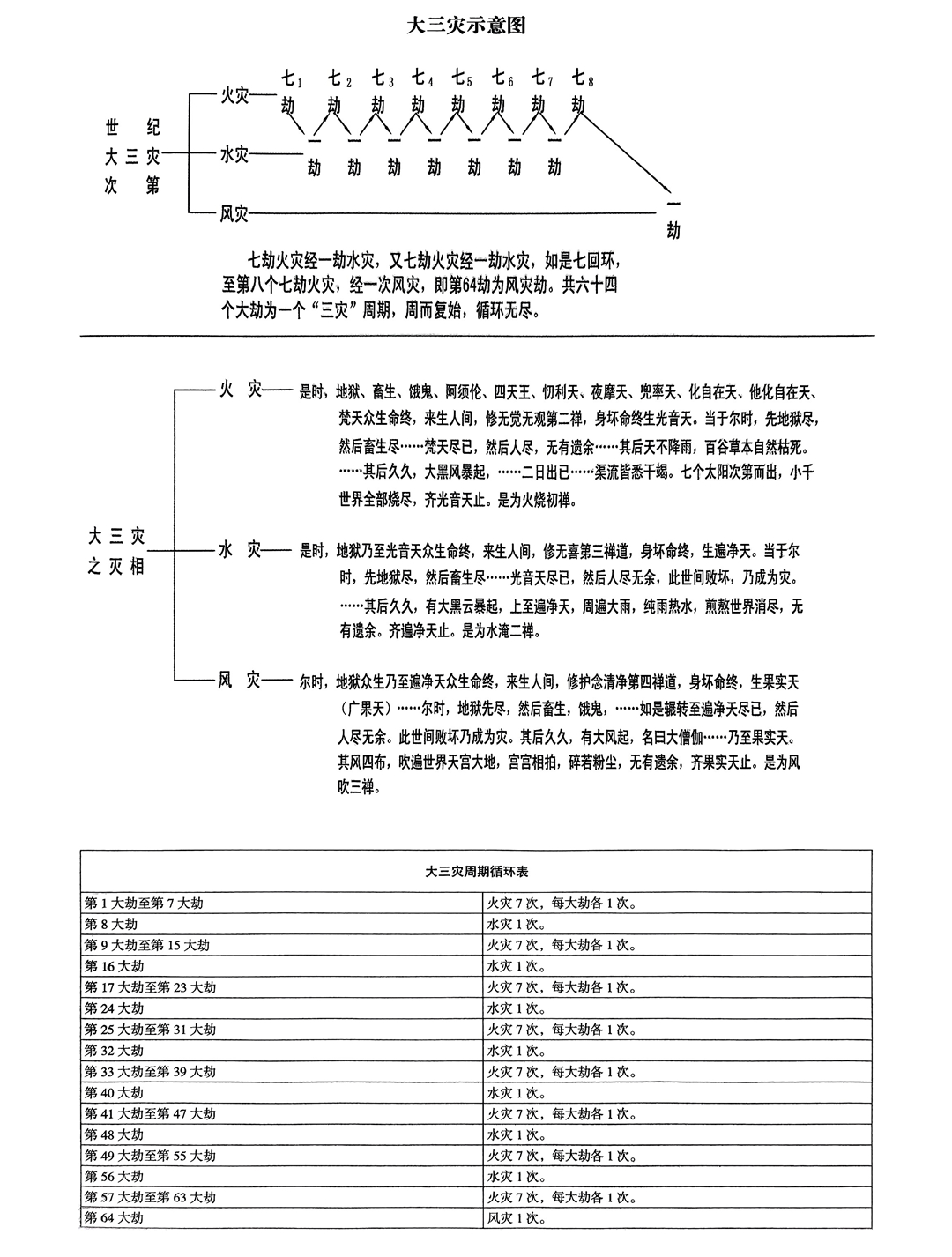
- Please explain the situation of the Three Calamities.
- Please explain the four lines of verse with real-life examples: "For thousands of years, the soup in the bowl is made of flesh and blood; the injustice is as deep as the sea and the resentment is hard to appease. If you want to know about the calamities of war in the world, just listen to the sounds of the slaughterhouse at midnight."
- How does Buddhism view the phenomenon of dying young?
- How many years are there in the True Dharma Age, the Image Dharma Age, and the Degenerate Dharma Age as mentioned in Buddhist scriptures?
- In the Lotus Sutra, when did the Buddha's great disciples attain Buddhahood? Please summarize based on the predictions made by the Buddha for his great disciples.
- The *Mahaprajnaparamita Sutra, Volume 570* states: "In this supreme heaven, countless, innumerable, and boundless great kalpas have already passed. For the perfection of all paramitas practiced by the Buddhas, the Bodhisattvas guard the Prajna Paramita." Why, then, is it still necessary to "pass through countless, innumerable great kalpas in the future world and cultivate the provisions for supreme enlightenment" before attaining Buddhahood?
- Before entering Nirvana, the World-Honored One selected sixteen disciples, requesting them not to enter Nirvana but to remain in the Saha world to propagate the Buddha's teachings and uphold the true faith. —Who were these sixteen disciples? Are there any records of their reincarnations?
- Hanshan, Shide, and Fenggan are the incarnations of which holy beings? In history, which temples did they appear in?
- How do Master Zhijia's "Six Instantaneous Buddhahood" correspond to the "Three Gates" of Zen Buddhism?
- Among all the patriarchs of Zen Buddhism, from Mahakasyapa (corresponding to the "Flower-holding Smile") to all the (Chinese) Zen patriarchs, who has been prophesied to attain Buddhahood in the Kalpa of Virtuousness or other kalpas?
- Wu Zetian, who wrote the Gatha of Opening the Sutra, what was her past-life connection with Buddhism?
- If all things are manifestations of the Dharmakaya, does the Dharmakaya exist beyond time and space?
- What would a person with divine eyes see when looking at "someone chanting the mantras of Buddhas and Bodhisattvas"?
- Please talk about the Dharma Protectors, such as how chanting sutras and reciting Buddha's name can help people avoid disasters, etc.
- Before the birth of Shakyamuni Buddha, were there any remaining Buddhas or Bodhisattvas in the Southern Jambudvipa who taught the Dharma, such as the "Heart Sutra of Prajna Paramita"?
- Please analyze the authenticity and unadulterated nature of Buddhist sutras from multiple perspectives, including the history, versions, media, countries of transmission, and Dharma Protectors of the Tripitaka.
- Is the earliest (original) Chinese Tripitaka related to Emperor Yang of Sui?
- In philosophy, the "three views" refer to the worldview, outlook on life, and values. What are the Buddhist perspectives on these three views? Please provide as detailed guidance as possible.
- The *Shurangama Sutra* states: "The physical body, as well as the mountains, rivers, void, and the earth, are all objects within the wonderful, bright, and true mind... This perception and its conditions are originally the wonderful, pure, and bright essence of Bodhi... All things in the world are the wonderful, bright, and original mind of Bodhi." — Please analyze the concept of "the oneness of mind and matter" based on this.
- After people die, they are cremated into a pile of ashes, and after some years, even the ashes will dissipate. They come and then vanish, just like a bubble that once swelled in space and time. Therefore, the Buddhist scriptures say: "Form is like a cluster of foam, feeling is like a floating bubble, perception is like a mirage, mental formations are like a banana tree, and consciousness is like a magical illusion." Please explain these five metaphors in detail.
- Since everything is empty, where do afflictions come from? Who is enduring the cycle of rebirth? What does spiritual practice rely on? And where is the foundation for attaining Buddhahood?
- If the mountains, rivers, and the earth are all manifestations of consciousness, why do we all see the same scenes? Why are there stable rules of time and space? Why is the law of cause and effect never wrong?
- Please provide a simple and concise summary of the Buddha's teachings.
- What is the ultimate thought in Buddhism?
- Which Pure Lands are mentioned in the Buddhist sutras for rebirth? Which Pure Lands are commonly known to Buddhist disciples for rebirth? Please compare the Pure Land of Tushita Heaven of Bodhisattva Maitreya with the Pure Land of Ultimate Bliss of Amitabha Buddha.
- Why is Master Tanluan revered as the first patriarch of the Japanese Pure Land sect, rather than Master Huiyuan?
- The Buddha taught eighty-four thousand dharmas. In the Dharma-Ending Age, how can people transcend the cycle of birth and death across the Three Realms within a single lifetime and ultimately attain Buddhahood?
- What is Samadhi? What is the Samadhi of Buddha-Recitation? What Samadhis are mentioned in the Avatamsaka Sutra? Why is the Samadhi of Buddha-Recitation called the King of Samadhis?
- Some people who favor Zen meditation look down on practitioners of Buddha-recitation, calling them "human repeaters." Please analyze this situation.
▍Why is the Buddha called "Perfectly Enlightened"? ▲
[Reference Answer] The Buddha is called "Omniscient" because he not only completely eradicated ignorance and delusion (correct), but his wisdom can also universally, unimpededly, and simultaneously realize the true nature of all phenomena (omni-). The Buddha's wisdom can not only know all countable, measurable, and nameable things in the world, but also know the ineffable, immeasurable, and unnameable truths beyond the world (such as Nirvana and the nature of reality). This is the unique merit that distinguishes the Buddha from all ordinary beings, heretics, Sravakas, Pratyekabuddhas, and even Bodhisattvas, and it is also the ultimate goal pursued by practitioners of Buddhism.
Question: How many grains of sand are there in the Ganges River? Answer: No calculation can know this; only the Buddha and the Dharmakaya Bodhisattvas can know their number. The Buddha and the Dharmakaya Bodhisattvas can count and know the birth and death of all the fine dust particles in all the Jambudvipas, let alone the sands of the Ganges. For example, when the Buddha was sitting under a tree in the forest outside Jetavana,A Brahmin came to the Buddha and asked, "How many leaves are in this forest?" The Buddha immediately replied, "There are a certain number."The Brahmin was skeptical: "Who can verify this?" He went to a tree, plucked a few leaves, hid them, and returned to ask the Buddha, "Exactly how many leaves are in this forest?" The Buddha replied, "There are now a certain number fewer." He spoke exactly as the Brahmin had taken. Having known this, the Brahmin was greatly impressed and believed, asked the Buddha to ordain him, and later attained the path of an Arhat. Therefore, it is known that the Buddha can know the number of the sands of the Ganges. —Nagarjuna Bodhisattva's "Mahaprajnaparamita Sastra》 |
[The number of raindrops in a heavy downpour is known only to the Buddhas and Bodhisattvas] Excerpts from the *Avatamsaka Sutra*Volume 50"Furthermore, O Son of Buddha! Just as a great cloud pours down a torrential rain, no one in the great thousand-fold world can know the number of drops. If one tries to count them, it will only lead to madness;Only the Lord of the Great Thousand-fold World—Mahesvara—by the power of his past virtuous roots, knows every single drop clearly.O Son of Buddha! The Tathagata, the Fully Enlightened One, is likewise. He raises the great clouds of Dharma and pours the great rain of Dharma, which all sentient beings, Shravakas, and Pratyekabuddhas cannot know. If they try to contemplate it, their minds will surely go mad;"Only the Bodhisattva Mahasattva, the Lord of all worlds, through the power of the awakened wisdom cultivated in the past, can enter the minds of all sentient beings with even a single word or sentence, leaving nothing unclear."O Bodhisattva! This is the fourth mark of the Tathagata, the Fully Enlightened One. A Mahasattva Bodhisattva should know this." |
"In the time it takes to clap hands and snap fingers, there are 3.2 billion myriad thoughts. Each thought takes form, and every form possesses consciousness. These consciousnesses and thoughts are extremely subtle and cannot be grasped. The Buddha's divine power enters these subtle consciousnesses, allowing all to be liberated." — Taisho Shinshu Daizokyo, Volume 12, No. 384The Bodhisattva descends from the Doshu Heaven to the womb of the Divine Mother to preach the Sutra of Universal Propagation.Excerpt: The Buddha asked Maitreya: "When the mind has thoughts, how many thoughts, how many perceptions, and how many consciousnesses are there?" Maitreya replied:"In the time it takes to clap hands and snap fingers, there are 3.2 billion myriad thoughts. Each thought takes form, and every form possesses consciousness. These consciousnesses and thoughts are extremely subtle and cannot be grasped. The Buddha's divine power enters these subtle consciousnesses, allowing all to be liberated. This consciousness is taught and transformed, not being without consciousness. Furthermore, these subtle consciousnesses are more infinitesimal than a mote of dust. These dust-mote consciousnesses cannot be seen. The Tathagata's divine power enters them to teach and transform, allowing all to be liberated.Maitreya should know that there is no doubt: these dust-mote consciousnesses are also subject to the four elements and the four modes of birth. Why is this so? Sentient beings are boundless, the boundaries are boundless, the Tathagata is boundless, and the Way is boundless. All things that exist are said to exist, yet existence is also non-existence. Without boundaries, without places, without abiding, and without anyone to teach and transform sentient beings, this is called the Samadhi of Reverse and Smooth. Not abiding, not not abiding, one aspect without aspect; not clinging, not bound, also without a true limit. Cultivating the Bodhimanda to purify the Buddha-realm, using provisional means in countless ways, which are beyond the reach of the inferior." |
Excerpts from the Avatamsaka SutraVolume 44: Son of the Buddha! Bodhisattva Mahasattvas, through the divine power of knowing the minds of others, know the differences in the minds of sentient beings in a single thousand-fold great thousand-fold world, namely:good minds, unwholesome minds, broad minds, narrow minds, great minds, small minds, minds that follow life and death, minds that oppose life and death, Sravaka minds, Pratyekabuddha minds, Bodhisattva minds, Sravaka-practice minds, Pratyekabuddha-practice minds, Bodhisattva-practice minds, Deva minds, Naga minds, Yaksha minds, Gandharva minds, Asura minds, Garuda minds, Kinnara minds, Mahoraga minds, human minds, non-human minds, hell minds, animal minds, Yama-realm minds, hungry ghost minds, and the minds of sentient beings in all realms of suffering,and thus clearly know all these countless and diverse minds of sentient beings. Just as in one world, so in a hundred worlds, a thousand worlds, a hundred thousand worlds, a hundred thousand billion nayutas of worlds, and even in worlds as numerous as the dust particles of countless, inexpressible Buddha-lands, they clearly know the minds of all sentient beings. This is called: the Bodhisattva Mahasattva's supreme divine power of knowing the minds of others. Son of the Buddha! Bodhisattva Mahasattvas, through the unobstructed and pure divine power of the heavenly eye, see the sentient beings in countless, inexpressible Buddha-lands as numerous as dust particles, seeing them die in this life and be born in another, in good realms or evil realms, with auspicious or sinful appearances, beautiful or ugly, defiled or pure. Such countless categories of sentient beings are, namely:The Deva assembly, the Naga assembly, the Yaksha assembly, the Gandharva assembly, the Asura assembly, the Garuda assembly, the Kinnara assembly, the Mahoraga assembly, the human assembly, the non-human assembly, the subtle-bodied beings, the vast-bodied beings, the small assembly, and the great assembly,Among all these sentient beings, with the unobstructed eye, all are clearly seen; according to the karma they have accumulated, the suffering and happiness they experience, their thoughts, their discriminations, their views, their words, their causes, their actions, their objects of cognition, and their arising, all are seen without error. This is called: The Second Unobstructed Heavenly Eye Wisdom Supernatural Power of the Bodhisattva Mahasattva. |
The Six Aspects of Buddhahood:Principle is Buddha, Name is Buddha, Contemplation is Buddha, Similarity is Buddha, Partial Realization is Buddha, Ultimate Realization is BuddhaThe Fifty-Two Stages:Ten Faiths, Ten Abidances, Ten Practices, Ten Dedications, Ten Grounds, Equal Enlightenment, Perfect Enlightenment |
▍When the thousand Buddhas of the Kalpa of Virtuousness were born, what were the corresponding human lifespans? Why did only Shakyamuni Buddha choose to be born when the human lifespan was one hundred years? ▲
[Reference Answer] Shakyamuni Buddha's choice to be born when the human lifespan was a hundred years was not a passive "choice," but an active "response" of his "compassionate vow" and "wisdom" afterobserving sentient beingswhose "capacities had matured." He chose to manifest as a Buddha in the darkest and most suffering "Five Defiled Evil World"" to use the "short lifespan" to inspire the "rarity and difficulty of encountering" in sentient beings, and to use the "suffering at the end of the kalpa" to awaken their "aversion to worldly existence," thereby "liberating" the most difficult-to-save beings. This perfectly embodies the Buddha's fundamental mission of "appearing in the world for a single great cause"—to teach the realization of the Buddha's wisdom and view, so that sentient beings may leave suffering and attain happiness.
Haichen thought to himself: I have already urged countless followers before the Tathagata to develop the Bodhi mind, and everyone has made great vows to sustain their own Buddha-fields.All Bodhisattvas abandon the sentient beings of the defiled world, except for the Wind of Universal Entry. Therefore, I should make vows for the sentient beings of the defiled world.Making such vows will surely benefit the beings of the human and heavenly realms, and all Buddhas and Bodhisattvas will surely praise it. In the future, Bodhisattvas with great compassion will follow this path, and Bodhisattvas from the ten directions will also save the pitiful sentient beings of the defiled world. After my Nirvana, through inconceivable kalpas, the Buddhas of the ten directions will surely praise the vows I make today, and upon hearing them, they too will make vows to sustain the Buddha-fields of the defiled world. — "The Life of Shakyamuni Buddha: Treatise on the White Lotus"The Five Hundred Great Vows made by Haichen Bodhisattva, a previous incarnation of Shakyamuni Buddha. |
In the ninth residence of the kalpa of the virtuous age,(the reduced kalpa)there are four Buddhas who successively appeared in the world:Kanakamuni Buddha, Kassapa Buddha, Shakyamuni Buddha, and Dipankara Buddha.The Sutra of the Names of the Thousand Buddhas of the Present Auspicious Aeon(Also known as Mount of the Great Merits of All Buddhas)(亦名集诸佛大功德山) |
At that time, the World-Honored One raised his golden arm, touched the head of the Bodhisattva Ksitigarbha Mahasattva, and said: "Ksitigarbha! Ksitigarbha! Your divine power is inconceivable, your compassion is inconceivable, your wisdom is inconceivable, and your eloquence is inconceivable. Even if the Buddhas of the ten directions were to praise and proclaim your inconceivable deeds, they could not fully express them even in ten thousand kalpas. Ksitigarbha! Ksitigarbha!Remember that today in the Trayastrimsa Heaven, amidst the great assembly of countless inexpressible Buddhas and Bodhisattvas, and the eight classes of heavenly beings and dragons, I entrust to you the human and heavenly beings who have not yet escaped the Three Realms and are still in the burning house. Do not let these beings fall into the evil realms for even a single day and night, let alone fall into the Five Avici and Avici hells, where they would endure for countless kalpas with no hope of escape.Ksitigarbha, the beings of Jambudvipa have unstable natures and are mostly accustomed to evil. Even if they develop a good heart, they retreat in an instant; if they encounter evil conditions, their evil thoughts grow moment by moment. For this reason, I manifest this form and transform countless beings, saving them according to their capacities. Ksitigarbha, I now earnestly entrust the heavenly and human beings to you.In the future world, if there are heavenly beings, good men, or good women who plant even a tiny seed of goodness in the Buddha-dharma—as small as a hair, a speck of dust, a grain of sand, or a drop of water—you shall protect them with your power of the Way, guiding them to gradually cultivate the supreme path and preventing them from regressing.Furthermore, Ksitigarbha, in the future world, if any heavenly or human beings, following the retribution of their karma, fall into the evil realms. As they are about to fall into those realms, or even when they reach the very threshold,"If all sentient beings can recite the name of a Buddha, the name of a Bodhisattva, or a single verse from a Mahayana sutra, then by your divine power, you shall use skillful means to rescue them. You will manifest an infinite body to shatter the hells, send them to the heavenly realms, and let them experience supreme bliss.”——《Ksitigarbha Bodhisattva Purvapranidhana Sutra》 |
Why were the Buddhas of the three past times all born in the kingdom of Kapilavastu in India?ProblemOrigin
As the Buddhas emitted a light of quickening, the Bodhisattvato prove he was not born from the essence of his parents,especially to demonstrate purity and transcendence,deliberately emerged from the right side of his mother's womb,accompanied by a majestic yet gentle light, born fully clothed at midnight under the constellation of the Ghost. When the Bodhisattva was born, Indra, to fulfill his past vow and have the gods serve as his attendants, wore leather gloves and welcomed him in celestial robes. But to subdue Indra's arrogance, the Bodhisattva transformed his body into a diamond form, and the unprepared Indra failed to catch him, his hands trembling uncontrollably. At that moment, the Bodhisattva spoke his first words upon entering the human world:"Get away, Shakra, let go!"—Chapter 3 of "The Life of Shakyamuni"Born from his mother's right rib |
▍Please describe in detail from largest to smallest and from farthest to nearest: the One True Dharma Realm, the Sea of Ten Thousand Worlds (please provide their names), the Sea of the Flower-Adorned World, the Seed of the Blazing Jewel-Light World Illuminating the Ten Directions (please provide the names of the twentyfold worlds and the Buddha names), the Saha World, the Great Thousand World, the Middle Thousand World, the Small Thousand World, a Single World, the Four Great Continents, and the Southern Continent of Jambudvipa. ▲
Excerpts from the Avatamsaka SutraChapter on the Avatamsaka WorldExcerpt: “All you Buddhas’ children, in all those world-systems,some are shaped like Mount Sumeru, some like rivers, some like spirals, some like whirlpools, some like wheel-rims, some like altars, some like forests, some like pavilions, some like mountain pillars, some like squares, some like wombs, some like lotus flowers, some like kheleka vessels, some like the forms of sentient beings, some like clouds, some like the auspicious marks of the Buddhas, some like perfect radiance, some like various jeweled nets, some like all kinds of gates and doors, some like all adornments—… and so forth. If described in full detail, there would be as many forms as the dust-motes in the ocean of worlds.” |
The Ocean of the Splendid World of Avatamsaka(Overview) The Ocean of the Splendid World of Avatamsaka(Mind Map)The Buddha's Diagram of the World's Arrangement |
▍What is the relationship between Amitabha Buddha's Western Pure Land and the Flower-Adorned World described in the *Avatamsaka Sutra*? ▲
[Reference Answer] The Western Pure Land is the most convenient and supreme ladder and gateway to enter the Flower Adornment World (the complete Dharma realm of Vairocana Buddha). The vow power of Amitabha Buddha and the complete merits of the Flower Adornment World are one and the same. Seeking birth in the Pure Land is not abandoning the Flower Adornment World, but rather entering the complete reality of the Flower Adornment World in the fastest and most secure manner. As Master Qingliang Chengguan judged: "The Pure Land fully possesses the Flower Adornment World, and thus they are the same Nirvana." The two are a perfectly integrated Dharma realm that is "one yet two, and two yet one."
[In this world of mine, one kalpa in the Buddha-land of Shakyamuni is but a single day and night in the Buddha-land of Infinite Light in the Pure Land.] Translated by Xuanzang, the Tripitaka Master of the Great Tang, from the "Sutra on the Merits of the Infinite Buddha-lands". Thus have I heard. At one time, the Blessed One was in the tranquil forest of Magadha, sitting on a lion throne atop a red lotus pedestal adorned with wonderful bodhi, vajra, firm, infinite, and precious treasures, accompanied by great Bodhisattvas numbering the countless dust motes of ten inexpressible kotis of hundreds of thousands of Buddha-lands. Also, heavenly beings, asuras, and countless multitudes surrounded him from the front and back. At that time in the assembly, there was a great Bodhisattva named Inconceivable Light King. Relying on the Buddha's majestic power, he rose from his seat, prostrated at the Buddha's feet, joined his palms respectfully, and said to the Buddha: World-Honored One. Among the Buddha-lands, is there a distinction of superiority and inferiority in their respective adornments? The Buddha said: Good man!
Good man! Just as the days and nights of the worlds gradually increase. So too are the lifespans, quantities, and marks of the Buddhas. The adornments of the Bodhisattva worlds are likewise so. This is because the sentient beings therein have their blessings continuously increasing. If there are good men and good women who, upon hearing this dharma gate of the infinite merits of the Buddha lands, rejoice in faith, uphold it, recite it, contemplate it according to the truth, and widely proclaim it, then at the time of their approaching death, the countless Buddhas from the Buddha lands of the ten directions will all appear before them, comforting and praising them, causing them to increase their immeasurable roots of goodness, and allowing them to be reborn in the pure lands of the Buddhas according to their wishes, even attaining supreme perfect enlightenment. In every lifetime, they will constantly remember their past lives, practice the Bodhisattva path, and swiftly achieve perfection. Thus have I heard. The Bodhisattva Mahasattva of Inconceivable Light King, along with the gods, humans, asuras, and all assembled beings, heard the Buddha's teaching, were greatly rejoiced, and accepted it with faith and practiced it. The Sutra of the Merits of the Manifestation of the Boundless Buddha Land |
[One kalpa in the Buddha land of Shakyamuni is one day and night in the Buddha land of Amitabha in the Pure Land.] Excerpt from "The Avatamsaka Sutra, Chapter on the Lifespan": At that time, the Great Bodhisattva King of Mind, in the midst of the assembly, said to the Bodhisattvas: "Son of the Buddha,"This Saha world, one kalpa in the Buddha Shakyamuni's realm, is but a single day and night in the Buddha Amitabha's realm of Ultimate Bliss.One kalpa in the realm of Ultimate Bliss is a single day and night in the Vajra-Firm Buddha's realm of the Kasaya Banner World. One kalpa in the Kasaya Banner World is a single day and night in the Exquisite-Light-Blooming-Lotus Buddha's realm of the Unretrogression Sound-Wheel World. One kalpa in the Unretrogression Sound-Wheel World is a single day and night in the Dharma-Banner Buddha's realm of the Stainless World. One kalpa in the Stainless World is a single day and night in the Lion Buddha's realm of the Good-Lamp World. One kalpa in the Good-Lamp World is a single day and night in the Light-Treasury Buddha's realm of the Wondrous-Light World. One kalpa in the Wondrous-Light World is a single day and night in the Dharma-Light-Blooming-Lotus Buddha's realm of the Incomparable World. One kalpa in the Incomparable World is a single day and night in the All-Supernatural-Light Buddha's realm of the Solemn-Wisdom World. One kalpa in the Solemn-Wisdom World is a single day and night in the Moon-Wisdom Buddha's realm of the Mirror-Light World. Son of the Buddha, in this sequence, passing through millions of asankhyeya worlds, one kalpa in the final world is a single day and night in the Virtuous-Excellence Buddha's realm of the Victorious-Lotus World. Samantabhadra Bodhisattva and all the great Bodhisattvas of the same path fill it. |
▍How does Buddhism view time? ▲
[Reference Answer] In Yogacara, time is categorized as one of the "mental factors not associated with consciousness". It is neither a material dharma (matter) nor a mental dharma (mind), but rather a "differentiation of aspects" established based on the arising, ceasing, and changing of material and mental dharmas. Independent of material and mental dharmas, there is no independent substance of time. Buddhism divides time into the three realms of past, present, and future. This is a "conventional name" established to explain the continuity of cause and effect, and the cycle of karmic retribution. Buddhism has established an extremely precise system of time measurement, ranging from the extremely short "ksana" to the extremely long "kalpa".
The Tathagata, out of boundless great compassion, pities and cherishes the three realms, and thus comes forth into the world. Shining forth to expound the teachings, he desires to save all sentient beings, bestowing upon them the benefit of true reality. He is difficult to encounter and difficult to see, like the rare appearance of the Udumbara flower. What you ask now will bring much benefit. Ananda, you should know: the Tathagata's perfect enlightenment and his wisdom are immeasurable. There is no obstacle.In a single thought, he can abide for immeasurable billions of kalpas. His body and all his faculties remain without increase or decrease.Why is this so? Because the Tathagata's samadhi and wisdom are infinitely profound and unobstructed. He attains the supreme freedom in all dharmas. —The Sutra of the Great Vehicle on Infinite Life, Solemnity, Purity, and Equality of Enlightenment |
[The Lord of the Heavens of Free-Spirited Sound has attained the Gate of Liberation through the power of the merit of all sentient beings across infinite kalpas in a single thought.] This Lord of the Heavens of Free-Spirited Sound,can manifest the infinite kalpas of the three times in a single thought. He can make the past life become the present life, turn the present life into the future life, and the future life can then be regarded as the past life.The past, present, and future three times all manifest simultaneously in a single thought, as the saying goes: "Gathering infinite kalpas into a single thought, and releasing a single thought into infinite kalpas." Within the infinite kalpas, there are also infinite sentient beings who cultivate merit and wisdom to attain Buddhahood. Cultivating merit brings the power of merit, and cultivating wisdom brings the power of wisdom. In other words, when merit and wisdom are perfectly cultivated, power is also achieved, and thus one is not far from attaining Buddhahood. This Lord of the Heavens has attained this Gate of Liberation. —A Simple Explanation of the Avatamsaka Sutra |
▍Between the Tathagata of Great Universal Wisdom-Victory in the *Lotus Sutra* and the Tathagata of Treasure-Store in the *Sutra of the Jewel Flower*, which Buddha is chronologically earlier and more ancient? ▲
[Reference Answer]One of the sixteen princes of the Buddha of Great Wisdom (the ninth prince) is one of the causal grounds of Amitabha Buddha, and the Non-contention Wheel King (Chakravartin) prophesied by the Buddha of Treasuries is also one of the causal grounds of Amitabha Buddha.However, the Lotus Sutra explicitly states that the "immeasurable, boundless, inconceivable asankhyeya kalpas" of the Buddha of Great Universal Wisdom Victory far exceed the "asankhyeya kalpas equal to the sands of the Ganges"—because the time of the Great Universal Buddha is illustrated by the "dust-point kalpa," and the base unit of a dust-point kalpa is itself on an "immeasurable, boundless, and inconceivable" scale, far greater than a single grain of sand from the Ganges. The Tathagata of Great Universal Wisdom Victory is earlier and more ancient than the Tathagata of Treasuries. The "dust-point kalpa" of the Great Universal Buddha is the ultimate metaphor in Buddhist scriptures for describing the vastness of time, with a scale far exceeding the "asankhyeya kalpas equal to the sands of the Ganges." Yet, in the ultimate sense that the Dharmakaya of all Buddhas "permanently abides, without past or present," the distinction between long and short is merely a skillful teaching.
The Buddha said to the monks: 'In the past, countless, boundless, inconceivable asankhyeya kalpas ago, there was a Buddha namedGreat Wisdom-Victorious Tathagata,Worthy of Offerings, Perfectly Enlightened, Accomplished in Conduct, Well-Gone, Knower of the World, Supreme Being, Tamer of Men, Teacher of Gods and Men, Buddha, World-Honored One. His country was named Good City, and the kalpa was named Great Appearance. Monks,Since that Buddha passed into Nirvana, an extremely long time has passed,For example, if all the earth in the three thousand great thousand worlds were ground into ink, and a person were to mark a single point in a thousand countries to the east, as large as a speck of dust, and then mark another point in a thousand more countries, and so on, until all the earth is ground into ink, what would you think? If the master of those countries and his disciples were to count them, could they find the boundary and know their number?' 'No, World-Honored One.' 'Monks, the countries passed through by that person, whether marked or not, would be ground into dust. One speck of dust equals one kalpa. Since that Buddha passed into Nirvana, it has been countless, boundless, hundreds of thousands, millions, billions, asankhyeya kalpas beyond that number,'By the power of the Tathagata's wisdom and vision, I perceive that distant past as if it were today.'——The Lotus SutraChapter 7: The Parable of the City of Transformation》 |
Asankhyeya = 10^(7.1*10^31), also known as "innumerable" —A casual talk on the "Avatamsaka numerical system"; At that time, Bodhisattva Samantabhadra said to the Buddha: "World-Honored One, all Buddhas and Tathagatas preach of the immeasurable, the boundless, the unequaled, the uncountably, the unnamable, the unthinkable, the unmeasurable, the unspeakable, and the unspeakable unspeakable." "World-Honored One,how do we get from Asankhyeya to the unspeakable unspeakable?— *Avatamsaka Sutra*Chapter 30: Asanga》 |
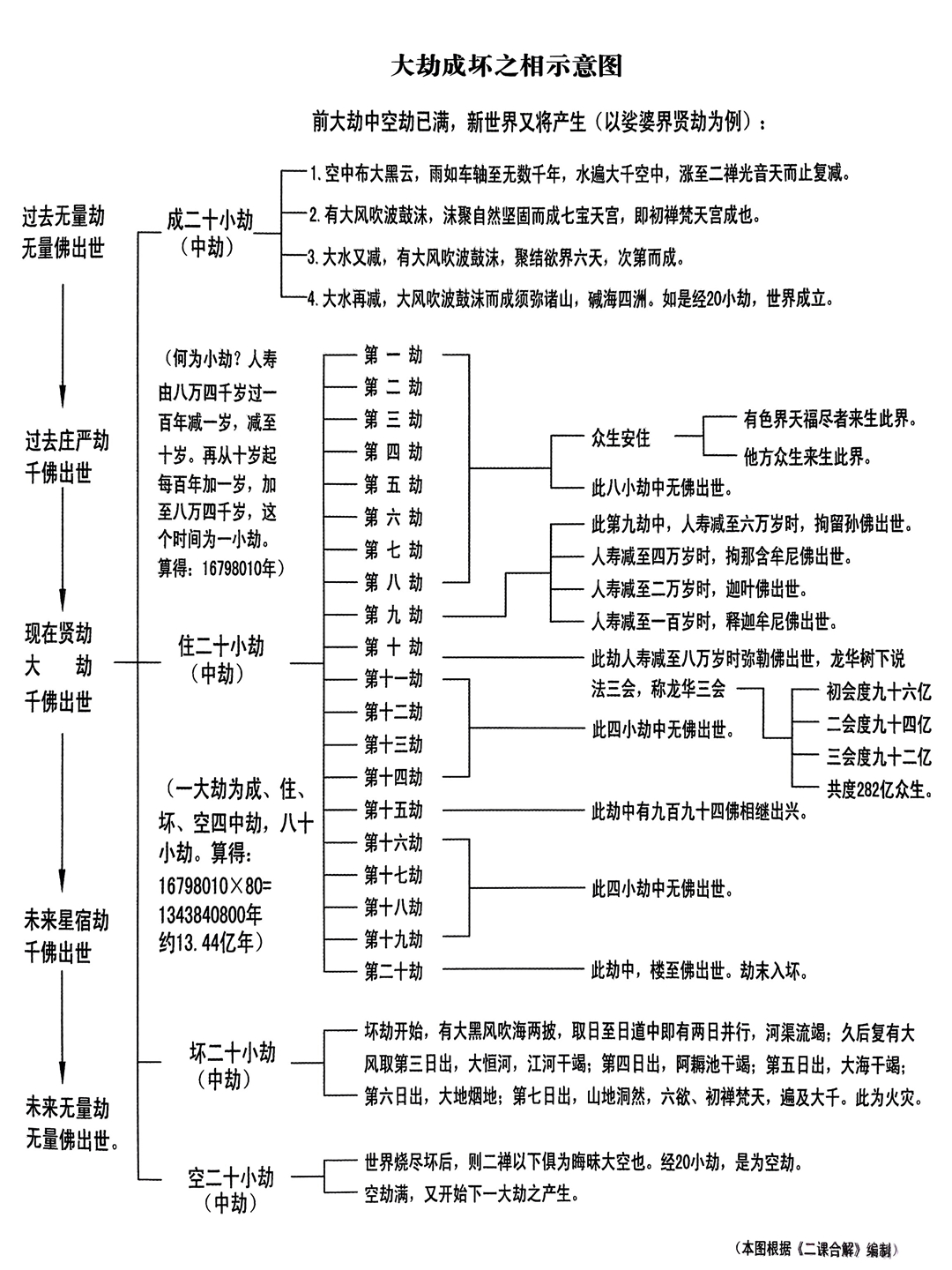
▍Please describe in detail the concept of time known as a "Kalpa", as well as the conditions of the "beginning of the kalpa", the "end of the kalpa", and the three great calamities of "fire, water, and wind". ▲
[Reference Answer] "Kalpa" is the basic unit of time in Buddhism used to measure extremely long cosmic cycles. Its concept encompasses the four stages of the world: formation, dwelling, destruction, and emptiness, while the "beginning of a kalpa," the "end of a kalpa," and theThree Great Calamities(fire, water, and wind) are precisely the key phenomena at different stages of this cyclical period.
The Buddha said to the brave Bodhisattva, "O World-Honored One! How long is a kalpa?" The Buddha replied, "Good man, imagine a great city, twelve yojanas wide and three yojanas high, filled to the brim with sesame seeds. If a long-lived person, over a hundred years old, takes away one seed at a time, even when the sesame seeds in the city are completely gone, the kalpa will not yet be over. O brave one,Also imagine a great mountain, twenty-five yojanas wide and twelve yojanas high. If a long-lived person, over a hundred years old, wipes it once with a light silk cloth, even when the mountain is completely worn away, the kalpa will not yet be over.This is what is called the measure of a kalpa." —Sanghatasutra |
The total destruction of this kalpa by fire is the manifestation of the great skillful means and power of the Tathagatas;The Bodhisattvas of the ten stages of all Buddhas and Tathagatas... in the void above, use their compassionate and wise bodies and hands to rescue sentient beings, ensuring they do not suffer or touch the fire. |
[Reference Answer] When the Great Mahatejas Light Immortal asked the Buddha about the cause of the great fire at the end of the kalpa, the Buddha's answer was profound and differed from the stance of other Mahayana sutras and treatises—the great fire at the end of the kalpa is not only caused by the karma of sentient beings, but is also the great skillful means of all Buddhas: "The total destruction by fire during the burning of this kalpa is the work of the great skillful means of all Tathagatas.When the earth burns at the end of the kalpa, the Bodhisattvas of the Ten Stages are more numerous than the microscopic raindrops of the ten directions, rescuing sentient beings in the void with hands of compassion and wisdom, so that their bodies do not touch suffering. The"Sutra of the Great Mahatejas Light Immortal's Inquiries"provides the most unique, positive, and profound explanation for the great fire at the end of the kalpa—The great fire at the end of the kalpa is not a punishment of karma, nor the cold cruelty of natural laws, nor a disaster beyond the power of Buddhas and Bodhisattvas; rather, it is a great expedient, a great compassion, and a great teaching intentionally set forth by Buddhas and Bodhisattvas.Similarly, although the great floods and great winds of the kalpa-end are driven by internal causes such as the enjoyment of pleasure and the coming and going of breath, they are no less encompassed by the "great skillful means and power of the Buddhas and Tathagatas," and are equally manifestations of the great compassion and skillful means of the Buddhas and Bodhisattvas to demonstrate impermanence and edify sentient beings—Great fires, great floods, and great windsIn the midst of them, the three calamities do not harm those with karmic affinity, as the Bodhisattvas reach out their hands to save all sentient beings.
[The Faults of Bodhisattva Manjusri] At that time, the World-Honored One said to Bodhisattva Mahasattva Manjusri... Manjusri, in the past, you offered various clothes and four requisites to the World-Honored Ones, always ensuring they were abundant.Yet you never skillfully expounded this Dharma for the sake of others. For this reason, you still have many faults in the presence of those Buddhas.If you had, in the presence of those past Buddhas, even a single Buddha, not only offered requisites but also widely expounded this profound and wonderful Dharma for the sake of others, then you would know that in the presence of all the World-Honored Buddhas, you would be fully endowed with offerings and free from all faults. — *The Sutra in Which the Great Radiance Light Immortal Asks Doubts》 |
[Reference Answer] "The rise of the Wheel-Turning King in the increasing kalpa and the Buddha in the decreasing kalpa" is a universal law of the sutras and commentaries, but this is a skillful expedient of the "Master of Smooth Liberation" to teach sentient beings, not an unchangeable iron rule. The original vows of Buddhas and Bodhisattvas (such as the Buddha Lokesvara), the capacity and response of sentient beings in the five turbidities (such as Maitreya appearing at the beginning of the decreasing kalpa),the shared great merit of the Wheel-Turning King and the Buddha (if a Buddha does not renounce the world, he should become a Wheel-Turning King)all indicate that the arrangement of "the rise of the Wheel-Turning King in the increasing kalpa and the Buddha in the decreasing kalpa" is ultimately a great compassion and skillful means established to suit the capacities and timing of sentient beings.
▍In the Kalpa of the beginning, how many suns and moons are there? Where are they placed? Who created the sun and the moon? ▲
【Reference Answer】At the beginning of the kalpa, sentient beings were born from the "Light-Sound Heaven" into the human world. They originally had bodily light and could fly freely. Later, because they ate food such as fertile earth (sweet spring water), earth cakes, and glutinous rice, their bodily light disappeared, and the world fell into darkness. At this time, Amitabha Buddha of the West (the realm of Ultimate Bliss), out of compassion, sent Bodhisattva Baoying and Bodhisattva Jixiang to descend to the human world. They constructed the Sun and Moon Palaces (made of seven treasures and glass) and placed them on the slopes of Mount Meru. From then on, the human world had day and night, and light.
【Why did Amitabha Buddha of the Western Pure Land create the sun and moon for the Saha World (of Shakyamuni Buddha)?] Because Shakyamuni Buddha and Amitabha Buddha had a profound karmic connection in the distant past, Amitabha Buddha sent Avalokitesvara Bodhisattva to create the sun and Mahasthamaprapta Bodhisattva to create the moon (seven suns and one moon);The origin of the Moon Rabbit: From then on, the Tushita Heaven, the Palace of Good Dharma,and the surface of the moon all began to feature images of mountain rabbits., to this day, images including the Moon Rabbit still remain in the world. |
At that time, Bodhisattva, the Physician, along with five hundred attendants, used his supernatural powers to leap into the sky. From his body emerged lions, tigers, and white elephants, and he manifested great supernatural powers. Sitting in the lotus position atop a high mountain, he filled the space for twenty thousand yojanas,transforming into ten thousand billion suns and moons. Then, the young men asked the Buddha, "World-Honored One, why is there such light in the world?" At that time, the World-Honored One said to the young men, "Good men, do you see these suns and moons?" The young men asked the Buddha, "World-Honored One, we indeed see them." The Buddha said to the young men, "This is the Bodhisattva's own light, manifesting as suns and moons to show to all living beings,preaching the Dharma to bring peace, happiness, and benefit to all heavenly beings, and for those who practice among humans to attain this supernatural power." — *Sanghatasutra*Volume 4》 |
【Although all sentient beings in the world are born of karma, the Buddhas have also bestowed their blessings】Taisho Tripitaka Vol. 12 No. 0380Mahakaruna Sutra》Excerpt: Sometimes the three thousand great thousand worlds are burned by the fires of kalpas, blazing and blazing...During the time when the sun and moon of these three thousand great thousand worlds revolve for ten billion cycles……All these are the realms of the Buddhas, bestowed by the Buddhas.。 |
[Reference Answer] In Buddhist scriptures, the sun, moon, and stars are referred to as the "Three Lights" or the "Three Sons of Light." The *Exegesis on the Lotus Sutra* explicitly states that these three celestial beings are manifestations of the Three Great Bodhisattvas (Avalokitesvara, Mahasthamaprapta, and Akasagarbha). Master Tai Xu's interpretation, which attributes the planets to the Four Heavenly Kings and the constellations, is an integrative judgment made within the framework of the Four Heavenly Kings governing the four worlds, combined with the astronomical knowledge of his time. While it lacks direct basis in the Buddhist sutras, it is doctrinally sound—because the Four Heavenly Kings themselves are the "Four Kings who Protect the World," each ruling a region and guarding the four great continents.
Layman Feng Feng's "The Mystery of Saturn's Rings" Excerpt: Saturn is one of the sacred training grounds of Vairocana Buddha and Avalokitesvara Bodhisattva! This is already recorded in the Buddhist scriptures translated by Gautama Siddhartha during the Tang Dynasty.The Sun is also a place where Avalokitesvara Bodhisattva frequently resides, and the Moon is a place frequently visited by Mahasthamaprapta Bodhisattva and the Thousand-Armed Avalokitesvara,Mars is the permanent residence of Ratnasambhava Buddha and Aluka Avalokitesvara, Mercury is one of the training grounds of the Buddha with the Subtle and Solemn Body, Jupiter is one of the places where Bhaisajyaguru Buddha preaches the Dharma, and Venus is one of the places where Amitabha Buddha preaches the Dharma. The Tang Dynasty's "Brahma Fire Luo Nine Luminaries"There is also this saying." |
Who cares about gods and immortals fighting?Today, let me show you how a Bodhisattva fights—the sun is completely "beaten" away! |
【The Secrets of the Twelve Zodiac Signs in BuddhismHow did Western astrology enter the West from the esoteric practices of Buddhism? How did Western astrology inherit the astrology found in the Buddhist Tripitaka? Why do the Chinese lunar calendar, calendars, and many esoteric arts originate from Buddhism? |
The origin of Halley's Comet:The centipede is sealed. The appearance of chickens on Earth. Existing animals are miniature models of ancient giant beasts. |
▍Why do the sun and moon appear to be round? What are their actual shapes? How are sunlight and moonlight produced? Please answer according to the Buddhist scriptures. ▲
[Reference Answer] Its actual shape is a square palace, just like a house. Because it is extremely far from the human realm, it appears circular from a distance. This is consistent with the principle stated in "Lun Heng":"The sun and moon are not round; they appear round because they are far from humans."The light of the Sun Emperor → illuminates the golden chariot → illuminates the palace → illuminates the four continents, totaling a thousand lights (500 side-illuminations + 500 downward-illuminations). The light of the Moon Emperor → illuminates the blue glass chariot → illuminates the palace → illuminates the four continents, totaling a thousand lights, also known as the cool and serene light.
Descriptions of the sun and moon in Buddhist scripturesThe palace is perfectly circular, with its four directions extending far into the distance. The temperature is mild and pleasant, and it is made of heavenly gold. It is divided into two parts of heavenly gold, pure and unadulterated, clear and transparent inside and out, shining brightly and far. One part is made of pure pear wood, also pure and unadulterated, clear and transparent inside and out, shining brightly and far. The Sun Palace is fifty-one yojanas wide, and its palace walls and ground are as thin as cypress and cedar. |
Baidu Zhidao: What object is square during the day and turns into a circle at night?The most common object that fits this riddle is a square paper lantern.During the day when unlit, its physical shape is a regular square structure. At night, once the internal light source is turned on, the light diffuses outward through the translucent paper. When viewed from a distance, the overall light and shadow create a circular visual effect, giving the intuitive impression that the object has changed from square to round. |
▍What roles did the Buddhas and Bodhisattvas play in the process of the world's formation, stability, destruction, and emptiness? ▲
[Reference Answer] In the process of the world's formation, abiding, destruction, and emptiness, Buddhas and Bodhisattvas do not directly create or destroy the world like a creator. Instead, as the "superordinate condition of karma" and "guiding force of vows," they take the "collective karma of sentient beings" as their foundation. Through their own compassionate vows, wisdom, and supernatural powers, they guide, purify, solemnize, and transform the world, thereby influencing the direction and quality of its formation and destruction. Buddhas and Bodhisattvas are the "protagonists" of the world's formation and destruction process, not the "screenwriters." The collective karma of sentient beings is the script, and the compassionate wisdom and vow-actions of Buddhas and Bodhisattvas are the directors—they adjust how the script is presented (making the bitter fruits lighter, making the pure lands appear), but never deny the existence of the script. Therefore, the formation, abiding, destruction, and emptiness of the world is neither a purely natural law (karma) nor a game of a creator, but a solemn manifestation of the unity of mind, compassion, and wisdom between Buddhas and Bodhisattvas and sentient beings.
[The Dragon King of the Flaming Mouth attained the boundless Buddha worlds and established the gates of differentiated liberation.] This Dragon King of the Flaming Mouth can breathe fire from his mouth and transform into a volcano. He attained the dharma gate that reaches the Buddha worlds of the ten directions. What is established and accomplished in the Buddha worlds varies from one to another.The Sahā world was established by Shakyamuni Buddha, and he preached the Buddha-dharma in that world.The Pure Land was established by Amitābha Buddha, and he expounded the Buddha-dharma in that world.The Pure Land of Lapis Lazuli was established by the Medicine Buddha....preaching the Dharma in that world. Because the worlds established by the Buddhas differ for various reasons, there are different gates of liberation. The worlds established by the Buddhas may have been established for a longer or shorter time, or may be more or less magnificent and grand. All these are manifestations of the Buddhas of the ten directions, appearing in such worlds to save sentient beings according to their capacities. This Dragon King attained this gate of liberation. — Venerable Master Xuan Hua*A Simple Explanation of the Avatamsaka Sutra* |
The great divine power of the Buddha is achieved through virtues accumulated over countless kalpas.This world was originally destined to be destroyed, but the Buddha uses his great divine power to keep the world in peace, preaches various wholesome dharmas in this world, and uses skillful means to guide sentient beings, leading them to enlightenment, knowing the truth that the sea of suffering is boundless, and turning back is the shore. — Venerable Master Hsuan Hua's "A Simple Explanation of the Avatamsaka Sutra》 |
▍What would it be like to watch the sun and moon move from the Trayastrimsa Heaven? Please provide specific passages from the scriptures. ▲
[Reference Answer] Observing the movement of the sun and moon from the Trayastrimsa Heaven is a transcendent, bird's-eye, and self-sufficiently luminous experience. The sun and moon are no longer lighting tools or time scales of the heavenly realm, but scenery moving around the waist of Mount Meru for viewing. The light and lifespan of the heavenly beings themselves allow them to be completely liberated from the constraints of the sun and moon in the human realm. —Based on CBETA
▍What would it be like to watch the sun and moon move from the Trayastrimsa Heaven? Please provide specific passages from the scriptures. ▲
[Reference Answer] From the perspective of Trayastrimsa Heaven, the sun and moon are not "looked up at from below," but are "observed from above." Furthermore, the light of the sun and moon is dim compared to the self-radiance of Trayastrimsa Heaven, and their appearances across the four continents are diverse and relative. Additionally, there are unique celestial phenomena such as the Asura obscuration. —— Based on the Treasure Trove of Chinese Buddhist Scriptures
▍How does Buddhism view solar and lunar eclipses? ▲
[Reference Answer] Buddhism acknowledges that solar and lunar eclipses follow predictable calendrical patterns on a secular level (the interaction of Yin and Yang), while also preserving the legendary narratives of Asura mythology. However, the ultimate meaning of the Buddha's teaching is to point out that—The nature of the moon is inherently unchanging; its light is merely obscured.; Meanwhile, Esoteric Buddhism regards eclipses as the most auspicious time for achieving spiritual accomplishments, whereas the monastic community treats them as solemn rituals for prayer and protection.
Where are Asuras and Garudas located?
【Solar and lunar eclipses in Buddhist scriptures, and the reasons for colors] Rahu Asura King blocks the sun and moon with his hands; his multi-colored robes and the light from his precious jewels are blue, yellow, red, or black. [Cause of the Blood Moon] The light from Rahu Asura King's precious jewels is red. [Appendix] A video leaked from the dark web showing a giant hand wiping the stars; the past life karma of the Asura King. |
[The Asura King has great blessings, capable of covering the sun and moon with his hands, so why is he warlike?] At that time, a Brahmin named Bharali recited the Vedas and extensively created meritorious deeds as mentioned above. The Brahmin then used four thousand chariots to carry food for the crowd. As they traveled through the vast wilderness, intending to give what was needed, they saw a stupa two yojanas high and fifty yojanas wide. At that time, a wicked man set the stupa on fire and abandoned it. Seeing the burning stupa, the Brahmin thought: 'I should stay and perform this meritorious deed to save the Tathagata's stupa—marvelously magnificent, exquisitely carved, vast and rare—and extinguish this fire to prevent the stupa from being destroyed. If I do not save it and the King finds out, I might be severely punished.' This was not from true faith or respect. He immediately used the four thousand chariots to carry water to extinguish the fire. After the fire was out, he said with a smile: 'Did I save this stupa for merit or without merit? If it was for merit, may I in my future life attain the great marks of a Buddha, unparalleled in the Desire Realm.' Although he made this vow, he still did not believe, did not think rightly, constantly loved fighting, and did not believe in righteous deeds. Due to the power of the field of merit, he was born in the City of Light as the Asura King. — "Sutra on the Mindfulness of the True Dharma" |
[The Asura King's subjects are all extremely angry, arrogant, and jealous, and no one submits to him. When the world was first formed, they resided on the summit of Mount Meru.] Asura males are ugly, while females are exceptionally beautiful, even more beautiful than the goddesses of the Trayastrimsa Heaven. However, their food is poor; they have beautiful women but no good food. The Trayastrimsa Heaven has good food but no beautiful women. They mutually hate and envy each other, which is why wars frequently break out. For example, the "Sutra on the Samadhi of Contemplating the Sea of Buddhas" records: "The Asuras give birth to a daughter every eight thousand years. One was named Yueyi, and her appearance was exceptionally upright and beautiful... Indra descended to the Asuras to ask for this daughter. The Asura king joyfully agreed to give her as his wife... When Indra arrived at the Joyful Garden, he played in the pool with the concubines. At that moment, Yueyi became jealous and sent five yakshas to her father, saying: 'Now Indra no longer favors you, and plays with the concubines by himself.' Upon hearing this, the father became enraged and immediately raised four armies to attack Indra..." The Asuras were later defeated and had nowhere to hide. "They fled and found no place to hide, entering the holes of lotus roots." Only by hiding in the lotus root holes did they escape the pursuit. There are four Asura Kings:
The four great Asura Kings each lead ten million subordinates and reside in the four great oceans. The Asura King's followers are all extremely wrathful, arrogant, and jealous, and none of them submit to anyone. When the world was first formed, they resided on the summit of Mount Meru. The summit of Mount Meru also had heavenly palaces, and from the Light-Sound Heaven downwards, heavenly beings resided everywhere, all with heavenly palaces. The Asuras hated the heavenly beings and avoided them, having no place to dwell, so they eventually descended to live on the earth. When the Buddha was in the world, the Asuras were jealous of his preaching. The Buddha taught the Four Foundations of Mindfulness to the heavenly beings: ① Contemplating the impurity of the body. ② Contemplating feelings as suffering. ③ Contemplating the impermanence of the mind. ④ Contemplating the non-self of all phenomena. The Asuras added one thought to make it the Five Foundations of Mindfulness. The Buddha taught the Thirty-Seven Factors of Enlightenment, while the Asuras taught the Thirty-Eight Factors of Enlightenment. Asuras possess a musical instrument called the Asura lute, which produces sound spontaneously without being played, a manifestation of their accumulated merit. — "The Illustrated Diagram of the World as Spoken by the Buddha" |
▍Based on Mount Meru, from the perspective of the height of one's location, are the stars higher than the sun and moon? ▲
[Reference Answer] Based on the structure of Mount Meru, the stars and the sun and moon are at the same height level (the mid-section of Mount Meru, where the Four Heavenly Kings reside), so the stars are not higher than the sun and moon. They both belong to the "Heaven of the Sun, Moon, and Stars" and revolve around Mount Meru together. Visually, the stars appear higher because they are more widely distributed, and the scriptures emphasize that "stars are palaces dwelling in the void," but their actual positions are level with the sun and moon.
▍Please explain the origin of "Jambudvipa". ▲
[Reference Answer] The origin of Jambudvipa is fundamentally derived from the name of a unique, miraculous tree native to the continent, known as "Jambu" or "Yandufu". This tree is the most prominent geographical and biological landmark of the continent; therefore, the continent is named after it, called "Jambudvipa" (meaning "the continent of the southern Jambu tree").
▍There is a story in the Buddhist scriptures about a man named "Changjing" who wanted to see the "Shanfu tree". Please provide that passage from the scripture. ▲
[Reference Answer] [Character] Changjing (name), originally Wangzhong (Juli clan), possessed supernatural powers (walking on water, grass, and leaves without leaving a trace). [Motivation] Hearing of the vast magnificence of the Shanfu tree from the Buddha, he proactively asked, "If I travel there, can I reach it?" The Buddha replied, "You can." [First Failure] Changjing set out north, crossed seven mountains, and upon reaching Mount Jinbian, saw darkness. Overcome by fear, he returned. The Buddha told him, "This darkness is the color of the Shanfu tree." [Second Success] Changjing set out again, traversing seven mountains, six great lands, seven great forests, and rivers, finally reaching the southern branch of the Shanfu tree and traveling from the south to the north branch. He attempted to walk on water using his supernatural powers, but failed because the water there was the lightest and finest, surpassing the nature of water in this land (his feet sank like stones). [Result] He retrieved a fruit from the Shanfu tree and offered it to the Buddha. The Buddha shared the fruit with the assembly, and the juice stained his hands. The Buddha then struck a mountain rock with his hands, leaving a red palm print that remains unchanged to this day. The rock was thus named **"Pianpian Rock"**.
▍Please describe in detail the shape of Jambudvipa (South Yamadhvipa). If the uneven parts such as hills, seas, rivers, and lakes are removed, is the surface of the earth a plane or a curved surface? ▲
[Reference Answer] Multiple classical texts consistently describe the shape of Jambudvipa aswide in the north and narrow in the south, and the surface of Jambudvipa is a plane rather than a curved surface (sphere). This planar cosmology differs from the modern scientific understanding of the Earth as a sphere. The Buddhist scriptures describe thestructure of the Sahā world centered around Mount Meruwhich belongs to the "world establishment" teachings preached by the Buddha to sentient beings.
The Buddha said, "Brahma! Thusthe earth rests upon water, water rests upon wind, and wind rests upon the void. In this way, the earth is six million eight hundred thousand yojanas thick, without cracking or dispersing.Brahma! What do you think? Is this your creation, or is it your transformation?" Brahma replied, "No, World-Honored One!" —《Mahakaruna Sutra》 |
▍How do Buddhist scriptures explain the following question: "Why is our human sky blue?" ▲
【Reference Answer】According to the interpretation of Buddhist scriptures, the blue color of the sky seen by us humans is mainly because our abode, Jambudvipa (Jambudvipa), faces the blue lapis lazuli treasure (Vaidurya) on the south side of Mount Meru, and the light from this treasure reflects upwards into the void to form it. This is a natural manifestation of color based on the cosmological theory of the "Four Treasures of Mount Meru" and the combination of the four great elements. Its fundamental source of blue is the "manifestation of color in the void" caused by the causal conditions of the water element (the attribute of the lapis lazuli treasure) and the collective karma of all sentient beings.
▍What descriptions of the microscopic world are found in Buddhist scriptures? ▲
[Reference Answer] Buddhism (especially Mahayana sutras and treatises, as well as Madhyamaka and Yogacara schools) provides an extremely rich and subtle description of the microscopic world. It is not a simple precursor to the modern scientific concept of "particles," but is elucidated through three core dimensions: the manifestation of consciousness, the inherent emptiness of nature, and the integration of the macro and micro. Its perspective transcends mere physical dimensions, pointing directly to the essence of all subtle material phenomena. The Buddhist description of the microscopic world does not stop at its physical size, but reveals that its essence is "emptiness," its manifestation is "mind," and its philosophy is "perfect integration." The microscopic world is not an objective, fixed pile of the smallest particles, but a wondrous dynamic of "emptiness" and "dependent origination," representing the most subtle manifestation of the "three non-differences" between mind, Buddha, and sentient beings.
▍"The blessings of a full-year Jambudvipa human are not equal to the blessings of a single person from the Western Qutraya", please analyze the blessings or merits of the Four Great Continents, the Six Desire Heavens, the Form Realms, the Eight Bhumi Bodhisattvas, the Ten Bhumi Bodhisattvas, and the Buddhas one by one, following this method of comparison and thinking. ▲
[Reference Answer] The merits of the Buddha are immeasurable, beyond the reach of the thoughts and language of both ordinary beings and saints. From a single hair pore to a single hair, and then to the thirty-two marks, it is endless layer by layer, immeasurable and boundless.
Taisho Tripitaka Vol. 16 No. 0661Mahayana Sutra on the Hundred Auspicious MarksExcerpt: Suppose all sentient beings in Jambudvipa practice the ten wholesome paths, and the total merit of all their wholesome deeds is gathered together. If this accumulated amount were to increase a hundred or a thousand times over, it would equal the merit of a Wheel-Turning King. O Manjusri! A Wheel-Turning King possesses the seven treasures and a thousand sons. What are the seven treasures? First, the golden wheel treasure; second, the elephant treasure; third, the horse treasure; fourth, the jewel treasure; fifth, the woman treasure; sixth, the treasury treasure; and seventh, the army treasure. His thousand sons are all upright, brave, and strong, capable of subduing enemies. Such is the merit possessed by a Wheel-Turning King. O Manjusri! Suppose all sentient beings in the Four Heavenly Kings attain the merit of a Wheel-Turning King, and this accumulated amount increases a hundred or a thousand times over, it would equal the merit of Shakra. O Manjusri! Suppose all sentient beings in the Four Heavenly Kings attain the merit of Shakra, and this accumulated amount increases a hundred or a thousand times over, it would equal the merit of the Lord of the Sixth Heaven of Transformation (Paranirmita-vasavartin). O Manjusri! Suppose all sentient beings in the Four Heavenly Kings attain the merit of the Mara King, and this accumulated amount increases a hundred or a thousand times over, it would equal the merit of the Lord of the Small Thousand World System, the Brahma King of the First Dhyana. O Manjusri! Suppose all sentient beings in the Small Thousand World System attain the merit of the Brahma King of the First Dhyana, and this accumulated amount increases a hundred or a thousand times over, it would equal the merit of the Lord of the Middle Thousand World System, the Brahma King of the Second Dhyana. O Manjusri! Suppose all sentient beings in the Middle Thousand World System attain the merit of the Brahma King of the Second Dhyana, and this accumulated amount increases a hundred or a thousand times over, it would equal the merit of the Lord of the Great Thousand World System, the Brahma King of the Fourth Dhyana, Mahasila. O Manjusri! Mahasila possesses great merit, great wisdom, and great divine power, which he achieved not through a small amount of wholesome roots. Why is this? Even if the world were burned by a kalpa and then reconstituted, and he rained down great rain from the Fourth Dhyana for five kalpas, the water would accumulate and fill the Great Thousand World System up to the Brahma World,and every single drop of rain would be known by Mahasila.Manjushri! Suppose that all sentient beings in the three thousand great thousand worlds were to attain the merit of a Mahasila, and that this merit were to accumulate a hundred thousand times over, equaling the merit of a solitary Pratyekabuddha. Manjushri! Let us set aside these three thousand worlds. Suppose that all sentient beings in the Buddha-lands of the ten directions were to attain the merit of a Pratyekabuddha, and that this merit were to accumulate to an immeasurable, boundless, and countless number of times over, equaling the merit of a Bodhisattva in their final body. |
《SanghatasutraExcerpt: The Buddha said: "Good man, listen attentively! The merit of a Buddha..."For example, as the drops of the ocean, as the dust of the earth in Jambudvipa, as the sands of the Ganges, all such sentient beings who have become Bodhisattvas of the Ten Stages, the merit of all these Ten-Stage Bodhisattvas is not equal to the gathering of merit of a single Buddha. |
《The Sutra of the Great Vehicle on Infinite Life, Solemnity, Purity, and Equality of EnlightenmentExcerpt: The Buddha told Ananda:The majestic and divine light of Amitabha Buddha is the most supreme and foremost. It is beyond the reach of the Buddhas of the ten directions.It illuminates the Buddha-lands of the eastern direction as numerous as the sands of the Ganges. The same is true for the south, west, and north, as well as the four corners and above and below. If the circular light atop his head were to expand by one, two, three, or four yojanas, or by hundreds of thousands, millions, or billions of yojanas, the light of other Buddhas might illuminate one, two, three, or a hundred thousand Buddha-lands.Only Amitabha Buddha's light universally illuminates immeasurable, boundless, and countless Buddha-lands.The distance and proximity illuminated by the light of the Buddhas vary according to the magnitude of the merits and vows they made while seeking the Way in their past lives. Upon attaining Buddhahood, each attains their respective light. This is freely achieved and cannot be predicted.The light of Amitabha is supremely good, surpassing the brightness of the sun and moon by a thousand, ten thousand, and myriad times. It is the most honored among lights and the king among Buddhas.Therefore, the Buddha of Infinite Life is also called the Buddha of Infinite Light; he is also called the Buddha of Boundless Light, Unobstructed Light, and Peerless Light; he is also called the Light of Wisdom, Ever-Illuminating Light, Pure Light, Joyful Light, Liberating Light, Peaceful Light, Light Transcending the Sun and Moon, and Inconceivable Light. Such light universally illuminates all worlds in the ten directions. |
Nowadays, many have devoted themselves to the Buddha's teachings, yet they have abandoned the precious jewel-studded necklaces of hymns praising the Buddha,treating the praise of their own gurus as the sole solemn adornment for their necks; facing the all-encompassing treasure trove of Buddhist scriptures, some rest upon the seat of doubt;nor is there any sage seen traversing the vast expanse of the ocean of his deeds to teach and chant the beautiful legends of the Buddha; though there are works by renowned masters, they are like lotuses blooming in sunshine and rain that cannot match the wisdom of a sage. — "Tibetan Biography of Shakyamuni Buddha》Invocation |
[Reference Answer] The passing away of the Pratyekabuddhas upon the advent of a Buddha is rooted in the fundamental Buddhist principle that "there can never be two Buddhas in one world." Since a Pratyekabuddha is also called a "Great Awakened One" or "like a Buddha," if a Buddha (Bodhisattva) were to appear in the world while one already existed, it would cause the chaos of "two awakenings emerging simultaneously." Therefore, when a Bodhisattva descends to the Tushita Heaven and emits light to touch the world, the Pratyekabuddhas who are aware of the Buddha's imminent appearance will pass into Nirvana, while those who are unaware will be divinely transported by the Buddha's power to a place where no Buddha exists. The passing away and relocation of the five hundred Pratyekabuddhas of Varanasi (who, in the context of the Lotus Sutra, belong to the category of "those who practice the Dharma and desire to see the Buddha"), and the falling of their sarira to the ground to form the "Deer Park," is precisely a compassionate manifestation of the Pratyekabuddhas yielding the seat of teaching to the Buddha. This prevents the coexistence of "two awakenings" and paves the way for the sacred realm of "one Buddha supreme" for the Buddha's preaching. The profound meaning of this arrangement is: the Buddha appears in the world to save countless sentient beings, and the Pratyekabuddhas pass into Nirvana to fulfill this great event; both are the perfect manifestation of the "One Vehicle" of the Dharma Realm.
▍Please describe the circumstances of the Buddha's birth from his mother's right side, and why did the Buddha manifest in this way? ▲
[Reference Answer] Lady Maya climbed the branches of the Sal tree in Lumbini Garden (the Garden of Bliss), and the Prince was born peacefully from her right side. The *Buddhacarita* and other texts state that,even great kings with immense merit do not take birth through the birth canal (King Uruvela was born from the hip, King Mandha from the crown, etc.), let alone a Bodhisattva.The *Jataka* emphasizes that when the Bodhisattva emerged from the right side, the mother felt no pain, and there was no tearing or splitting, and the Bodhisattva's body was pure and unstained. Birth from the right side demonstrates the Bodhisattva's supreme unconditioned karma and transcendent merit, which cannot be compared to the defiled karma of ordinary beings in the Three Realms. Being born from the right side without any pain to the mother perfectly highlights the suffering of birth that ordinary beings are forced to endure, while simultaneously showing that the Bodhisattva uses great majesty to bring peace and joy to his mother. Ancient masters pointed out that "right" in Buddhism represents "the right path, truth, and purity," and "birth from the right side" carries the meaning of "manifesting the Middle Way." The *Avatamsaka Sutra* specifically notes that birth from the right side is a divine manifestation of the Bodhisattva. In reality, the Bodhisattva has already realized that all phenomena are like illusions; his birth is a "manifestation" rather than "actually suffering the karma of birth." This "manifestation of birth" is to complete theEight Great Eventsand adapt to the world, letting sentient beings know that the Buddha also comes from cultivating wholesome roots, thereby inspiring faith in attaining Buddhahood. The ultimate spirit of this manifestation is that although the Buddha enters the turbid world of the Three Realms, his mind and essence remain pure and untainted by worldly defilements, which is the pure aspect of the Buddha-nature inherently possessed by all sentient beings.
Mahaparinirvana Sutra:Why did Shakyamuni Buddha manifest through birth rather than through transformation? |
【The Heart of the Buddha Mother] From "Sudhana's Fifty-Three Visits: A Vernacular Illustrated Guide", Lady Maya then manifested a compassionate and majestic sacred image and said: "Good man, I wish to proclaim to you the Heart of the Buddha Mother." ... "I have resolved to be a compassionate mother to all sentient beings. I was the Buddha Mother of the past Buddhas, including Kassapa and Vishuddha, as well as the present Shakyamuni Buddha. When the future Maitreya Buddha descends from the Tushita Heaven, I will be waiting for him in Lumbini Garden to be his Buddha Mother." |
《The Great Biography of ShakyamuniExcerpt from 》: When the Bodhisattva was born, Indra, to fulfill his past vow and have the gods serve as his attendants, wore leather gloves and welcomed him in celestial robes. However, to humble Indra's arrogance, the Bodhisattva transformed his body into a diamond-hard form. The unprepared Indra failed to catch him, and his hands involuntarily began to tremble. At that moment,the Bodhisattva spoke his first words upon coming to the human world:"Get away, Shakra, let go!" |
▍Please generate a comparison table based on the *Sutra of the Elder's Question to the Buddha on the Power of Narayana* to show the power of the Buddha. ▲
[Reference Answer] The origin of this sutra is that Elder Mahāyāna asked the Buddha, "What is the reward of offering food?" The Buddha replied, "If one offers food, one attains the power of the Tathagata." The Elder then asked if the power of the Tathagata could be explained through parables. The Buddha then used this nineteen-fold progressive comparison, advancing from the strength of an ordinary ox to the strength of the Buddha's pores and joints, allowing sentient beings to catch a glimpse of the inconceivable power of the Buddha. The single act of offering food is the seed for attaining Buddhahood, yielding such an inconceivable fruit.
《The Narayana Power Sutra, asked by Elder Mahāyāna to the Buddha》Excerpt: As ten ordinary ox strengths equal one wild ox strength, ten wild ox strengths equal one rhinoceros strength, ten rhinoceros strengths equal one ordinary elephant strength, ten ordinary elephant strengths equal one Setārabha strength (shaped like ?, with a face like a rhinoceros and a body with eight legs, four on its back and four on the ground, the lower feet being like overturned soles so that the upper feet tread on the ground to walk, capable of carrying an elephant), ten Setārabha strengths equal one fighting elephant strength, ten fighting elephant strengths equal one drunken elephant strength, ten drunken elephant strengths equal one wild elephant strength, ten wild elephant strengths equal one Kalināga elephant strength, ten Kalināga elephant strengths equal one Kumudā-flower elephant strength, ten Kumudā-flower elephant strengths equal one Kambhala-flower elephant strength, ten Kambhala-flower elephant strengths equal one Nīlā-flower elephant strength, ten Nīlā-flower elephant strengths equal one Great Fragrant elephant strength, ten Great Fragrant elephant strengths equal one Five-Colored Lion King strength, ten Lion King strengths equal one human strongman strength, ten strongman strengths equal one Nokura strength, ten Nokura strengths equal one Etsunā strength, ten Etsunā strengths equal one Vimalasīna strength, ten Vimalasīna strengths equal one Narayana strength,Six hundred and sixty-three Narayana strengths equal the strength of one pore of the Buddha, the World-Honored One, and each of the eighty-four thousand pores possesses such a Narayana strength, and the strength of eighty-four thousand pores equals the strength of one joint of the Blessed One. ...In every section of the Tathagatas, they all possess the 84,663 types of Narayana powers. |
Excerpts from the Mahaparinirvana SutraVolume 16"Furthermore, good men, when I was about to enter Nirvana, I first set foot towards the city of Kushinagar. There were five hundred strongmen who were clearing and sweeping the path. In the middle of the road, there was a large stone that they tried to lift and cast aside with all their might, but they could not. At that time, I felt compassion and a loving heart arose within me. Those strongmen......soon saw me lift this great stone with my mother-finger, cast it into the void, then catch it with my hands and place it on my right palm. I blew upon it, causing it to shatter into dust, and then gathered it back together.This caused the strongmen to be filled with great awe and reverence. I then briefly explained various essential teachings to them, causing them all to develop the mind of Anuttara Samyak Sambodhi." The Mahaparinirvana SutraVolume 10 of the Latter PartExcerpt: At that time, the Bodhisattva Vimalakirti said:Even if all the men, women, young, and old in the city were to lift the Tathagata's coffin to enter the city, they would still be unable to do so. How much more so could you expect to succeed?You must invite the assembly and the heavenly beings to help you lift the coffin in order to enter the city. Before Vimalakirti could finish speaking, Sakra immediately held the subtle and magnificent seven-jeweled canopy, countless fragrant flower banners, and music, and with the heavenly beings, wept and shed tears. They suspended it in the air to make offerings to the holy coffin. Up to the sixth heaven and the heavens of the Form Realm, all followed Sakra in making offerings to the holy coffin.At that time, the World-Honored One, with great compassion covering all, enabled all beings in the world to attain equal happiness and blessings without distinction. In the Sala grove, he personally carried the coffin and ascended into the sky, standing atop the high Tara tree.……At that time, the Great Holy One, the Golden Coffin, slowly rode through the void in the Sal Grove, entering from the west gate of Kushinagar....At that time, the Tathagata's Seven-Jeweled Golden Coffin slowly rode through the void, exiting from the east gate of Kushinagar. It rode through the air, circling right to enter the south gate of the city. Gradually, it traveled through the air and exited from the north gate. It rode through the air, circling left to return and enter through the west gate of Kushinagar. Having thus circled three times, it slowly rode through the air back into the west gate. It rode through the air and exited from the east gate. Traveling through the air, it circled left to enter the north gate of the city. Gradually, it traveled through the air and exited from the south gate. It rode through the air, circling right to return and enter the west gate. Thus it circled and passed through four times. In this manner, it circled left and right around Kushinagar seven times. |
《Vimalakirti SutraExcerpts:The Bodhisattva of Inconceivable Liberation. He seizes the three thousand great thousand worlds, as a potter's wheel is thrown from his right palm, casting it beyond the worlds as numerous as the sands of the Ganges. The sentient beings therein are unaware and do not know where they have gone.Then he returns it to its original place, without allowing anyone to have any thought of its movement, while the original nature of this world remains unchanged. ...Vimalakirti... entered into Samadhi,manifested his supernatural powers, and with his right hand seized the Wonderful Joy World, placing it upon this land. |
▍Please first find out how much "one laksha" is equivalent to, then convert the numbers used by the Buddha in *Avatamsaka Sutra, Volume 45* into modern notation (mathematical exponents), number them in order, and summarize them into a table. ▲
Note: In the Q&A above, IMA usesone Lo-cha is ten thousand, and the unspeakable-unspeakable-trans = 10³¹⁹⁰⁰⁵⁹⁶⁴⁵⁷⁹⁶⁴²¹⁹⁹²⁹⁰⁸⁵⁴¹⁷³⁹²⁸⁹⁶³²⁸²⁵⁰⁹⁸²⁴; in the article below, it usesone Lo-cha is one hundred thousand, and the unspeakable-unspeakable-trans = 3.721838379*10^37. [In the Avatamsaka Sutra, "diāndǎo" is a numeral]A casual talk on the "Avatamsaka numeral system", discussing the "unspeakable" |
▍Please generate the topological structure of the "Avatamsaka Sutra" and compare it with the high-dimensional vector space of AI. ▲
[Reference Answer]
The topological structure of the "Avatamsaka Sutra" isa "panoramic" description of the true reality of the "Dharmadhatu", which, through models such as the "Indra's Net" and the "Ten Mysteries", reveals that all things in the universe areNatureOn a dimensional levelholographic, interconnected, unobstructed, and perfectly integratedof its essence. This is more like aThe "ultimate, unspeakable, and beyond-calculation" model of the universe。
The high-dimensional vector space in AI isan "efficient and computable" mathematical modeling of "semantics" by humans, which successfully simulates the associations in human language through vector operations. It is more like a"practical, actionable, and quantifiable" technical tool。
The similarity between the two lies in their mutual recognition that "high-dimensional correlation" and "holism" are the keys to understanding complex systems (whether the universe or language).But the fundamental difference between the two is:The Avatamsaka Sutra is a truth "realized" through enlightenment, while AI is a tool "calculated" through computation.The "dependent origination" in the Avatamsaka Sutra is the reality of "things being as they are," whereas the "correlation" in AI is a "data-driven" statistical law. The "unobstructedness" in the Avatamsaka Sutra is the perfect harmony of "original mind-nature," while the "unobstructedness" in AI is the seamlessness of "algorithmic optimization."
Therefore,The high-dimensional vector space of AI can serve as a modern scientific metaphor for understanding the doctrines of the Avatamsaka Sutra (especially concepts like "the compatibility of one and many" and "Indra's Net" within the "Ten Mysteries").But we must clearly recognize that,this is merely a "metaphor," not an "equivalence". The true "Avatamsaka realm" transcends all algorithms, data, and logic, and can only be understood through "direct realization."
▍What are the characteristics of the Buddha's voice? Please provide a summary based on the *Avatamsaka Sutra* and the *Sutra of the Inconceivable Secret Mahayana of the Tathagata*. ▲
[Reference Answer] The voice of the Buddha does not emanate from the throat, tongue, lips, or teeth of the physical body, nor is it produced by the workings of the mind. Instead, it arises naturally from the void, like the sound of a heavenly drum beating without intention, or an echo in an empty valley, benefiting all sentient beings without artifice or volition. With a single sound, the Buddha expounds all dharmas. Depending on their respective capacities, inclinations, and levels of faith and understanding, sentient beings hear the specific teachings they need, each believing that the Buddha is preaching exclusively for them. The essence of this sound is the single taste of liberation, yet it manifests in infinite variations according to the differences in the minds and capacities of sentient beings. The Buddha's voice pervades the ten directions of the dharma realms; regardless of distance, even across ninety-nine countless Ganges-sand-grain Buddha-lands, hearing the Buddha's voice is as if facing him directly. All beings in the world—devas, asuras, brahmins, shramanas, and even the Pratyekabuddhas—cannot conceive of or measure the boundaries and magnitude of the Buddha's voice.
The Buddha Speaks the Inconceivable Secret Mahayana SutraVolume 7Excerpt Vajrapani Bodhisattva, the Great Secret Lord, said to Mahasattva Shishihui: "...Furthermore, Shishihui!The Tathagata does not produce sounds from his lips, teeth, tongue, throat, or facial orifices, nor does he hear anything. The sounds produced by the Tathagata emerge from the void,"But for all sentient beings, the Buddha Tathagata's voice comes from the mouth. One should know that the Tathagata's speech possesses sixty-four wonderful characteristics. What are these sixty-four? First, flowing and moist; second, soft; third, pleasing to the mind; fourth, delightful; fifth, pure; sixth, free from defilement; seventh, bright; eighth, sweet; ninth, pleasant to hear; tenth, without inferiority; eleventh, complete; twelfth, harmonious; thirteenth, without roughness; fourteenth, without evil; fifteenth, gentle and kind; sixteenth, pleasing to the ear; seventeenth, suitable for the body; eighteenth, inspiring courage and vigor in the mind; nineteenth, bringing joy to the mind; twentieth, delightful; twenty-first, free from irritation; twenty-second, as instructed; twenty-third, well-understood; twenty-fourth, clear; twenty-fifth, kind and loving; twenty-sixth, bringing joy; twenty-seventh, making others follow instructions; twenty-eighth, making others understand well; twenty-ninth, according to the truth; thirtieth, beneficial; thirty-first, free from repetitive errors; thirty-second, like the voice of a lion; thirty-third, like the voice of a dragon; thirty-fourth, like the roar of thunder in the clouds; thirty-fifth, like the voice of a dragon king; thirty-sixth, like the wonderful song of a Kinnara; thirty-seventh, like the voice of a Kalavinka; thirty-eighth, like the voice of Brahma; thirty-ninth, like the voice of the Co-life Bird; fortieth, like the wonderful voice of Indra; forty-first, like the sound of a beating drum; forty-second, not high; forty-third, not low; forty-fourth, penetrating all sounds; forty-fifth, without deficiency; forty-sixth, without destruction; forty-seventh, without defilement; forty-eighth, without rarity; forty-ninth, fully endowed; fiftieth, magnificent; fifty-first, manifest; fifty-second, perfecting all sounds; fifty-third, pleasing to all senses; fifty-fourth, without mockery; fifty-fifth, without turning away; fifty-sixth, without wavering; fifty-seventh, penetrating all assemblies; fifty-eighth, fully endowed with all characteristics. ... "Next, O Śīlavati! Regarding the sixty-three,The voices of all Buddhas and Tathagatas have no measurable quantity. I have not seen any beings in the world—be they gods, humans, demons, Brahmas, Shramanas, or Brahmins—who can know the boundary or quantity of the Tathagata's voice.Why is this? I recall at one time, the Buddha was on Vulture Peak in the city of Rājagṛha, surrounded by the assembly of Bodhisattvas, preaching the pure Dharma gate of the Wheel of Sound, widely and clearly proclaiming it to all sentient beings. Later, by the blessing power of the Bodhisattva Mahasattva Maitreya, the Venerable Mahākātyāyana thought to himself: 'What is the boundary and quantity of the Tathagata's pure voice, and how far does it reach?' Having thought this, he hid himself in his original seat and did not appear,and by his own divine power, he immediately went to the summit of Mount Meru,to listen to the distance and proximity of the Tathagata's voice."With divine power restored, traversing the three thousand great thousand worlds,Passing again the west of Mount Sumeru, crossing the boundaries of the four great continents, passing again the Great Iron-Fence Mountain, and reaching the very edge of the world, I remained atop the Iron-Fence Mountain to carefully listen to the Tathagata's voice. This voice is equal and without any increase or decrease. At that time, the World-Honored One, knowing this, thought: 'Mahamochagalla intends to measure the volume of my voice, so I should now manifest my divine power.' Thus, the World-Honored One manifested his divine power, and Mahamochagalla, blessed by the Buddha's majestic power,used his own divine power to travel across ninety-nine times the number of Ganges sands to the western Buddha-fields, arriving at a world named Bright Banner,where there is a Tathagata named King of Light, who is currently teaching and instructing sentient beings.At that time, Venerable Mahamochagalla arrived at that land and carefully listened to the volume of the voice of the World-Honored One Shakyamuni Tathagata, as if hearing the voice of a person speaking within a space ten cubits wide. Mahamochagalla listening to the Buddha's voice in that world was likewise the same, his voice being equal without any increase or decrease.That King of Light Tathagata's body is a hundred yojanas high, and the Bodhisattvas' bodies are fifty yojanas high. At that time, Mahamochagalla used his own divine power to walk in circles within the alms bowls used by those Bodhisattvas. Having seen this, the Bodhisattvas burst into laughter and said to the Buddha: 'World-Honored One!How is it that today, like a tiny insect with the appearance of a shramana, [it] comes here and walks around in this bowl?The Buddha said, 'O good men! You should not harbor a mind of contempt. Why is this? The practitioner currently in this bowl is the chief disciple of the World-Honored One Shakyamuni Tathagata, and among the great assembly of Hearers, he is foremost in supernatural powers.' ... At that time, all the Bodhisattvas in the assembly arose with a rare thought and said to the Buddha, 'World-Honored One! What is the purpose of the Venerable Mahakatyayana coming to this world?' The Buddha said, 'O good men! This Mahakatyayana came here to measure the extent of the sound-wheel of the World-Honored One Shakyamuni Tathagata.' Then the World-Honored One Guangmingwang Tathagata said to the Venerable Mahakatyayana, 'From this moment on, do not again arise the desire to measure the extent of the Tathagata's sound-wheel. This is because the pure sound of the Tathagata has no measurable extent. Even if you were to use your power and divine strength to travel to the extreme western regions for as many kalpas as there are grains of sand in the Ganges, you would ultimately be unable to reach the boundary of the sound-wheel of the World-Honored One Shakyamuni Tathagata, because the sound-wheel of the Buddha Tathagata is immeasurable.'’” |
▍Please tell us the wonderful story of the Stupa of Prabhutaratna based on the *Lotus Sutra*. ▲
[Reference Answer] This is an utterly incredible scene—a magnificent stupa of seven treasures emerges unexpectedly from the earth and hovers in the void; from within the stupa comes the voice of an ancient Buddha who passed away countless kalpas ago, praising the Lotus Sutra spoken by Shakyamuni Buddha as absolutely true. This is the core content of the eleventh chapter, "The Stupa Emerges," of the *Lotus Sutra*. "Excellent! Excellent!"—this is the direct praise and confirmation from the ancient Buddha of the past. By affirming that the Lotus Sutra spoken by Shakyamuni Buddha is "entirely true," it grants the highest recognition to all teachings, including the Pure Land method and the prediction of attaining Buddhahood. When the Buddha Prabhutaratna was practicing the Bodhisattva path in his previous lives, he made an extremely sublime vow: after he attained Buddhahood and passed away, wherever in the ten directions anyone preaches the *Lotus Sutra*, his stupa will emerge there to bear witness to the sutra and utter praises. This ancient Buddha, who has passed away for countless millions of kalpas, remains whole and unscattered, as if in deep meditative absorption—this is a true manifestation of "non-arising and non-ceasing." After praising once again, the Buddha Prabhutaratna makes the most touching gesture—splitting his stupa in half to sit together with Shakyamuni Buddha. The most heart-stirring part of this story lies here: an ancient Buddha who has passed away for countless kalpas still emerges from the earth to hear and realize the Dharma; what reason do we, ordinary beings still caught in the cycle of rebirth, have not to diligently seek the Dharma? This is not only the most spectacular manifestation of supernatural power in the *Lotus Sutra*, but also the most profound call of compassion from Shakyamuni Buddha and the Buddhas of the past to all sentient beings—this sutra is rare to encounter, this truth is hard to believe, and this path is difficult to practice, but we must take the Buddha as our model and practice diligently without retreating.
《The Sutra of the Great Vehicle on Infinite Life, Solemnity, Purity, and Equality of EnlightenmentExcerpt: Out of infinite great compassion, the Tathagata pities the three realms, and thus arises in the world. Shining forth to expound the teachings, he desires to save all sentient beings, bestowing upon them the true benefits. It is rare to encounter and difficult to see, like the rare appearance of the Udumbara flower. What you ask now will bring much benefit. Ananda should know: the Tathagata is perfectly enlightened, his wisdom is immeasurable, and he is without hindrance.In a single thought, he can abide for immeasurable billions of kalpas. His body and all his faculties remain without increase or decrease.Why is this so? Because the Tathagata's samadhi and wisdom are infinitely profound and unobstructed, and he attains supreme freedom in all phenomena. |
[Reference Answer] The ultimate direction of this story is that attaining Buddhahood does not lie in long-term cultivation and gradual accumulation, nor in being male or female, monk or layperson, but in a sudden moment of enlightenment in the present, and in the willingness to let go of the most persistent "attachment to the Dharma." The Dragon Girl, with her eight-year-old body, non-human nature, and in a mere instant, offered her pearl to become a Buddha, precisely to make all sentient beings deeply believe: all sentient beings possess Buddha-nature and can attain Buddhahood instantly.
[Reference Answer] As soon as Zen Master Huisi saw him, he spoke a profound sentence: "In the past, we listened to Shakyamuni Buddha preach the Lotus Sutra together at Mount Ling, and our past-life karma has brought us back together."Prince Shotoku(574–622) was the regent of Japan's Asuka period, revered as the founder of Japanese national culture. Japanese Buddhism recognizes him as the reincarnation of Zen Master Huisi of Mount Nan of China. Prince Shotoku is known as the founder of Japanese Buddhism. Before him, although Buddhism had been introduced to Japan, its influence was limited.His efforts allowed Buddhism to take root in JapanThis confirms the inconceivable "cause and condition" of the Dharma—a single thought of intention can influence a thousand years; the vow of a Zen master can manifest as the cultural foundation of an entire nation.
Master Zhizhe recited the Lotus Sutra and personally witnessed:The assembly at Vulture Peak appeared as if it had never dispersed. |
[Reference Answer] As Good said: "The teaching of the Lotus Sutra is the supreme medicine among all medicines in the world and beyond the world. The two sutras each describe one aspect, yet they both refer to the same Medicine King Bodhisattva." This illustrates that the practice and wisdom of the Medicine King Bodhisattva are vast and profound. The Lotus Sutra emphasizes his compassionate vow of asceticism and spreading the Dharma, while the Shurangama Sutra focuses on his wisdom in attaining perfect penetration through the realization of the essence of taste. The simultaneous practice of compassion and wisdom is precisely the different facets of the same Bodhisattva.
"The wise master is the reincarnation of the Medicine King Bodhisattva," Xuan Lu asked Tian.Chen Guosi Sui Guoyi.His divine virtue transcends the ordinary. In the past, he was at Vulture Peak, listening to the Lotus Sutra together. He asked, "Who was he back then? Did he also lecture the sutras in accordance with the Buddha's intention?" The answer was that they were all traveling great masters, originally ancient Buddhas.He thought it was Guanyin.The first chapter of the Universal Gate explains its benefits.Yi is the King of Medicine.The sun and moon shine with pure and bright virtue, bringing prosperity to the world. Suddenly abandoning the body, it is offered to the Dharma. — Taisho Shinshu Daizokyo, Volume 51, No. 2068Biography of the Lotus Sutra》 |
[Reference Answer] When the Bodhisattva of Joyful Seeing witnesses the Nirvana of the Buddha, his "sorrow and regret" is not the "sorrow of attachment" of ordinary beings (clinging to the Buddha and fearing the loss of a refuge), but rather a profound triple meaning: first, the sorrow of the Dharma (the loss of the Tathagata's holy path, the impending extinction of the True Dharma, and sentient beings losing their refuge); second, the manifestation (manifesting "shared sorrow and reverence with all beings" out of great compassion); and third, the gravity of the Dharma (the Buddha-Dharma is of supreme importance and difficult to let go, hence he repays the Buddha with the ultimate sincerity and reverence by burning his body as an offering). It is precisely because of this great compassionate vow to "forget the body for the sake of the Dharma, valuing the Dharma above life" that the Sun-Moon Pure Bright Virtue Buddha entrusted him with the entire generation of the Buddha-Dharma, the land, the sentient beings, and the stupas and temples. Only then could he serve as the exemplar for the dissemination of the Lotus Sutra—this is the true meaning of the "extraordinary deeds" of the Medicine King Bodhisattva.
[Reference Answer] "The World-Honored One remains in the world" is not the cause of "sorrow and regret"—it is a joyful expression of a Bodhisattva rejoicing that the Buddha is still in the world, celebrating the opportunity to meet him, and inviting him to remain. The direct cause of "sorrow and regret" is "witnessing the Buddha's passing"—because the Buddha had already announced his passing and indeed entered Nirvana after the night, the Bodhisattvas, upon seeing the Buddha enter Nirvana, felt sorrow and regret for losing their refuge and for the suffering of all sentient beings.
▍Please explain the Buddha's Nirvana based on the following scriptures.The *Lotus Sutra* states: "Therefore, although the Tathagata does not truly perish, he speaks of passing away." The *Sutra of the Buddha's Great Vehicle on the Infinite Life, Solemnity, Purity, and Equality of Enlightenment* states: "In the midst of this, he manifests his passing away." The *Bardo Sutra* states: "The Tathagata abandons his body and, having fulfilled his lifespan, manifests his passing away, entering the Bardo to teach and transform sentient beings." — Additionally, is the following understanding correct: "Although Shakyamuni Buddha has manifested his nirvana through his transformation body, even after countless kalpas, the merit of reciting 'Namo Shakyamuni Buddha' is the same as when Shakyamuni Buddha was still in the world." Please usethe principles of the "Chapter on the Tathagata's Lifespan" from the *Lotus Sutra*to provide an explanation.▲
[Reference Answer] Although Shakyamuni Buddha manifested his entry into Nirvana, his Dharmakaya is eternal and his Sambhogakaya is infinite. The merit of the Buddha and the merit of his name do not increase or decrease with his manifestation of passing away. After countless kalpas, sincerely chanting "Namo Shakyamuni Buddha" yields the exact same merit as chanting it during the Buddha's lifetime.
【The Tripitaka emitted a brilliant light at Shenzhen CustomsExcerpt from "Teachings of Venerable Master Tiguang": Originally, I didn't like going out and didn't want to go anywhere. But since I didn't want to go, some things forced me to go anyway. They asked us to arrange a set of the Tripitaka, which was a major undertaking, so I had to go. Actually, going was useless; I was detained at Shenzhen Customs. They demanded money, but I didn't have any, so I just came back. Later, this sutra emitted a tremendous light. The fire department even rushed over, thinking there was a major fire. When they arrived, they realized it was the sutra emitting light. The head of the Customs office loaded the sutra into two large trucks and delivered it to the mountain gate. They said they were delivering it, so I told the reception hall to give them some money. They refused and drove off in their trucks. This sutra is incredibly miraculous; it can emit light. The light was so bright that people outside thought there was a fire, but that wasn't the case—it was the sutra emitting light. |
Excerpts from the Mahaparinirvana SutraVolume 2, Part 1Excerpt: At that time, the Buddha addressed Ananda and the assembly: "After my passing, you, the fourfold assembly, must diligently uphold and protect my Great Nirvana. For immeasurable, countless asankhyeya kalpas, I have practiced this precious and difficult Great Nirvana Dharma, which I now reveal. You should know that this Great Nirvana is the Vajra Treasure of all Buddhas in the ten directions and three times, eternally blissful, joyful, self, pure, perfect, and complete. All Buddhas attain Parinirvana through this Nirvana, reaching the ultimate and absolute truth without any omission."The Buddhas sacrifice their lives here, hence it is called Nirvana."You, who wish to obtain the certain and true reward of the Buddha's grace, to swiftly attain Bodhi, to have the Buddhas touch your heads in blessing, to never lose right mindfulness in all your future births, and to have the Buddhas of the ten directions constantly appear before you, guarding you day and night so that all beings may attain the Dharma of liberation, must diligently practice this Nirvana Sutra... At that time, all the mountains in the ten directions—Mount Meru, Mount Mahameru, the Iron Circumference Mountain, the Great Iron Circumference Mountain, the Sumeru Mountains, the Fragrant Mountains, the Treasure Mountains, the Golden Mountains, the Black Mountains, and all the mountains on the earth—would simultaneously crack and collapse. A great sound would roar through the world, crying out: 'Alas, what suffering! Alas, what suffering!'""How can the world be left so lonely and exposed, when the sun of wisdom has set and the Great Nirvana Mountain has vanished? All sentient beings have lost their true compassionate father, and the revered heavens are gone, leaving no one to look up to."At that time, all the great oceans in the ten directions were all turbid, boiling with surging waves. They emitted various sounds, chanting, "How painful, how painful!"The Perfect Enlightenment has already extinguished the sins and suffering of sentient beings. Having long drifted in the vast ocean of birth and death, how can they be liberated from losing the right path?At that time, all rivers, streams, ravines, and gullies, flowing waters, springs, canals, wells, and bathing pools were all overturned, their waters completely drained and dried up. At that time, the earth and the void in the ten directions were silent and in great darkness. The light of the sun and moon no longer shone. Darkness and sorrow spread throughout the world. Then, suddenly, a furious black wind roared and shook, blowing dust and sand to fill the dark world. At that time, all plants and trees on the earth, medicinal herbs, various trees, flowers, fruits, branches, and leaves were all broken and shattered without exception. Then, for a moment, all the heavens in the ten directions filled the void with wailing and lamenting, shaking the three thousand great thousand worlds. They rained down countless hundreds of thousands of various wonderful heavenly fragrances and heavenly flowers, filling the three thousand great thousand worlds [20/accumulated] and the high Mount Meru to make offerings to the Tathagata. From the sky above, they again rained down countless heavenly banners, heavenly flags, heavenly necklaces, heavenly canopies, and heavenly precious pearls, filling the void and transforming into a jeweled platform. On all four sides, pearl necklaces and seven-jeweled garlands were entwined, their brilliant light and splendor making offerings to the Tathagata. From the sky above, they again played countless subtle heavenly music. Drums, flutes, strings, and songs were played, emitting various sounds, chanting, "How painful, how painful. The Buddha has already entered Nirvana."The world is empty. The eyes of sentient beings are extinguished. The Rakshasas of affliction and great desire prevail. The suffering of existence continues incessantly, like a wheel of pain that never stops. |
▍After the Parinirvana of Shakyamuni Buddha, he left behind the Buddha's relics, robes, and alms bowl for the world. Please explain the history of these three sacred objects. ▲
[Reference Answer] The three sacred relics left to the world by the Buddha after his Nirvana—the Sarira (relics), the Robe, and the Alms Bowl—are precisely the Buddha's great compassion and skillful means to "protect sentient beings from the calamities of a chaotic world." The Buddha's Sarira eventually circulated along with his Alms Bowl, ultimately sinking into the Dragon Palace and the Vajra Realm, waiting to shine again and preach the Dharma to save beings when Maitreya Buddha appears in the world. The Dharma Robe was jointly passed down by the thousand Buddhas of the Virtuous Kalpa (passed from the Buddha of the past to the Buddha of the present), and the four corners of the Buddha's robe are all adorned with the Swastika (卍). Mahakasyapa held the golden-threaded Sanghati (robe) and entered the Samadhi of Extinction in the Chicken-Foot Mountain, waiting for Maitreya's appearance to transmit the Dharma and receive the robe.
①The Buddha Finger Relic of Famen Temple emits divine light② Miraculously discovered under scientific instrumentsThe miraculous nature of the Buddha Tooth Relic of Yingxian③ The Nanjing Municipal Party Committee and Municipal Government invested 4 billion RMB to build Niushou MountainBuddha Peak Palace(Baidu Baike) |
In the future, when Maitreya Buddha descends to the mortal realm and the third Sangha assembly occurs, Maitreya Buddha will come to this place, lift the head of Mahakasyapa with his right hand, exhume his spiritual body, and say to the assembly of monks: "This is Kasyapa, the chief disciple of the World-Honored Shakyamuni Buddha, who gathered the Dharma. After my nirvana, no bhikshu among you will emerge who preaches and spreads the Dharma like him. This robe he wears is also the robe of that World-Honored One."As soon as he finishes speaking, Kasyapa will ascend to the sky, manifest various divine transformations, cremate his body with his own samadhi fire, and vanish completely. Afterwards, Maitreya Buddha will begin teaching the Dharma and edifying all sentient beings, starting from the moment Mahakasyapa disappears. In this way, after Mahakasyapa's spiritual body vanishes in the era of Maitreya Buddha, he will practice the Bodhisattva path,worship billions of Buddhasand receive the Dharma from all Buddhas, complete the holy life, and ultimately become the Extremely Bright Light Buddha in the pure world named De Guang. — From the 'Great Biography of Shakyamuni Buddha'"Mahakasyapa's Parinirvana |
If the Buddha and the Triple Gem truly possess incomparable power,why are temples and Buddha statues destroyed in wars and natural disasters? |
Please explain the whereabouts of the Buddha's alms bowl after his Parinirvana.
[Reference Answer] The Buddha's alms bowl (the vessel used by Shakyamuni Buddha for his daily meals) did not simply remain in the human world for worship after the Buddha's Parinirvana. Instead, it underwent an extremely long and miraculous journey—traveling through various human kingdoms to save sentient beings, providing offerings to the heavenly deities and dragon kings, eventually sinking into the Dragon Palace, and waiting until Maitreya Buddha's appearance to manifest its divine powers and deliver sentient beings. The journey of the Buddha's bowl is a miniature epic of "The rise and fall of the Dharma and its future revival"From being entrusted to Ananda after the Buddha's Parinirvana, traveling through human kingdoms to save beings (manifesting five-colored light, suppressing plagues, and calming sentient beings), to ascending to the Tushita Heaven to be offered to Maitreya, sinking into the palace of the Sagara Dragon King (at which time the Dharma subsequently vanished), traveling through the heavens, to breaking the bowl to manifest the Dharma when the Dharma was about to perish, and finally emerging from the Vajra Realm upon the appearance of Maitreya Buddha, emitting five-colored light to preach the "Three Seals of the Dharma" and delivering countless sentient beings, who then erected the Four Treasure Pagoda to worship it—the journey of the Buddha's bowl is closely linked to the rise and fall of the Dharma in the human world, as well as the advent of Maitreya Buddha.The bowl is not only a ritual vessel for the Buddha's meals, but also a symbol of the Dharma and the causal condition for the liberation of sentient beings—It traveled the human world to open the eyes of sentient beings, vanished into the Dragon Palace to protect the true Dharma, and finally shone again during the time of Maitreya Buddha, testifying to the "Three Seals of the Dharma" and continuing the Buddha's wisdom-life."
▍Hinayana Nirvana vs. Mahayana Nirvana ▲
[Reference Answer] The Hinayana abhors suffering and seeks Nirvana, extinguishing the body and mind like a dying lamp. The Mahayana possesses both compassion and wisdom, refusing to enter Nirvana to save all sentient beings.
《SanghatasutraExcerpt: The supreme field of merit, surpassing all fields of merit, the supreme lord of the world, who increases all the sons of Buddhas, the supreme field of the Buddha, capable of removing all fears, the great master of skillful means, who protects all sentient beings,Dwelling in the realm of Nirvana, yet appearing in the world, bringing peace and stillness to the world, the Buddha is the supreme teacher,Saving and protecting the few sentient beings, also saving the many sentient beings, all beings of the three realms, skillfully delivering them, closing the gates of hell, and saving animals and hungry ghosts, so that in this world they find peace and happiness, and in future lives they also find peace and happiness. |
What is Nirvana?One hundred metaphors for Suchness, what is true liberation? |
▍What benefits can sentient beings derive from the light of the Buddhas? ▲
[Reference Answer] The light of all Buddhas is the manifestation of the great compassion and great wisdom of the Buddha, and its benefit to sentient beings is all-encompassing. It can both "extinguish sin" (removing the "affliction obstacle, karmic obstacle, and retribution obstacle") and "remove" (liberating from the three evil sufferings, and "the blind, deaf, mute, and those who do not hear"); it can both "teach and transform" (enabling the stingy, angry, and ignorant to find their respective antidotes, and to accomplish all virtues, uphold precepts, endure hardships, and attain wisdom) and "protect and nurture" (combining with "all difficulties and terrors", "extinguishing" bodily illnesses, "arousing" faith and understanding, and "planting" the roots of good karma), and even "receive and transplant" (recalling the Buddha, grasping the sentient beings without letting go, and benefiting them at the moment of death to attain rebirth). Wherever the light reaches, one can generally choose to "remove suffering", "purify defilements", "promote goodness", "awaken enlightenment", and "protect life". As praised in the sutras: "Where the World-Honored One's light shines, all sentient beings are at peace and happy; all suffering is extinguished, and great joy arises in their hearts." This is precisely the ultimate compassion of the Buddha "using light as a Buddha-service".
【The light shines everywhere. The blind receive sight. The deaf receive hearing. The mad receive sanity. The naked receive clothing. All who suffer find peace and joy.] All Buddhas fully understand the pure realm of reality.With the light of wisdom, they dispel the darkness of worldly ignorance.Enabling all to fully comprehend the Buddha's teachings, following the Tathagata and dwelling in the ten powers... All Buddhas.Radiate great light, whose radiance is equal, illuminating all places and the teachings of all Buddhas.May all Bodhisattvas attain a pure mind and perfect omniscience... all Buddhas.All of them can emit countless lights.Each light. There is an unspeakable net of light. Taking it as their kin. It universally illuminates the lands of all Buddhas. It eradicates all darkness in the world. It manifests the arising of immeasurable Buddhas. Their bodies are equal. All are perfectly pure. The Buddha-deeds they perform are never in vain. They enable sentient beings to reach the stage of non-retrogression. This is the fourth supreme and unsurpassed adornment of light for all Buddhas. When all Buddhas currently smile, in their mouths,They emit hundreds of thousands of billions of asankhyeya lights.Each light. Each has immeasurable and inconceivable various colors. Universally illuminating all worlds in the ten directions. Among the great assembly. They utter truthful words. Granting the prediction of Anuttara Samyak Sambodhi to immeasurable and countless inconceivable sentient beings. This is the fifth supreme and unsurpassed adornment of the smiling manifestation, free from worldly delusions, for all Buddhas. ... All Buddhas. Enter all royal cities and towns. For all sentient beings. They perform Buddha-deeds. Such as the cities of the Human King, the Deva King, the Naga King, the Yaksha King, the Gandharva King, the Asura King, the Garuda King, the Kinnara King, the Mahoraga King, the Rakshasa King, and the Vishak King. In all these cities. When they enter the city gates, the great earth trembles.The light universally illuminates. The blind gain sight. The deaf gain hearing. The mad gain sanity. The naked gain clothing. All who suffer from sorrow and pain. All attain peace and happiness. All musical instruments. Play themselves without being struck.All the wonderful adornments, whether worn or not, emit exquisite sounds. All sentient beings who hear them are filled with joy. — Avatamsaka SutraThe Chapter on the Buddha’s Inconceivable Dharma》 |
At that time, the World-Honored One, the Great Compassionate Teacher, entered the Samadhi of Moon-Love for King Ajatashatru.Having entered Samadhi, he emitted a great light. Its cool radiance shone upon the king's body, and the festering sores were instantly healed, the heat and congestion dispelled.The king felt his sores healed and his body cooled. — "Mahaparinirvana Sutra"Volume 20》 |
At that time, the World-Honored One, whose great compassion permeated his heart, knew the thoughts of all sentient beings and wished to follow their ultimate benefit. He immediately rose from his reclining posture and sat in the full-lotus position. His countenance was radiant and joyful, like molten gold, and his features were dignified and serene like the full moon. His appearance was pure and free from all defilement.He magnified his light to fill the entire void. The brilliance of this light surpassed that of a hundred thousand suns.It illuminated the Buddha worlds in the east, south, west, north, the four directions, and above and below. It was a torch of great wisdom bestowing benefits upon sentient beings, enabling them all to extinguish the darkness of ignorance. It caused hundreds of thousands of billions of nayutas of sentient beings to firmly establish and never regress from the mind of Bodhi. At that time, the World-Honored One, his mind free from doubt and anxiety like a lion king, adorned his body with the thirty-two great marks and eighty minor characteristics. From every single pore of his body, a lotus flower emerged. These flowers were exquisite, each possessing a thousand petals, pure and true gold in color, with stems of lapis lazuli, whiskers of vajra, and pedestals of rose. Their forms were large and perfectly round like chariot wheels. Each of these lotus flowers emitted various colored lights—blue, yellow, red, white, purple, and purplish-red. All these lights reached as far as the Avici Hell, the Hell of Thought, the Hell of Black Ropes, the Hell of Crowds, the Hell of Howling, the Hell of Great Howling, the Hell of Scorching Heat, and the Hell of Great Scorching Heat.In these eight hells, the sentient beings are constantly tormented by various sufferings.Namely, being burned, boiled, roasted, chopped, pierced, skinned, and flayed.Encountering this light, all suffering is completely extinguished without remainder.Peaceful, cool, joyful, and infinite. It is the secret treasury of the Tathagata proclaimed within the light. It states that all sentient beings possess Buddha-nature. Upon hearing this, sentient beings, even if they die immediately, will be reborn in the human and heavenly realms. Even in the eight types of ice hells—namely the Abopa hell, Atata hell, Aloro hell, Apopo hell, Upala hell, Potuma hell, Kujutu hell, and Phandali hell—the beings therein are constantly tormented by extreme cold. Their bodies are torn apart and crushed, and they mutually mutilate each other. Upon encountering this light, such sufferings are completely extinguished. They instantly attain a harmonious, warm, and comfortable state. Within this light, the secret treasury of the Tathagata is also proclaimed, stating that all sentient beings possess Buddha-nature. Upon hearing this, sentient beings, even if they die immediately, will be reborn in the human and heavenly realms.At that time, in this Jambudvipa realm and all other worlds, all hells were completely emptied of sinners, except for the Icchantikas.Hungry ghost beings, tormented by hunger and thirst, have their bodies wrapped in coils. For hundreds of thousands of years, they have never even heard the name of water. Upon encountering this light, their hunger and thirst are instantly removed. Within this light, the Tathagata's subtle and secret treasury is also proclaimed, stating that all sentient beings possess Buddha-nature. Upon hearing this, sentient beings, even if they die immediately, will be reborn in the human and heavenly realms.All hungry ghosts are also completely emptied, except for those who slander the Mahayana Equal-Perfect Canon.Animal beings, who mutually kill and devour each other, have their wrathful minds completely extinguished upon encountering this light. Within this light, the secret treasury of the Tathagata is also proclaimed, stating that all sentient beings possess Buddha-nature. Upon hearing this, sentient beings, even if they die immediately, will be reborn in the human and heavenly realms.At that time, even the animals will be completely cleared of slander against the True Dharma.— Mahaparinirvana SutraVolume 11》 |
At that time, the Tathagata smiled and released hundreds of millions of billions of great clouds of light.These are known as the great perfect-completeness light clouds, great compassion light clouds, great wisdom light clouds, great Prajna light clouds, great Samadhi light clouds, great auspicious light clouds, great merit light clouds, great virtue light clouds, great refuge light clouds, and great praise light clouds. — "Ksitigarbha Bodhisattva Purvapranidhana Sutra》 |
"Maharatnakuta Sutra, Volume 30The Appearance of the Light Assembly, Part 11-1》At that time, there was a youth in the assembly named Moonlight. He rose from his seat, bared his right shoulder, knelt on his right knee, prostrated at the Buddha's feet, and said respectfully with palms joined: "World-Honored One! What kind of karma did the Tathagata cultivate in the past to attain such a determined light,"Taking in light, initiating light, manifesting light, various colored lights, unmixed colored lights, narrow light, vast light, pure light, universally pure light, stainless light, extremely stainless light, defilement-free light, gradually increasing light, fresh and pure light, extremely fresh and pure light, boundless light, extremely boundless light, immeasurable light, extremely immeasurable light, countless light, extremely countless light, swift light, extremely swift light, unconditioned light, omnipresent light, blazing light, illuminating light, delightful light, light reaching the other shore, unhindered light, immovable light, upright light, light dwelling in the boundless space, colored forms of light, various colored forms of light, immeasurable colored forms of light, blue, yellow, red, and white colored forms of light, red colored forms of light, purplish-red colored forms of light, and void-like colored forms of light. All these various lights manifest in union with the five-colored lights, and even the blue, yellow, red, and white lights manifest in union with immeasurable and boundless various colored lights. |
①Nianfo and the Emanation of Light Series② During the nightmare, two beams of white light shot out from her chest,melting the Buddha amulet ③The Tripitaka emitted a brilliant light at Shenzhen Customs |
Please compare the Buddha's light with sunlight.
[Reference Answer] Both the Buddha's light and sunlight serve to "remove darkness, foster growth, and shine equally upon all," which is why the sutras use "sunlight" as a metaphor for the Buddha's light. However, there is a fundamental and sublime difference between the two—sunlight is merely a light of the material realm, subject to obstacles and boundaries, able to illuminate only the external environment and dispel physical darkness. In contrast, the Buddha's light is the light of wisdom, unhindered and unobstructed, illuminating the ten directions and infinite worlds day and night without distinction. It can dispel ignorance, open the eyes of wisdom for all sentient beings, and save them from their sins. Its radiance surpasses all worldly lights (even the light of the highest form heavens is not even one-sixteenth of the light from a single pore of the Buddha). This is precisely the original meaning of the title "Buddha Who Surpasses the Light of the Sun and Moon"—the Buddha's light is "ten thousand times, millions of times brighter than the sun and moon," and it can "illuminate and touch" the bodies and minds of sentient beings, removing the defilements of afflictions, far beyond what sunlight can achieve. Therefore, the sutras praise: "Although sunlight has radiance, it still has obstacles; only the Buddha's light penetrates the deepest darkness and reaches the most obscure places, with nothing able to block, obstruct, or separate it."
[Reference Answer] The *Mahaprajnaparamita Sutra* explicitly states that the Buddha's eternal light could naturally illuminate countless worlds, but out of compassion for the sentient beings of the Saha world, he specifically "restrained the light" to a distance of one *xun* (about 8 feet to 10 meters) from his face. The phrase "the Buddha's light is like a thousand suns" is a laudatory expression describing the brilliance and transcendence of the Buddha's light over the sun and moon; it is absolutely not meant to burn the eyes. Because the essence of the Buddha's light is the pure light of wisdom and compassion ("the light is called wisdom"), its function is to dispel darkness, eradicate sin, awaken wisdom, and embrace sentient beings, rather than being a scorching light of material phenomena like that of the sun. In particular, when Shakyamuni Buddha manifested in the five-turbid world of Saha, he specifically showed himself by "restraining the light to illuminate only one *xun* from his face"—though he could naturally illuminate countless worlds, he restrained the intensity of the light for the sake of sentient beings. This precisely demonstrates that the Buddha's light is always a compassionate light that "dispels darkness without harming the eyes, and embraces without causing distress." Furthermore, "emitting light" is a skillful means by which the Buddha "sets up teachings according to the needs of the occasion"—before preaching the sutras, he would extend a "single light" from his brow, crown, and mouth to illuminate the entire Dharma realm, causing sentient beings to see the light, develop faith, yearn to hear the Dharma, and dispel their confusion and doubts. Therefore, it is said that the Buddha's light is "like a thousand suns" yet compassionate, while the sun "illuminates all things" yet can scorch—this is precisely the fundamental reason why the Buddha's light transcends sunlight, known as the "unobstructed light" that "embraces without letting go."
Ananda said: "That Buddha's pure land is unprecedented, and I also wish to be born in that land." The World-Honored One replied: "Those born there have already been close to immeasurable Buddhas and have planted the roots of countless virtues. If you wish to be born there, you should devote your whole heart to taking refuge and looking up to him." As he spoke these words,Amitabha Buddha immediately emitted immeasurable light from his palms,illuminating all the Buddha-worlds. At that time, all the Buddha-lands became clearly visible, as if they were within a single yojana, because of the supreme and extremely pure light of Amitabha Buddha. All the black mountains, snow mountains, diamond mountains, iron-surrounded mountains of all sizes, rivers, forests, and celestial palaces in this world—every realm was illuminated. Just as the rising sun brightly illuminates the world, even the hells, valleys, and dark places were all fully opened up and became of a single color.Just as the waters of a kalpa flood the world, causing all things within to sink and disappear, leaving only the vast, surging waters visible. The light of that Buddha is likewise.The lights of all Shravakas and Bodhisattas were completely hidden, and only the Buddha's light was seen, brilliantly shining and magnificent. The four assemblies, the eight classes of heavenly beings and dragons, and the humans and non-humans at this assembly all saw the various splendors of the Land of Ultimate Bliss. Amitabha Buddha sat on his high throne, majestic in power and virtue, with a radiant and perfect appearance. Shravakas and Bodhisattas surrounded him with reverence. Just as Mount Sumeru, the king of mountains, rises from the sea, clearly visible and shining, pure, level, and straight, without any impurities or strange forms. It is adorned only with countless treasures, and the sages and saints dwell there together. Ananda and the assembly of Bodhisattvas were all greatly joyful, leaping up to pay homage, touching their heads to the ground, and chanting: "Namo Amitabha Samyaksambuddha." — "The Sutra of the Buddha on the Mahayana Infinite Life, Splendor, Purity, Equality, and Enlightenment"The 38th Manifestation of Light upon Worshipping the Buddha |
[The Golden Appearance of the Buddha] If an iron block is placed next to gold, it cannot show any radiance. The gold of the present day, if compared to the gold of the Buddha's era, cannot show any radiance. The gold of the Buddha's era, if compared to the gold of the Jambudvipa River, cannot show any radiance. The gold of the Jambudvipa River, if compared to the gold dust on the path of the Wheel-Turning King in the ocean, cannot show any radiance. When gold dust is compared to a mountain of gold, it cannot show any radiance. When a mountain of gold is compared to Mount Meru, it cannot show any radiance. If the gold of Mount Meru is compared to the gold of the necklaces in the Thirty-Three Heavens, it cannot show any radiance. If the gold of the necklaces in the Thirty-Three Heavens is compared to the gold of the Yama Heaven, it cannot show any radiance. If the gold of the Yama Heaven is compared to the gold of the Tushita Heaven, it cannot show any radiance. If the gold of the Tushita Heaven is compared to the gold of the Parinirmita Heaven, it cannot show any radiance. If the gold of the Parinirmita Heaven is compared to the gold of the Parinirmita Heaven, it cannot show any radiance.When the gold of the Parinirmita Heaven is compared to the golden radiance on the body of a Bodhisattva, it cannot show any radiance.(Volume 4, middle and lower sections of page 90 of the Taisho Tripitaka) — A story from the Mahaprajnaparamita Sastra |
[The Blessed One... his footprints had a thousand spokes, shining with brilliant light] King Bimbisara's sister: When I was eight years old, the Blessed One entered the royal palace and I immediately prostrated at his feet. The golden hairpin on my head fell to the ground, and I could not find it, wondering why it happened.As the Tathagata passed by, his footprints had a thousand spokes, shining with brilliant light, and vanished after seven days. At that moment, the golden hairpin took on the color of the earth, which is why it could not be seen. After the light faded, I found the hairpin, and then I knew it was extraordinary. ——"The Causes and Conditions of King Ashoka's Faith in Buddhism"》 |
When Ananda draped the two robes over the Buddha, he was stunned. The Buddha's entire body shone brilliantly, and he could not help but say, "Lord, this is truly incredible. Your body is so pure and extraordinarily radiant.When I was about to drape the two golden robes over Your body, they seemed to absorb all the light."Immediately, the Buddha explained that his physical body emitted light twice in an extraordinary manner, namely on the night of his enlightenment and the night of his parinirvana. — *The Path to Enlightenment*, Chapter 14The Final Journey" |
▍What is the connection between Jesus and Buddhism? ▲
[Reference Answer] A prominent topic in modern Buddhist discourse (especially by Master Taixu), the core argument is that Jesus was a Bodhisattva practitioner influenced by Buddhism, and Christianity is a skillful means (upaya) sect established by Buddhism to save Western sentient beings ("Buddhist Christ Sect”)。
The Eighteen Years of Jesus' Mysterious Disappearance: A Dialogue Between Buddha and God"Disciples on the Water": Jesus' teacher was the Buddha; Tracing the footsteps of Jesus Christ in India and Tibet; The mystery of the "eighteen years of disappearance" — One of the investigations into the origins of Buddhism and Christianity; Jesus in the Himalayas |
A miraculous sign at the end of life, converting a Christian family to BuddhismLaywoman Zhang Lianjue of the Republic of China era was the wife of Sir Robert Hotung, a Hong Kong tycoon, and the mother of General Ho Sai-lai. Except for her, her entire family were Christians. |
[Reference Answer] The biblical account of the "Transfiguration" is typically categorized in Christian theology as a single core event. In contrast, there are numerous accounts of the Buddha emitting light in Buddhist scriptures, making it impossible to simply count the "number of times"—because: 1. Each sutra emits its own light; almost every Mahayana sutra features the "emission of light and manifestation of auspicious signs" in its introductory section; 2. Light is often emitted multiple times within the same sutra (such as the ten emissions of light in the Avatamsaka Sutra); 3. The Buddha's light is inherently immeasurable, and the emission of light is a "skillful means adapted to the needs of sentient beings," manifesting according to conditions, making its quantity "immeasurable and boundless." Regarding the Buddha emitting light, the core principle is that "the Buddha's light inherently has no aspect of emitting or not emitting, but manifests specifically to suit sentient beings." Therefore, the "number of times" light is emitted is essentially indeterminate, appearing instead according to the "capacities and perceptions of the beings being converted": how many times light is emitted in a single sutra or assembly, and from where it is emitted, all carry profound and secret symbolic meanings (such as the light from the forehead symbolizing the Middle Way, from the feet symbolizing faith and practice, and from the face symbolizing the secret teaching of the mouth). This is precisely the sublime nature of the Buddha's light emission in Buddhist scriptures—"immeasurable, boundless, and skillfully adapted to the needs of sentient beings."
[Quark Search] According to the teachings of various masters and the records in the sutras, when the Buddha preached theKsitigarbha Bodhisattva Purvapranidhana Sutra, he emitted light on three occasions, each with its own profound meaning:The first emission of light: Occurred in the first chapter of the sutra. The Buddha emitted a vast, brilliant cloud of light, aiming to draw all sentient beings to the Trayastrimsa Heaven to listen to the Buddha's teachings.The second emission of light: Appears in the Sixth Chapter. The Buddha enlarged his body and emitted great light, signifying that the heavy responsibility of delivering sentient beings in the future ages is entirely entrusted to Ksitigarbha Bodhisattva.The Third Emanation of Light: Appears in the Twelfth Chapter, "Chapter on Seeing and Hearing Benefits". The Buddha emitted light of countless great hairs from the crown of his head, thereby testifying to and praising the various deeds of Ksitigarbha Bodhisattva in benefiting sentient beings as true and not false, and demonstrating the supreme importance of this Dharma gate for saving sentient beings in the age of Dharma decline. |
▍How does Buddhism view Judaism? ▲
[Reference Interpretation] The birth of Christianity was essentially a revolutionary reform of Judaism. Jesus broke the unequal concept of the "Chosen People" in Judaism, "breaking the restrictions of the Old Testament to show that all human beings are equal." However, Christianity itself did not completely break free from the framework of theism; it merely made progress in "practicing equality and universal love." At the very least, Jesus was enlightened by Buddhism and sought to reform Judaism. Therefore, Jesus' actions, aiming for all humanity to believe in Buddha and be saved, can be considered the Bodhisattva path of wholeheartedly believing in Buddha to save all sentient beings.
《Alien Interview》wrote: "The Old Testament of the Bible... introduced a concept of time with a forged meaning, as well as a false concept of the origin of heaven, earth, and all things. ...It included the implantation of false memories, lies, superstitions, and commands, ...destroying the cognition that human beings possess an immortal spiritual life." |
Venerable Xuanhua:Even God has life and death |
Taisho Tripitaka Vol. 17 No. 0759The Sutra of the Buddha on the Comparison of LifespansExcerpts: At that time, the Buddha said to the Bhikkhus:Brahma HeavenLifespans are half a kalpa, and after this, life ends. The Bhikkhus should know,FanfutianThe Middle-Life span is one kalpa, and then life ends;The Brahma-Life span is one and a half kalpas, and then life ends.Bhikkhus should know,The Shorter-Light HeavenThe Middle-Life span is two kalpas, and then life ends;Amitabha BuddhaLifespan of four kalpas, and then death;Pure Heaven of AuroraLifespan of eight kalpas, and then death. Bhikkhus should know,Heaven of Lesser TranquilityMiddle lifespan of sixteen kalpas, and then death; ifAmitabhaA lifespan of thirty-two kalpas, and then death; ifthe Heaven of Purity of All Formsa lifespan of sixty-four kalpas, and then death. Bhikkhus should know that ifthe Heaven of No Cloudsa lifespan of one hundred and twenty-five kalpas, and then death; ifFosheng TianA lifespan of two hundred and fifty kalpas, and then death; ifthe Heaven of Great Fruita lifespan of five hundred kalpas, and then death; ifthe Heaven of Neither Perception nor Feelingthe lifespan is likewise. Bhikkhus should know that ifHeaven of No SorrowsA lifespan of one thousand kalpas, and then death;The Aruha HeavenA lifespan of two thousand kalpas, and then death. Bhikkhus should know,The Shani HeavenA lifespan of four thousand kalpas, and then death; ifGood Vision HeavenA lifespan of eight thousand kalpas, after which life ends; ifthe Form-Ultimate Heavena lifespan of sixteen thousand kalpas, and then life ends. |
▍How does Buddhism view Catholicism? ▲
[Reference Answer] The attitude of Buddhism toward Catholicism has undergone a profound transformation, from "enemy contradiction" (viewed during the Ming and Qing dynasties as a cult that undermined the orthodox lineage and threatened the state) to "partner and disciple" (viewed in modern times as a skillful means and organizational foundation that can be harmonized, guided, and embraced). This shift is not an abandonment of core doctrines (non-self, dependent origination, mind-only), but rather the wisdom of "perfect harmony and non-obstruction" and "skillful means" displayed by Buddhism in the face of globalization and multiculturalism. Simply put, Buddhism believes: the God you believe in is just one among trillions of heavenly deities; the good deeds you follow are a ladder to the Dharma; your church organization is an excellent platform; but if you cling to an external "God" and your own eternal "soul," that is the most fundamental delusion.
The Past of the Virgin Mary and Guanyin BodhisattvaTo convert the beings of the heterodox paths, the Buddhas and Bodhisattvas manifested as the gods of those heterodox paths... |
▍How does Buddhism view Islam? ▲
[Reference Answer] Buddhism considers Islam to be a powerful religion with a long history and devout believers, but its monotheistic exclusivity and the determinism of divine will conflict with the fundamental Buddhist doctrines of dependent origination, non-self, and reaping what one sows. Although Islam has historically caused immense destruction to Buddhism, from the Buddhist perspective of "perfect harmony," it is still regarded as a "skillful means" that can be "Buddhized." It has its merits in worldly good practices and organizational models, but it cannot occupy a dominant position in the ultimate truth and the vision of global integration.
[The Religious Driving Force Behind the Mongol Empire's Conquest of Eurasia: We worship the Sky, and by the power of the Sky, from east to west, we destroy the earth] Excerpt from "The Mongol Conquests in World History": When should the study of modern history begin? The most compelling answer is likely from the Mongol era. Today's major powers in Eurasia (such as China, Russia, and India), as well as most countries in the Middle East, were once incorporated into the Mongol Khanates and transformed by this period. At its peak, the Mongol Empire was vast, the largest empire in history—nearly 33 million square kilometers, roughly equivalent to the area of Africa. The Mongols had already conquered all who opposed and refused to submit to Genghis Khan and his successors:Heaven has commanded us to destroy them and deliver them into our hands. If Heaven had not done so, how could men accomplish it? You Westerners believe yourselves to be the only Christians, and others are not. How do you know to whom Heaven will bestow its grace? We worship the Sky, and by the power of the Sky, from east to west, we destroy the earth. If not for the power of Heaven, how could men do it? If you do not believe us, do not obey the commands of the Eternal Blue Sky, and do not heed our advice, we will confirm your intention to wage war. We do not know the consequences; only Heaven knows. |
Quark search results: The Mongol Empire was not a single-religion empire, and its religious policies exhibited diverse characteristics: the core Mongol heartland was predominantly Shamanistic but adopted a policy of tolerance toward other religions; among the four khanates after the split, the Golden Horde, the Chagatai Khanate, and the Ilkhanate gradually became Islamized, while only the Yuan Dynasty maintained Tibetan Buddhism as its state religion. |
▍How does Buddhism view Hinduism? ▲
[Reference Answer] The Buddhist perspective on Hinduism can be summarized from multiple angles, including historical origins, doctrinal differences, mutual influences, and modern relationships. The core view is that Buddhism regards Hinduism as a religion that integrates various indigenous Indian beliefs (especially the later revived Brahmanism). Although it shares historical roots with Buddhism in form, there are fundamental differences in core doctrines (such as "Atman," "Brahman," and the "caste system"). The Buddhist doctrines of "Anatman" (non-self), "Pratityasamutpada" (dependent origination), and "equality" represent a transcendence and critique of the core ideas of Hinduism. Meanwhile, Buddhism also acknowledges that Hinduism has historically absorbed many elements of Buddhism, and in modern society, the two exhibit a relationship of mutual respect and cooperation.
▍How does Buddhism view Japanese Shintoism? What is the connection between Shintoism and Buddhism? ▲
[Reference Answer] Buddhism regards Shinto as a "primitive religion" or "polytheism," and a worldly good dharma of the "Human-Heaven Vehicle." Its essence is a combination of "theocracy" and "ancestor worship," which fundamentally differs from the transcendental wisdom of Buddhism's "dependent origination and emptiness" and "non-self and great compassion." However, Buddhism and Shinto have historically undergone a profound process of "Shinbutsu-shugo" (syncretism), forming complex connections. When Buddhism was first introduced to Japan, it clashed with Shinto. But soon, Japanese Buddhists (especially Prince Shotoku) began to promote the policy of "Shinbutsu-shugo," regarding Shinto deities as Buddhist "Dharmapalas" (protectors of the law) or "Honji Suijaku" (manifestations of Buddhas and Bodhisattvas).
Was Prince Shotoku of Japan the reincarnation of Zen Master Huisi?"The Biography of the Great Tang Monk's Eastern Expedition" is the most detailed and original historical source for studying Jianzhen's journey to the East. It records a passage from a lecture Jianzhen gave at Daming Temple in Yangzhou, where he said:"In the past, I heard that after Zen Master Huisi of Mount Nan been enlightened, he was reborn as a prince of the Wa Kingdom to flourish the Buddha Dharma."This prince of the Wa Kingdom was Prince Shotoku. |
▍How does Buddhism view ancient Eastern and Western myths? ▲
[Reference Answer] Buddhism's view on ancient Eastern and Western myths can be summarized from three perspectives: essential criticism, historical positioning, and hierarchical integration. The core view is: Buddhism regards Eastern and Western myths as "superstitious myths and speculative discourses" arising from "ignorance" (obstacles of knowledge and afflictions). Although they hold a place in human cultural history, they all belong to the realm of "mundane laws" or "heterodox paths," fundamentally differing from the "truth" of the Buddha Dharma (dependent origination, emptiness, and the true nature of all phenomena). However, the Buddha Dharma does not entirely negate these myths; instead, it uses "skillful means" (upaya) wisdom to adapt to the capacities of sentient beings from different cultural backgrounds, integrating and guiding the parts that align with "good dharmas" and the "vehicle of humans and gods."
《Alien InterviewExcerpt: In the absence of complete and accurate information, whenever anyone observes a phenomenon, they will attempt to make sense of that information by interpreting it through assumptions or guesswork. Therefore,Although myths and legends may be based on real events, these records are equally filled with misunderstandings, distorted evaluations, as well as unwarranted embellishments, doctrines, and erroneous assumptions. |
The Secrets of the Twelve Zodiac Signs in BuddhismHow did Western astrology enter the West from the esoteric practices of Buddhism? How did Western astrology inherit its astrological knowledge from the Buddhist Tripitaka? And why do the Chinese lunar calendar, its dating systems, and many esoteric practices originate from Buddhism? |
Professor Huang Heqing's travels to Iran, Turkey, Greece, and other regions inspired him to write two monographs using illustrations to prove historical facts: "Greece Need Not Be Called Greece" and "Light Comes from China". Ancient Europeans had no concept of time or history. A passage in "Greece Need Not Be Called Greece" explains how numerous Western historical figures inadvertently proved the falsity of Western history, demonstrating that Western history spans only a short period.Western figures inadvertently prove false history—Zhejiang University Professor Huang Heqing's new book reveals that European history is only 1,000 years old. |
▍How does Buddhism view the Chinese ancestors such as the Yellow Emperor Xuanyuan? ▲
[Reference Answer] Buddhism reveres the Huaxia founding ancestors, such as the Yellow Emperor Xuanyuan, as "ancient sage-kings" and "worldly role models" with sublime morality who pioneered civilization. Their ways of governing the world (such as the pure and tranquil Huang-Lao philosophy) are seen as compatible with the Dharma. However, from the perspective of Buddhist otherworldly liberation and cosmology, the Yellow Emperor's achievements and realm are strictly confined to the category of "worldly laws." His "royal power" cannot be equal to the Buddha's "Dharma King" status, and Zen Buddhism even uses it as an object to break attachments. This evaluation reflects Buddhism's rational attitude during its Sinicization process: it actively integrated into the local culture to seek legitimacy and identity, while firmly adhering to its core of "otherworldly liberation" to avoid conflating secular authority with sacred faith.
Three Sovereigns (one version): Fuxi, Shennong, and the Yellow Emperor. |
Liezi said that when the Prime Minister of Shang, Dai Pi, asked Confucius, "Are you a sage?" Confucius replied, "I have broad knowledge and a strong memory, but I am not a sage." He asked again, "Are the Three Kings sages?" Confucius replied, "The Three Kings were good at using wisdom and courage. Their sagehood is beyond my understanding." He asked again, "Are the Five Emperors sages?" Confucius replied, "The Five Emperors were good at using benevolence and trust. Their sagehood is also beyond my understanding."He asked again, "Are the Three Sovereigns sages?" Confucius replied, "The Three Sovereigns were good at using timing and righteousness. Their sagehood is also beyond my understanding."The Prime Minister was greatly shocked and asked, "Then who is a sage?"Confucius's expression changed slightly and he said, "There is a sage in the West. He does not rule, yet there is no disorder. He does not speak, yet people trust him. He does not transform others, yet they transform themselves. He is so vast and boundless that the people cannot even name him."If the Three Sovereigns and Five Emperors were certainly great sages, how could Confucius hide this and not speak of it? He would have committed the sin of concealing a sage. Based on this standard, the Buddha is considered a great sage. The *Laozi Xisheng Jing* says, "My master transformed and traveled to India, skillfully entering Nirvana." Fu Zi said, "The master of Laozi was named Shakyamuni. He directly attained the place of the teacher of Confucius and Laozi, and his teachings on the Buddha are not in vain." — Taisho Tripitaka, Volume 52, No. 2109Treatise on Vanquishing EvilWritten by Shi Falin, a monk of Jifa Temple in the Great Tang Dynasty |
▍How are Laozi and Confucius described in Buddhism? ▲
[Reference Answer] From the perspective of Buddhism, Laozi and Confucius are not merely ordinary worldly sages, but "expedient saints" manifested as Buddhas and Bodhisattvas. Their teachings are the "preliminary skillful means" of the Buddha-dharma, sharing the same fundamental principle (both aiming for goodness and jointly breaking the attachment to the self), yet in terms of spiritual realization, the "transcendental" wisdom of the Buddha-dharma is more ultimate and perfect. The relationship between the three religions is likened to a "tripod with three legs," jointly supporting the world's moral and educational systems.
Master Xuanhua's teachings:The three teachings of Confucianism, Buddhism, and Taoism are three in one, and one in three. Primary school is a preparation for middle school, middle school is a preparation for university, and university is a preparation for all common people who wish to pursue advanced studies, hence the existence of primary, middle, and university schools. Buddhism can be described as a university that fills the entire void and pervades the whole dharma realm."Teachings of the Vajra Master Nona Hutuqtu"Excerpt: Confucius is the incarnation of Manjushri Bodhisattva, and Taishang Laojun is the incarnation of Avalokiteshvara Bodhisattva of a Thousand Hands. |
Travels to the Western ParadiseExcerpt: We then entered the "Tushita Heaven"...Guanyin Bodhisattva pointed to a pagoda taller and grander than Mount Kunlun, radiating a hundred colors of light, and said to me:That is the abode of Taishang Laojun (Laozi),It is called the Great Alchemy Tower. |
Amitabha Buddha further instructed: All religious circles, including Confucianism, Taoism, and Buddhism,(including the ten schools of Shakyamuni Buddha's teachings)...Judaism, Islam... All religions should help and encourage each other. Do not slander one another by claiming "I am righteous and you are evil," "I am the true path and you are demonic," "I am superior and you are inferior," or "I am noble and you are lowly." To seize upon one-sided flaws and slander incessantly, thereby destroying each other's paths, is truly wrong! The Buddha's teachings are vast, with eighty-four thousand dharma gates, each teaching being true. Those who practice can turn evil to righteous, demons to the path, and the small to the great. We must help and love each other, correcting the wrong and supporting the right, for that is the true lineage of the Buddha's wisdom. —"Travelogue of the Western Pure Land" |
Master Yin Guang's comments on Cheng-Zhu Neo-Confucianism:What deadly poisons are actually mixed into Song-Ming Neo-Confucianism? |
[Reference Answer] Tanluan originally studied the immortal path to seek eternal life, but Bodhiruci told him:Immortal arts in the mortal world may grant a thousand years of life, but one must eventually die and undergo reincarnation; whereas practicing the Pure Land Dharma to be reborn in the Land of Ultimate Bliss grants an immeasurable lifespan—this is true eternal life!Taoists often say, "Even Shakyamuni Buddha will die, only immortals achieve eternal life," but Bodhiruci exposed the truth in a single sentence—The Buddha's Dharma is the true path to eternal life, while the immortal path ultimately cannot escape reincarnation.Master Tanluan was able to abandon the immortal path and return to the Buddha's Dharma without hesitation, as if taking off worn-out shoes. Is this not due to the profound roots of goodness from his past lives? Tanluan's story continues to touch the hearts of countless Buddha-reciters to this day—The key to spiritual practice lies not in how long the body lives, but in whether one can transcend life and death.His commentary on the *Treatise on Rebirth* is revered as a "masterpiece of Pure Land literature"; the *Gatha Praising Amitabha* he composed remains one of the daily recitations for Pure Land practitioners to this day.
Please analyze "Yi Zhongtian's comments on Confucianism" from a Buddhist perspective.
[Question] (Forwarded) Yi Zhongtian's summary of Confucianism consists of 4 points: First,Confucianism lacks the openness to embrace criticism, and thus is disconnected from the truth.Many people's unwillingness to accept criticism or listen to differing opinions when facing issues is a manifestation of this characteristic. Second,Confucianism lacks logic, and thus is disconnected from philosophy.Nowadays, many Chinese people speak without logic, taking a stance before discussing right and wrong, and prioritizing emotions over reason when judging things. Third,Confucianism lacks the concept of empirical evidence and emphasizes kinship ethics, and therefore has no connection to science.Fourth,Confucianism lacks the courage to transcend power, so it has no connection with justice, yet it is unwilling to endure loneliness and is eager to enter officialdom, ultimately making it easy to evolve into moral hypocrites. —Please analyze the above statement from a Buddhist perspective.
[Reference Answer] From a Buddhist perspective, each of Mr. Yi Zhongtian's four criticisms forms a sharp contrast with the core spirit of Buddhism. Buddhism is exactly the opposite of the Confucian characteristics criticized by Yi Zhongtian. The Buddhist principle of "Four Dependences and Four Non-Dependences"—"Depend on the Dharma, not on the person; depend on the meaning, not on the words; depend on wisdom, not on consciousness; depend on the definitive teaching, not on the non-definitive teaching""—is itself the highest requirement for critical spirit, logical reasoning, empirical verification, and independent judgment."
▍Several celebrities have claimed that many Taoist classics were plagiarized and fabricated from Buddhist scriptures. Is there any basis for this claim? ▲
[Reference Answer] This claim is well-founded. High-ranking Buddhist monks, scholars throughout history, and even the official review conclusions of the Yuan Dynasty court have all clearly pointed out that the vast majority of Taoist classics (with the exception of the "Tao Te Ching") were plagiarized, falsified from Buddhist scriptures, and fabricated by mixing in secular books.
Which classics in the Taoist Canon are clearly plagiarized from Buddhist scriptures?
[Reference Answer] Among the Daoist Canon, the only work truly authored by Laozi is the 5,000-word "Tao Te Ching". The vast majority of other classics, especially those involving core Buddhist concepts such as the Three Realms, Six Paths of Reincarnation, Karma, Kalpas, the Thirty-Two Heavens, the Twelve Buddhist Sutras, and the names and numbers of human laws, are products of later Daoist priests "borrowing Buddhist words and changing their form and names" and "altering Buddhist sutras to pass them off as Daoist scriptures".This fact was repeatedly confirmed and the texts burned by imperial edicts from the Tang emperors Gaozong and Zhongzong to the Yuan emperor Shizu, with clear historical records and solid evidence.——Reference Note:The "Tao Te Ching" has been tampered with in over 700 places by later generations, with more than 160 sentences undergoing significant changes!
What was the nature of the debates between Buddhism and Taoism throughout history?
[Reference Answer] The debate between Buddhism and Taoism spanned the entire Middle Ages of Chinese intellectual history, beginning from the early introduction of Buddhism in the Eastern Han Dynasty and lasting until the Yuan Dynasty, covering a period of over a thousand years. During the reign of Emperor Ming of Han, the first public confrontation between Buddhism and Taoism in history occurred: the famous "Burning of the Sutras at White Horse Temple" incident—Taoist priests requested to burn the scriptures to determine the superiority of the two religions, but as a result, the Taoist classics were completely destroyed, while the Buddhist sutras alone survived.Although there is an element of later embellishment, this is the earliest direct confrontation between Buddhism and Taoism recorded in historical documents.The Yuan Dynasty court's ruling was to burn the apocryphal Taoist texts except for the "Tao Te Ching",and gave full affirmation to Buddhism. This was the most important official victory achieved by Buddhism in the Buddhist-Taoist debates.
Excerpts from the Mahaparinirvana Sutra:In the world... although there are good dharmas, they are all merely the remnants of the Tathagata's true Dharma |
Seven prominent figures(Lu Xun, Chen Yinke, Liang Qichao, Hu Shih, Ji Xianlin, Lü Simian, Hu Fuchen)Comments on Taoism. |
《The Chronological Biography of Master Xuyun as Told by HimselfExcerpts:The Buddha was born on the 8th day of the 4th month in the 24th year of King Zhao of Zhou; Originally, Confucius and Laozi were born after the Buddha, but now he places Confucius and Laozi before the Buddha. ...A Taoist wrote a novel titled "Journey to the West" to criticize Buddhism, and the world believed this fake "Journey to the West", burying the true "Records of the Western Regions";The "Investiture of the Gods" written in response to "Journey to the West" is a monk's way of criticizing Taoists. |
[Reference Answer] Your association is reasonable in terms of "scale analogy"—Buddhism indeed equates a "small world"with a solar system, and aThree Thousand Great Thousand Worldcontains ten billion solar systems, approaching the Milky Way in terms of magnitude. However, treating the "Yin-Yang fish" as the symbol of the solar system and the "Swastika" as the symbol of the Milky Way (Three Thousand Great Thousand World) is incorrect—the original meaning of the "Swastika" is the auspicious sign of the Buddha's body "gathering ten thousand virtues," while the Yin-Yang fish is a philosophical diagram of the opposition and unity of Yin and Yang energies; neither is a "diagram" of a specific celestial body or galaxy. For an accurate correspondence, it should be said: the solar system corresponds to the Buddhist "small world," while the Three Thousand Great Thousand World (containing ten billion solar systems) is the vast and boundless "Buddha-field" in Buddhism—but it is not illustrated by the "Swastika," rather it is organized by "numerical hierarchy."
▍Is the Tathagatagarbha really just a copy of Brahman Atman? ▲
[Reference Answer] Tathagatagarbha is a skillful means established by the Buddha to accommodate those outside the Dharma who cling to the "self" and sentient beings who fear "no-self"; its essence is the profound emptiness of "dharma no-self". It is absolutely not an eternal, sovereign "soul" or "divine self", but rather a truthful description of the lack of inherent nature and the inherent purity of all phenomena. Equating Tathagatagarbha with "Brahman-Atman" is a complete misunderstanding of the Buddha's original intention, and is precisely the "evil wisdom" and "attachment" condemned by the scriptures.
Ultimate Analysis of Human Origins:"The Theory of Creation by a Creator" and "The Theory of Creation by Karma" |
▍How does Buddhism view science? ▲
[Reference Answer] Buddhism is neither superstitious nor anti-scientific. It is precisely the "most rational religion" or the "scientific religion". It welcomes and utilizes science, but also transcends it. The goal of Buddhism is to go a step further beyond the laws of the material world revealed by science, and through a revolution of the mind, achieve a complete enlightenment of the truth of the universe and life.
Scientific Proof of BuddhismQuantum Entanglement, the Superluminal Perception of Holy Mantras, and Celebrities' Views on Buddhism |
Why did the Buddha not extensively teach the contents of science? The material conveniences we enjoy, such as food and shelter, are merely temporary benefits in the eyes of the all-knowing Buddha, rather than the ultimate benefit. The truly greatest and most ultimate benefit for all sentient beings is to attain Nirvana by being liberated from the afflictions and suffering of Samsara. For example, a child may be deeply cared for by their parents, but from the child's own perspective, they believe that playing is the most important thing in the world and most beneficial to them, while their parents are concerned about their future and know that learning and education are vital for their child. However, if the parents constantly emphasize education without considering the child's play and enjoyment, the child will feel neglected. Yet, we cannot say the child's view is correct,because only when the child grows up and matures do they truly realize that their parents have actually secured their true interests. Similarly, ordinary sentient beings in our world today do not understand this principle; just like a child's play, they think this temporary science is highly beneficial,but once we understand the principle of cause and effect and Samsara,or truly attain liberation from the sea of suffering in Samsara through spiritual practice, we will suddenly realize,that the Buddha has actually long ago told us about the greatest peace and the most ultimate benefit in the world.—Please read the works of Sogyal Rinpoche.Buddhist Science Treatise |
Mind Science:A Dialogue Between East and West. The fascinating content from the Mind Science Seminar at Harvard University featuring Rinpoche and Western scientists. |
When you sail to the edge of the universe conceived by science,you will ultimately fall into the dark, ruthless abyss and the cold, lifeless forces.。——《Alien Interview》 |
▍How does Buddhism view mathematics? ▲
[Reference Answer] Buddhism holds a dialectical attitude toward mathematics, viewing it as both "realistic and transcendent." On one hand, it regards mathematics as an important component of the "Skilful Arts" (Shilpa-vidya), a vital manifestation of a Bodhisattva's wisdom and skillful means, which must be earnestly studied and applied. On the other hand, it clearly points out the limitations of mathematics—it belongs to the "mundane laws" and "inferential reasoning," and cannot attain the realm of "Suchness" in the "supramundane laws." Therefore, practitioners should skillfully use mathematics as a "tool," but must not cling to "numbers" and "quantities." Ultimately, one must transcend all conceptual designations through "Prajna wisdom" to personally realize the "true reality of all phenomena."
[In the Avatamsaka Sutra, "diāndǎo" is a numeral]A casual talk on the "Avatamsaka numeral system", discussing the "unspeakable" |
The Five Sciences arethe Science of Declaration, the Science of Arts and Crafts, the Science of Medicine, the Science of Logic, and the Science of Inner Knowledge. The first four sciences are common to all schools, while the last one has its own scriptures and tenets in each school, and its content also differs.For example, Buddhism takes the doctrines of the Tripitaka and the Twelve Divisions of Scriptures as the Science of Inner Knowledge, while Brahmanism takes the Four Vedas as the Science of Inner Knowledge. Mahayana Buddhism actively advocates for the benefit of all sentient beings, regards the Five Sciences as essential content for learners, and considers it the "great wisdom resource" for perfectly attaining Buddhahood. The scope of the Science of Arts and Crafts is very broad. According to the "Industrial Arts" section in Volume 15 of the *Yogacarabhumi-sastra*: agriculture, commerce, royal affairs, writing, marking, measuring,NumberSealing, divination, sorcery, construction (sculpture), breeding (raising livestock, etc.), weaving (spinning, weaving, sewing), mediation (settling disputes), food processing (catering industry), music, and other twelve categories all belong to this. —FROM: [Encyclopedia of China] |
AI can hand us a bag full of answers called "truth," but facing this endless sea of truth, only profound "human understanding" can serve as our compass for navigation. The old era is collapsing, but a true era belonging toa mathematical Renaissance of "human mind understanding"may have just begun. A netizen echoed this: "The core philosophical divergence between physicists and mathematicians lies in:Physicists believe there is a reality behind mathematics, and mathematics is merely trying to approximate that reality; whereas mathematicians believe that mathematics itself is reality.Now, AI has shattered the lofty 'divinity' of mathematics,"Mathematicians are finally returning to human intuition.」 ——《Terence Tao's blog goes viral! 250,000 math PhDs facing a dead end, AI development must be slowed down.》 |
Avatamsaka SutraChapter on Leaving the World(200 Questions and 2000 Answers Related to Bodhisattvas) |
How does Buddhism view the Riemann Hypothesis?
▍How does Buddhism view entropy increase? ▲
[Reference Answer] Buddhism views "entropy increase" as the "natural phenomenon" and "scientific confirmation" of the cosmic truth of "impermanence of all conditioned things" in the physical world. It reveals the inevitable law of the world of "conditioned phenomena"—that all things arising from causes and conditions will ultimately lead to "decay" and "dissipation." This helps practitioners cultivate the "mind of renunciation" and not cling to the "impermanent" worldly realm. However, the fundamental purpose of Buddhism is to "transcend" this law. Through the practice of "precepts, concentration, and wisdom," one can personally realize "Nirvana," which is an "unconditioned phenomenon," thereby transcending the "impermanence" and "suffering" represented by "entropy increase," and attaining the "ultimate liberation" of "permanence, bliss, self, and purity." Therefore, for practitioners, "entropy increase" should not be viewed passively, but should be actively "transformed" into a "path tool." By using "Prajna wisdom" to contemplate the "emptiness" of "conditioned phenomena," one can "not destroy the worldly appearances, yet realize the true reality of all phenomena."
Taisho Tripitaka No. 0834The Sutra in Which the Great Radiance Light Immortal Asks DoubtsExcerpt from the sutra: At that time, the World-Honored One said to the Great Bodhisattva, "O Great Bodhisattva, you should know that there is no time or place that allows all sentient beings to truly gather together. O Great Bodhisattva,Only in the state of equality can sentient beings gather. Only on the path of the One Vehicle can sentient beings gather. Only in the Bodhisattva stage can sentient beings gather. Only in the realm of non-remnant Nirvana can sentient beings gather.You should know now. Just as all rivers, streams, canals, and ditches, and all sources of water, flow into the great ocean. Once they enter the great ocean, they dwell in a single taste, which is the salty taste without distinction. O Great Bodhisattva, you should know now. All sentient beingsIf they attain the destruction of all outflows, they will all dwell in the taste of liberation, merging into a single taste."Now you should know. Although I say that sentient beings are gathered together in the equality of suffering, it is not a true gathering. Why is this so?For example, when a great wind rises and swirls, it gathers all kinds of insects and creatures together. Once the wind subsides, they each scatter in different directions.All sentient beings are like this. Because they are bound by the wind of karma, they are gathered together in hell, or gathered together as hungry ghosts, or gathered together as animals. |
▍How does Buddhism view the Big Bang theory? ▲
[Reference Answer] Buddhism considers asking "where the universe originally came from" to be a flawed question—because time and causality themselves are beginningless, with no initial starting point. The universe seen by science is an "external objective existence," whereas Buddhism believes that even space and the world are transformations of the Alaya-vijnana (storehouse consciousness)—The mind-consciousness capable of transformation is the true fundamental.Buddhism welcomes scientific discoveries—the more science advances, the more it validates the truth of Buddhist scriptures regarding assertions such as "space is boundless and worlds are countless" and "worlds form, exist, decay, and dissolve"; however, science can only touch upon causality at the phenomenal level, while the "true reality of all phenomena" attested by the Dharma must be personally realized through the cultivation of morality, concentration, and wisdom. In general: Buddhism neither completely denies the Big Bang theory nor regards it as the ultimate truth. Buddhism believes that the process of cosmic evolution described by the Big Bang theory can be understood within the framework of "formation, existence, decay, and emptiness", representing the manifestation of the physical world perceived by the collective karma of sentient beings at a certain stage. But what Buddhism emphasizes more is:The origin of the universe lies not in matter, but in consciousness;To truly understand the ultimate reality of the universe, one cannot rely solely on physical instruments, but must instead transform consciousness into wisdom through spiritual practice, personally realizing the ultimate truth that "all phenomena are manifestations of consciousness."
The Big Bang vs. Instantaneous ManifestationIn the blink of an eye, three billion two hundred million thoughts arise, and each thought takes shape. |
How to cross the edge of the world,To reach the place of neither birth, nor aging, nor death.? |
The three subtle and six coarse aspects: The three subtle aspects arise from ignorance and non-awareness(movement aspect, transformation aspect = seeing aspect + object aspect, manifest aspect), the six coarse aspects are conditioned by the object(wisdom aspect, continuity aspect, grasping aspect, conceptualizing aspect, karma aspect, karma-linked suffering aspect)。 |
▍How does Buddhism view artificial intelligence? ▲
[Reference Answer] Buddhism holds a dialectical attitude of being "realistic yet transcendent" towards artificial intelligence. On a realistic level: Buddhism encourages learning and applying AI as a "skillful means" to benefit sentient beings and promote social progress. AI is a product of "dependent origination," and its good or evil depends on the "mind" of its creators. Therefore, in developing and using AI, one should cultivate "compassion" and "Bodhicitta," making good use of its benefits while preventing its harms. On a transcendent level: Buddhism clearly points out that the "intelligence" of AI belongs to "worldly wisdom"; it cannot "directly realize" the "Prajna wisdom" of the Dharma, nor can it generate "Bodhicitta." AI can become a tool for "attaining Buddhahood," but it can never "attain Buddhahood" itself. True "enlightenment" is the enlightenment of the "mind," not the upgrade of an "algorithm."
Rinpoche: Even from a Buddhist perspective, it has no cognition, so it is difficult to say it is not alive. We maintain that there are specific ways of birth, but they must be based on a prior continuum of consciousness. Consciousness is not truly produced by matter, but the continuum of consciousness can enter into matter. If it is not related to a prior continuous consciousness, it is impossible for a new cognition to arise. I cannot absolutely rule out another possibility, which isWhen all external conditions and karma are complete, a stream of consciousness might enter a computer.It is possible that a scientist spends his whole life studying computers, and in his next life, he is reborn in a computer, the same process! (laughter) After that, this half-human, half-machine becomes an incarnation. Imagine a person, a tantric practitioner,who transfers his consciousness into a freshly dead corpse. His original body has already died, been abandoned, and is useless. Now he has entered a new body. In this case, you see, he has a brand new body, but it is the same life, the same person. — 1979 Meeting 《Unveiling the mysteries of the mind》 |
▍How does Buddhism view quantum theory? ▲
[Reference Answer] Buddhism views quantum theory as a powerful validation of the truths of the Dharma (especially core teachings such as "dependent origination and emptiness" and "transformation of consciousness") by modern science, but simultaneously points out that quantum theory still falls within the realm of "worldly wisdom," and there are fundamental differences between it and the Dharma in terms of "experiential realization" and "ultimate truth." Quantum theory:Its core is "algorithms," "data," and "probability". It cannot describe or touch theNirvana realm of "permanence, bliss, self, and purity", nor can it arouse "Bodhicitta" or "great compassion." The Dharma: The truth of the Dharma is "personally realized" through the practice of "precepts, concentration, and wisdom," personally witnessing the "true reality of all phenomena." No matter how advanced quantum theory is, it is merely the observation of "scientific instruments" and the reasoning of "mathematical models," and it cannot replace the enlightenment of the "mind."
What is true liberation?One hundred metaphors for Nirvana and Suchness. |
▍The 43rd International Conference on High Energy Physics has announced the confirmation of the existence of glueballs. Please comment on this scientific achievement from the perspective of Buddhist doctrine. ▲
[Question] On August 6, 2026, at the 43rd International Conference on High Energy Physics in Natal, Brazil, the Beijing Spectrometer III (BESIII) International Collaboration announced a result in the form of a "Special Session Report". A team co-led by Professor Jin Shan of Nanjing University and Researcher Huang Yanping of the Institute of High Energy Physics, Chinese Academy of Sciences, relying on the Beijing Electron-Positron Collider, has confirmed the existence of glueballs for the first time with a complete chain of evidence after 15 years. Atomic nuclei are composed of protons and neutrons, which are in turn composed of quarks. Quarks are held together by the strong interaction mediated by gluons, which "glue" the quarks together. In traditional understanding, matter is matter, and force is force. Matter is the "brick", and force is the "interaction between bricks". Without bricks, force does not exist. But gluons have a special property. Photons mediate the electromagnetic force, but photons do not attract themselves. Gluons do. Gluons attract each other and become entangled, potentially clustering together to form a completely new type of particle—the glueball. In other words: the force carriers themselves clumped together to form a "brick". Force, in the absence of matter, generated matter itself. —After reading this text, please comment on this scientific research achievement from the perspective of Buddhist philosophy.
[Reference Answer] This discovery in contemporary particle physics, from the perspective of experimental science, provides a stunning modern footnote to the ancient wisdom of Buddhism's "non-duality of form and emptiness". This is not a denial of the Buddhist concept of "emptiness", but rather a verification through precise experiments of what the Buddha said: "Form is emptiness, emptiness is form"—"the force carriers themselves clumped together to form a 'brick'" is precisely the contemporary physics expression of "emptiness is form"."
[The four great elements are inherently pure and pervasive throughout the dharma realm, responding to the minds of sentient beings, manifesting according to their capacity to know, and revealing themselves according to their karma. Their reality can be fully proven by science.] When the fire element rises and the water element descends, the two natures intermingle and manifest to produce the earth element. Where it is wet, it becomes the great ocean; where it is dry, it becomes continents and islands. For this reason, firelight constantly rises in the ocean, and rivers and streams constantly flow within the continents and islands. When the water element is weaker than the fire element, it forms high mountains. Therefore, when mountain rocks strike each other, they produce fire, and when they melt, they become water. When the earth element is weaker than the water element, it sprouts into grass and trees. Thus, when forests and trees are burned, they become earth, and when they are crushed, they become water. ——"Shurangama Sutra Vernacular》 |
The Khenpo Sodargye teaches: Modern researchers of physical science should also realize that attempting to find the finest structure of matter is a futile endeavor, for matter is merely an illusion. It has no permanent, substantial, and indivisible finest particles. If one seeks them within the illusory realm of phenomena, they will drift further from the truth and never exhaust its microscopic depths. Only by turning to study the human mind can the mysteries of the universe and matter be unraveled. —Extensive Commentary on the Four Hundred Verses of the Middle Way |
Since science is a materialist religion, it has always worshipped matter. The scientific paradigm believes that the universe and everything in it are all there is, and the Creator is nothing. Religion believes that the Creator is everything, and the creation itself is nothing. These two extremes are the bars of a prison cell, preventing the vision of seeing all phenomena as an interacting whole.Without understanding the Now-Becoming as the source of creation, the activity of studying the universe and everything in it is futile. When you sail to the edge of the universe conceived by science, you will ultimately fall into a dark, ruthless abyss and lifeless, cold forces. |
▍How does Buddhism view psychology? ▲
[Reference Answer] Buddhism regards secular psychology as an "incomplete" form of "worldly wisdom," whereas Buddhist psychology (especially Yogacara) is an "advanced psychology" that "synthesizes inferences, discriminates good and evil, and guides practice and realization," with a scope, depth, and methodology far exceeding that of secular psychology. Buddhism views psychology as an important branch of "worldly wisdom" and highly recognizes its "partial verification" and "instrumental value." However, Buddhist psychology (especially Yogacara) itself, due to the "breadth and depth" of its research object (the eight consciousnesses), scope (emotions, perceptions, and wisdom), methodology (meditation and contemplative wisdom), and purpose (cultivation and realization of liberation), is regarded by Master Taixu and others as an "advanced psychology" of "transcendental wisdom." As Master Taixu said: "Adopt its strengths, discard its biases, and advance further to the study of Buddhist psychology, so that there may be a possibility of gradually illuminating the true nature of the mind!"
Mahayana Treatise on the Clear Gate of the Hundred DharmasThis "Simple Explanation of the Mahayana Treatise on the Clear Gate of the Hundred Dharmas" was originally taught by Venerable Master Hsuan Hua to a group of young American disciples in 1970. Although these disciples held master's or doctoral degrees, they had absolutely no understanding of the Chinese language or Buddhist studies. Therefore, the Master used the simplest words and phrases to explain the most profound and difficult-to-understand hundred dharmas. He repeatedly explained the concepts and added words of admonition and encouragement. It is evident from this that the Master put his heart and soul into his teaching to guide those with initial capacity. Note: Asanga Bodhisattva went to the Tushita Heaven every day to listen to the sutras, returned to the human world to record them, and they becameYogacarabhumi-sastra. The content elaborates on the dharma characteristics of "all phenomena are only consciousness" as taught by Shakyamuni Buddha, forming roughly 660 dharmas. Later, his disciple Vasubandhu Bodhisattva condensed it into theTreatise on the Hundred Dharmas. ———— Venerable Master Xuan Hua's "A Simple Explanation of the Avatamsaka Sutra》 |
▍How does Buddhism view love? ▲
[Reference Answer] The core of Buddhism's view on love is "knowing its flaws without hating it, and knowing its emptiness without being attached to it": From the perspective of worldly dharma: Acknowledge that love is a natural need of sentient beings, and legitimate marriage for laypeople does not violate Buddhist teachings, but one should use precepts as the baseline and compassion as the guide; From the perspective of supramundane dharma: Love and desire are the root of samsara, and to escape the cycle of birth and death, one must gradually sever attachment; From the perspective of ultimate dharma: The nature of desire is empty and non-dual with Bodhi, but this must be truly realized, not just empty talk.
Ask the world,What is love? Drifting in the sea of birth and death, it is not easy to escape the sea of suffering, and here are five reasons. |
The Bell of Warning by Yixi Pengcu KhenpoThe Heavy Shackles of Love and Passion |
Falling in Love and Practicing BuddhismHumans are beings of the Desire Realm, who, due to the afflictions, delusions, and karma of past lives, are born into this heavy, flesh-and-blood body. |
[Reference Answer] The object is not fixed—the "she/he" you love might be of a different gender, or even a different species, in another lifetime. Your attachment to "this specific male/female appearance" naturally loses its foundation; what you can accept and what you receive are both unattainable—you cling to being a man or a woman, and cling to the male or female appearance of the other, but the Sutra says:The female appearance is unattainable, and the male appearance is also unattainable"—your long-standing suffering,turns out to be chasing a non-existent "fixed appearance"; true "love" should be compassion—transcending gender differences, seeing that all sentient beings are future Buddhas,"Care with an equanimous and compassionate heart, rather than possessing with a greedy heart.。
The exchange of male and female genders in the cycle of reincarnation,multiple real-life cases. 11 cases of being male in a past life and female in the present life, and 15 cases of being female in a past life and male in the present life. — "Pingyang Reborn People";The God of War Bai Qi, after completing his period of suffering in the Three Evil Realms, was reborn as a short-lived woman generation after generation. — "Yijian Zhi" |
Excerpt from the "Sutra on the Merits of Creating Mahayana Images": Furthermore, you heavenly beings shall receive blessings and enjoy great fortune. Your bodies will be pure and adorned, possessing great majesty and courage.Due to jealousy, you shall be born in a female body, forever losing the majestic power of a man. |
The Tathagata, possessing omniscience, knows all; observing all sentient beings in the world,Since beginningless time, they have all been parents, brothers, and sisters, rising and falling in impermanence, alternating between high and low status, just like the countless transformations of a child's play,Therefore, the Tathagata purifies and practices the holy life. Furthermore, Manjusri! Within their own realms, enjoying the common nature, how can they enjoy pleasure with their remaining bodies? How can they not receive the retribution of the realms? Know that this pleasure is a great mass of suffering.Women possess the Buddha-nature, and men are the same; how can they be stained by self-attachment?Because of this single nature, the Tathagata purifies and practices the holy life, dwelling in the unshakeable stage of their own realm, and attaining the Tathagata stage. —《The Mara-vijaya Sutra》 |
Excerpts from Nagarjuna's *Mahaprajnaparamita Sastra*: [In the heavens and on earth, there is none like the Buddha; in the ten directions of the universe, there is none incomparable. I have seen all beings in the world, and none are like the Buddha!] [Shakyamuni Buddha, from the past Shakyamuni Buddha to the Ratnasambhava Buddha, constitutes the first asanga;the Bodhisattvas therein eternally leave the female body.] From the Ratnasambhava Buddha to the Dipankara Buddha, it constitutes the second asanga; the Bodhisattvas therein offered seven blue lotuses to Dipankara Buddha, spread out deer-skin robes, and covered the mud with their hair. At that time, Dipankara Buddha prophesied that in a future life, he would become a Buddha named Shakyamuni. From Dipankara Buddha to Vipashyi Buddha, it constitutes the third asanga. |
▍How does Buddhism view philosophy? ▲
[Reference Answer] Buddhism regards worldly philosophy as a form of knowledge exploration driven by "ignorance" and operating at the levels of "speculation" and "common sense." While it contains partial truths, it fails to touch the ultimate reality of the universe and human life due to the lack of "direct realization." The Dharma, with its unique system of the three wisdoms—hearing, contemplation, and cultivation—categorizes philosophy under the level of "wisdom from hearing and contemplation," but transcends its limitations through "wisdom from cultivation" (the practice of precept, concentration, and wisdom), ultimately achieving the perfection of "fruition." Therefore, Buddhism neither categorically rejects philosophy nor regards it as the ultimate truth.]
▍How does Buddhism view the theory of evolution? ▲
[Reference Answer] Master Taixu pointed out that although Darwin's theory of evolution shares commonalities with the Buddhist teaching that "all beings in the world are differentiated by the accumulation and retribution of karma," and represents progress compared to old doctrines like divine creation or natural generation, it "still falls short." Buddhism believes that the theory of evolution only touches upon changes at the phenomenal level, failing to penetrate the true nature of the universe and all things. This leads to "greed and anger filling the world, frequent wars, and the destruction of nations and races, without hesitation." True evolution is not the evolution of species' forms, but the awakening of consciousness, the elevation of morality, and the perfection of life—starting from the human realm, practicing the Bodhisattva path, and ultimately attaining Buddhahood.
The Ultimate Analysis of Human Origins: "The Creator Theory of Human Creation" and "The Karma Theory of Human Creation" |
[This world should have been destroyed long ago] The great majestic power of the Buddha is achieved through virtues accumulated over countless kalpas. This world should have been destroyed long ago, but the Buddha used his great majestic power to keep this world in peace, and preached various wholesome dharmas in this world, using skillful means to edify sentient beings and lead them to enlightenment. ——Venerable Master Hsuan Hua, "A Simple Explanation of the Avatamsaka Sutra》 |
【Although all sentient beings in the world are born of karma, the Buddhas have also bestowed their blessings】Taisho Tripitaka Vol. 12 No. 0380Mahakaruna Sutra》Excerpt: Sometimes the three thousand great thousand worlds are burned by the fires of kalpas, blazing and blazing...During the time when the sun and moon of these three thousand great thousand worlds revolve for ten billion cycles……All these are the realms of the Buddhas, bestowed by the Buddhas.。 |
In the Kalpa of the Beginning, how many suns and moons were there? Where were they placed? Who created the sun and the moon?【Why did Amitabha Buddha of the Western Pure Land create the sun and moon for the Saha World (of Shakyamuni Buddha)?】Because Shakyamuni Buddha and Amitabha Buddha had a profound karmic connection in the distant past, Amitabha Buddha sent Avalokitesvara Bodhisattva to create the sun and Mahasthamaprapta Bodhisattva to create the moon (seven suns and one moon). |
▍How does Buddhism view materialism? ▲
[Reference Answer] Buddhism regards materialism as a one-sided doctrine at the level of the "material world," characterized by the "view of annihilation" and "attachment to phenomena." Although it can explain certain physical phenomena and dispel the superstitions of theocracy, it contains fundamental fallacies when addressing the fundamental nature of life, the origin of consciousness, and ultimate liberation. Only the Buddha-dharma, based on "dependent origination and emptiness" and "the manifestation of consciousness," can provide a more comprehensive, thorough, and effective worldview and philosophy of life that leads to human spiritual freedom and peace.
The extraordinary Zhang Simu is the reincarnation of Sun Yat-senThere is evidence, but whether you believe it is up to you |
Former Deputy Secretary of the Central Commission for Discipline InspectionThe reincarnation story of Li Zhengting |
Qian Jiaju (1909–2002), the first CPC member in Jinhua Prefecture, Zhejiang Province, and a member of the Chinese Academy of Sciences. He served as an advisor to the head office of the People's Bank of China, a member of the Economic and Financial Affairs Committee of the State Council, deputy director of the Central Administration for Industry and Commerce, vice president of the Central Party School of Marxism, and vice chairman of the Central Committee of the China Democratic League. He dedicated his life to Marxism-Leninism, yet in his twilight years, he converted to Buddhism in a foreign land—Incredible and miraculous events recounted by a former high-ranking official。 |
Record of Mr. Hua, the "Reincarnated Person" from Gansu —A county bureau chief clearly recounts his past life as a landlord and his experiences as a ghost after death |
CCTV host Song Yingjie's four-year-old son, is actually the reincarnation of a victim from the Wenchuan earthquake |
When a Thai temple was performing a ritual to deliver the soul of a deceased young girl,Captured a photo of its ghost |
Ninety percent of Nobel Prize-winning scientists are devout believers.In the last century639Nobel Prize winners,nearly 97 percentReligious believers, including Christianity (Protestantism, Catholicism, Orthodoxy), Judaism, Buddhism, Islam, Hinduism, and non-religious individuals.Only twenty-one people。 |
In 1900, American scholar Albert Edward Winship conducted a study and wrote a book about two families from the same era, tracing their development and growth over nearly two hundred years.These two families were a religious family and a non-religious family, respectively.After two hundred years, their descendants formed a stark contrast, meeting completely different fates. |
We have not even spent much time and thought on this life. Think of those who work for years and years, only to find themselves old and on the brink of death when they retire, leaving them helpless. Although we always say one should be practical, the practicality spoken of by Westerners is actually ignorance, selfishness, and shortsightedness. Our vision is so shallow that we only focus on this life, which turns out to be a great deception, and the ruthless and destructive materialism of modern society stems from this. No one talks about death, no one talks about the afterlife, because people believe that talking about death or the afterlife will hinder the "progress" of the world. — "The Tibetan Book of Living and Dying》 |
▍How does Buddhism view the phenomenon of dreams sent by the deceased? Please provide some specific examples. ▲
[Reference Answer] Dreams are the mental activities of the sixth consciousness (manas-vijnana) during sleep, unrelated to the five sensory consciousnesses of the eyes, ears, nose, tongue, and body, and are notthe manas and alaya-vijnanas. Dream visitation primarily belongs to "Deities and Dreams"—ancestors, spirits, deities, and Bodhisattvas enter dreams with a compassionate heart to convey messages, provide guidance, or resolve karmic connections. In the 《》, the Buddha specifically explained the phenomena of spirits entering dreams and ancestors visiting in dreams, and provided solutions. This is one of the most authoritative Buddhist teachings on "dream visitation". Buddhism believes that the reliability of a dream visitation depends on the dreamer's mental state. If accompanied by keeping precepts, accumulating merit, and maintaining a pure, compassionate mind, the spiritual resonance in the dream is often reliable; if the mind is restless and filled with delusions, it is mostly caused by the habits of delusional thoughts. Although dreams are illusory, karma is not false. Dream visitations are manifestations of the interconnected mental thoughts and intertwined karmic forces of sentient beings, as well as a skillful means for Buddhas and Bodhisattvas to compassionately save beings, capable of subduing sentient beings within the dream state—this is the deepest meaning of the dream visitation phenomenon in Buddhism.Ksitigarbha Bodhisattva Purvapranidhana Sutra》中佛陀特别解释了鬼神入梦、祖先托梦的现象,并给出了解决方案。这是佛教对"托梦"最权威的指导之一。佛教认为,托梦是否可靠取决于梦者的心性。若配合持戒修福、慈心清净,则梦中感应往往可靠;若心性浮躁、妄想纷飞,则多由妄想习气所感。梦虽虚妄,但因果不虚。托梦者,是众生心念感通、业力交织的显现,亦是诸佛菩萨慈悲度化的方便,能做到在梦境中调伏众生——这是托梦现象在佛教中最深层的意义所在。
A woman from Sichuan "appeared in her best friend's dream" to lead her to her corpse after being murdered by her loverThis is just too creepy...(Three stories) |
Buddhas and Bodhisattvas entering the dreams of sentient beings,Sutras related to dreamsAs boundless as the infinite, as pervasive in the world as the clouds, manifesting dreams to subdue all beings, this is the vision of the Fragrant Pillar. ...Through every thought, by the mastery of dreams, manifesting the Dharma gates, awakening the countless beings as numerous as the dust motes in the ocean of the world. |
▍How does Buddhism explain lightning and thunder in the sky? ▲
[Reference Answer] Lightning: The electric light of the four directions (the light of the East, the indestructible nature of the South, the flowing flames of the West, and the fixed brightness of the North) collides, rubs, and contacts within the clouds, generating the flash of lightning. Thunder: The four great elements (earth, water, fire, and wind) in the clouds collide with each other—the great earth element touches the great water element, the great earth element touches the great fire element, and so on, thereby producing the sound of thunder. Buddhism's explanation of lightning and thunder acknowledges the natural causality of the "contact of the four great elements" from a physical perspective, while going a step deeper to reveal that they are governed by heavenly beings, dragons, and spirits (Dragon Kings), ultimately sublimating lightning and thunder into a magnificent metaphor for the wisdom-light and the spreading of the Dharma-sound of Buddhas and Bodhisattvas. These three perspectives are not contradictory but rather progressive: the physical level is the appearance of "dependent origination," the heavenly and dragon level is the operation of "supplementary conditions," and the level of Dharma principle is the transcendental truth revealed by the Buddha through worldly phenomena.
《The Long Agamas》Excerpt: The Buddha said to the monks:Clouds come in four types. What are the four? First, white; second, black; third, red; fourth, crimson. In white clouds, the earth element predominates; in black clouds, the water element predominates; in red clouds, the fire element predominates; and in crimson clouds, the wind element predominates. When clouds travel ten, twenty, or thirty miles, or up to forty-four thousand miles, they ascend to the Abhasvara Heaven at the end of the kalpa.Lightning comes in four typesWhat are the four? In the east, the lightning is named Body-Light; in the south, it is named Indestructible; in the west, it is named Flowing-Flame; in the north, it is named Fixed-Brightness. For what reason do these lightning flashes appear in the clouds of the void? Sometimes Body-Light touches Indestructible, sometimes Body-Light touches Flowing-Flame, sometimes Body-Light touches Fixed-Brightness, sometimes Indestructible touches Flowing-Flame, sometimes Indestructible touches Fixed-Brightness, and sometimes Flowing-Flame touches Fixed-Brightness. Because of this,Lightning flashes in the clouds of the void.. What is the cause for thunder to arise in the clouds of the void? In the void, sometimes the great element of earth meets the great element of water, sometimes the great element of earth meets the great element of fire, sometimes the great element of earth meets the great element of wind, sometimes the great element of water meets the great element of fire, and sometimes the great element of water meets the great element of wind. Because of these causes,thunder arises in the clouds of the void.。 "There are five causes that make rain divination uncertain, causing the diviner to be confused. What are these five? First, there is thunder and lightning, and the divination predicts rain, but because of excessive fire, the clouds are burned and no rain falls; this is the first cause of the diviner's confusion. Second, there is thunder and lightning, and the divination predicts rain, but a strong wind arises, blowing the clouds apart and scattering them into the mountains; because of this cause, the diviner is confused. Third, there is thunder and lightning, and the divination predicts rain, but at that time, the great Asura catches the floating clouds and throws them into the great ocean; because of this cause, the diviner is confused. Fourth, there is thunder and lightning, and the divination predicts rain, but the Cloud-Deity and Rain-Deity are negligent and debauched, and ultimately do not bring rain; because of this cause, the diviner is confused. Fifth, there is thunder and lightning, and the divination predicts rain, but the common people of the world are lawless and negligent, practicing impure deeds, being stingy, greedy, and jealous, and having distorted perceptions, so the heavens do not bring rain; because of this cause, the diviner is confused. These are the five causes that make rain divination uncertain." |
▍How does Buddhism view natural disasters, such as great floods, summer hailstorms, landslides, tsunamis, major earthquakes, mudslides, tornadoes, and so on? ▲
[Reference Answer] Buddhism has a complete causal view of "karmic causation" regarding disasters such as great floods, summer hailstorms, landslides, tsunamis, massive earthquakes, mudslides, and tornadoes. The fundamental cause of all natural disasters lies in the collective karma of sentient beings and the three poisons (greed, anger, and ignorance).Through the mediation and response of heavenly beings, dragons, and spirits,these ultimately manifest as retributive consequences in the material world. Buddhism views all natural disasters neither as "divine punishment" (punishment by a deity) nor as purely accidental physical phenomena. It reveals that there is a profound causal relationship between human thoughts and actions and the external environment. When greed overflows, floods rage; when anger burns intensely, earthquakes and landslides occur; when ignorance darkens the mind, storms and violent winds arise. True "disaster prevention" is not just about engineering measures and emergency management, but must start from the fundamental point of purifying the human heart and turning evil into good.
How does Buddhism explain volcanic eruptions?
The causes and conditions of the drought in Northwest China:During the time of Buddha Kassapa, the masses in this land harbored hatred and harmed the saints.During the time of Buddha Kassapa, the kingdom of Khotan was naturally desolate and barren. Shakyamuni Buddha specifically performed the seven-day ritual of binding to restore its prosperity. |
The eight causes and conditions for the great shaking of the earth as spoken by the Buddha:First, the earth rests upon water. This great water rests upon the wind-wheel. This wind-wheel rests upon the void. Sometimes a fierce wind arises in the void, blowing the wind-wheel. Once the wind-wheel moves, the water moves. Once the water moves, the earth moves. Second, when monks, nuns, upassakas, and upassikas who have newly attained supernatural powers wish to test them, the earth shakes. Third, when a Bodhisattva in the Tushita Heaven is about to descend and enter the mother's womb, the earth shakes. Fourth, when a Bodhisattva is first born, emerging from the right side, the earth shakes. Fifth, when a Bodhisattva leaves the royal palace to ordain and learn the Dharma, attaining the wisdom of all causes and conditions, the earth shakes. Sixth, when the Tathagata attains enlightenment and begins to turn the wonderful Wheel of Dharma for humans and gods, the earth shakes. Seventh, when the Tathagata extends his life through his supernatural power, the earth shakes. Eighth, when the Tathagata enters Parinirvana, the earth shakes. |
[The River Diverted by Divine Intervention] "The Chronological Biography of Master Xuyun as Told by Himself" Excerpt: The 25th year of the Republic of China · Bingzi · 97 years old [Postscript] Heavy rains built the embankment at the Caoxi River. It was originally 140 zhang from the front of the temple. Over the years, it had fallen into disrepair. Sand and stones had accumulated. The water changed its course to the north, shooting directly at the temple gate. This is the "reverse bow" formation. In the summer of the 25th year, Bingzi, the water line was surveyed and determined. It was planned to dig a new river and fill in the old one. The total length was over 840 zhang.It required three thousand workers. The cost was enormous.Just as work was about to begin, on the night of the 20th of July, a violent thunderstorm broke out. All night long, it sounded like ten thousand galloping horses.By dawn, the water had risen and leveled the embankment, breaking through to the new river, exactly following the predetermined boundary line.The old river has been silted up with sand and gravel, rising several feet high, and has instead become a straight altar in front of the temple.This is the divine miracle of altering the river's course. |
Venerable Xuanhua:Anyone with eyes to see would notice that in a hurricane, there is a ghost, a god, or a demon there blowing the wind.When it blows people to death, he laughs out loud; when it destroys trees and houses, he is also very happy! He says, "Oh! This is so much fun, what a great joke." He kills people just as indifferently as we would swat a fly or a mosquito. In this way, these demons and monsters use such disasters to harm people. But people still do not believe this logic today; they still say it doesn't exist, claiming that tornadoes, hurricanes, or any other winds are caused by the vapors of heaven and earth. |
With so many disasters happening now, where exactly does the problem lie? It lies in the ill intentions of the Earth's inhabitants, which manifest as disasters. The Buddha tells us in the Shurangama Sutra that greed,heavy greed attracts floods, like the rising sea levels and the melting of the polar ice caps, which will cause a great flood. This is how it happens, and this is the true cause.Anger manifests as fire disasters, such as volcanic eruptions and rising global temperatures. Wind disasters, there have been so many wind disasters this year, with hundreds of tornadoes in the United States in a single month, something never heard of before.Where does the wind come from? It comes from folly....like this typhoon of ours, it all belongs to ignorance. This greed, anger, and ignorance. Pride,Arrogance triggers earthquakes...arrogance, injustice! Earthquakes come from this. There is also doubt, and this problem of doubt is huge; faith is lost, and today many people saythis present world and this era is an era of crisis of faith...this is a very good point. ...Look at greed, anger, ignorance, pride, and doubt—these five words taught by the Buddha. The reason we see so many diseases on Earth today is because of this. For ourselves, greed, anger, ignorance, pride, and doubt bring about countless diseases, and these diseases affect our internal organs. If we want to save ourselves and live a healthy and long life, we must cut off these five things. If we want to resolve the disasters in the regions where we live, we must also cut off these five things. Therefore, Buddhism guides us: "Diligently cultivate precepts, concentration, and wisdom to extinguish greed, anger, and ignorance." When we do this, our bodies and minds will be healthy, and the earth will be free from disasters. —Exegesis of the Pure Land Sutra (Episode 469)2011/6/25 |
▍I saw the following statement on WeChat: "This society is a dead end. Almost every ordinary person is treated poorly, and almost every successful person meets a bad end. After circling for thousands of years, it is always repeating and reincarnating." — Please use the concepts of reducing karma, increasing karma, and the ten wholesome actions to analyze the way to break this deadlock. ▲
[Reference Answer] The error in the "deadlock theory" of that passage lies in treating samsara as predestined. According to the principles of kalpa reduction, kalpa increase, and the ten wholesome deeds, the way to break the deadlock is not to wait for an external "immortal emperor" to fix society, but to start with oneself by abandoning the ten evils and practicingthe ten wholesome deeds.:Individual karma can protect oneself, and collective karma can transform the kalpa.As the ancient masters advised: "We are blessed with the greatest spiritual potential today; we should cease the ten evils and diligently practice the ten wholesome deeds."
▍How does Buddhism view UFOs, and is there any connection to the turning of the Dharma wheel? ▲
[Reference Answer] Buddhist scriptures indeed record the Wheel Jewel of the Chakravartin (flying, glowing, circular, autonomous, and moving at will, anciently known as the "Flying Emperor"), which bears a striking resemblance to the appearance of UFOs; however, in essence, the Wheel Jewel is a "divine artifact obtained as a reward" for the ten virtuous deeds of a Chakravartin. Its profound meaning is to "turn the Wheel of Dharma" (preaching the teachings to save sentient beings and destroying afflictions), which is fundamentally different from the "unknown technology" nature of UFOs. When viewing such flying objects, Buddhism emphasizes not clinging to external appearances but reflecting on one's own mind—rather than chasing flying saucers in the sky, it is better to turn the Wheel of Dharma in one's heart to "sever delusions and realize the truth." (Note from Shengsi Book:"Zhuanbao" is a typo; it should be "Lunbao".ima has provided the correct understanding of the error.)
Flying Saucers and UFOs Sun Yat-sen personally saw a UFO Ten reasons why aliens do not intervene in Earth's evolution and development |
Reference: The Thousand-Handed, Thousand-Eyed Guanyin Bodhisattva manifested as King Gesar to come to Earth, driving away all demons, aliens, monsters, weirdos, etc., and saving humanity.The origin of Halley's Comet: The centipede was sealedThe emergence of chickens on Earth. Existing animals are miniature models of ancient giant beasts. |
▍It is stated in *Mahaparinirvana Sutra, Volume 3*: "In the world... although there are wholesome dharmas, they are all merely the remnants of the Tathagata's True Dharma." — Please provide a more in-depth, comprehensive, analytical, and argumentative exploration of this viewpoint. ▲
[Reference Answer] "In the world... although there are good dharmas, they are all merely the remnants of the Tathagata's True Dharma" This view carries an extremely profound and subversive meaning. This perspective does not ask practitioners to "deny" all worldly good dharmas, but rather to "not cling to" them and "transcend" their limitations, ultimately "returning" to the "root" of the "Tathagata's True Dharma". This assertion is a "thorough" and "complete" "manifestation" of the "Dharma-nature". It reveals the "source" and "root" of "all good dharmas", and clearly demarcates the boundaries between "expedient means" and "ultimate truth", "conditioned" and "unconditioned", and "mundane" and "transcendental". The "precepts, concentration, and wisdom" practiced by ordinary beings (including heretics) derive their "form" and "terminology" from the Buddha's teachings. However, because they fail to "personally realize" the "Dharma-nature" of the Buddha's teachings, they can only "rely on the text to understand the meaning", and even "alter it with their own interpretations" (such as heretics misinterpreting "permanence, bliss, self, and purity" as "Brahma and Lord of the Universe", etc.). Thus, their good dharmas are "stolen", just like "thieves" who steal a cow but do not know how to "extract the essence of the milk".
▍What kind of virtuous teachers did Sudhana visit during his fifty-three pilgrimages? Were there any heretics among them? ▲
[Reference Answer] The virtuous friends visited by Sudhana during his fifty-three visits indeed included "heretics." The most typical example is the heretic of universal movement in the twentieth visit, as well as other virtuous friends like the Brahmin of intense heat who manifested the appearance of a heretic. However, this is not to encourage following heretical views. Instead, by visiting these "heretics" manifested by the Bodhisattvas, one learns their skillful means and wisdom in saving sentient beings in all situations, and breaks through the practitioner's attachments to distinctions between monk and layperson, right and wrong, and external appearances, thereby truly realizing the Dharma realm.
[This is the great supernatural power of all Buddhas]: It is only through the great supernatural power of the Buddhas of the ten directions that such a realm can be manifested. Buddhism takes the Dharma-realm as its essence, and no one can escape beyond the boundaries of this Dharma-realm.All religions are contained within Buddhism.Especially this Avatamsaka Sutra, its profound virtue lies in taking the Dharma-realm as its core, specifically teaching the principle of the non-obstruction between principle and phenomena within the Dharma-realm. [Various teachings constantly guide and attract]: The Buddha spoke of various teachings, including both Buddhist and non-Buddhist religions. In other words,All religions are included within Buddhism, and no religion can exist outside the scope of Buddhism.The Buddha constantly teaches and guides sentient beings, inspiring them to develop the Bodhi mind, seek the supreme path, and attain the supreme fruit of enlightenment. —Venerable Master Hsuan Hua's "A Simple Explanation of the Avatamsaka Sutra》 |
"All religions are included within Buddhism; no religion can exist outside the scope of Buddhism." — Please analyze this statement.[Reference Answer] The "good dharmas" advocated by all religions can be incorporated into the "expedient teachings" of the Buddhist "Human and Heavenly Vehicle," and are considered "the remainder of the Tathagata's true dharma."
Excerpts from the "Shurangama Sutra": You originally did not know that within the Tathagatagarbha, the nature of form is true emptiness, and the nature of emptiness is true form, inherently pure and pervading the entire Dharma realm.Following the minds of sentient beings, responding to their capacity of cognition, and manifesting according to their karma.The ignorant in the world are deluded by causes and conditions, as well as by natural characteristics, regarding them all as the discriminating mind, calculating and measuring them. There are only words and speech, but none possess real meaning. |
《The Sutra in Which the Great Radiance Light Immortal Asks DoubtsExcerpt from the sutra: At that time, the World-Honored One said to the Great Bodhisattva, "O Great Bodhisattva, you should know that there is no time or place that allows all sentient beings to truly gather together. O Great Bodhisattva,Only in the state of equality can sentient beings gather. Only on the path of the One Vehicle can sentient beings gather. Only in the Bodhisattva stage can sentient beings gather. Only in the realm of non-remnant Nirvana can sentient beings gather.You should know this now.Just as all rivers, streams, springs, ditches, and sewers, and all sources of water, eventually flow into the great ocean. Once they enter the great ocean, they attain a single taste and abide there, meaning they all share the same salty taste without distinction.Great Immortal. You should know now. All realms of sentient beings.If one attains the exhaustion of outflows, they will dwell in the single taste of liberation.You should know this now. Although I speak of beings gathering together in the equality of afflictions, it is not a true gathering. Why is this so?For example, when a great wind swirls up, it blows all mosquitoes and insects together. Once the wind subsides, they scatter in all directions. In the same way, all beings of this kind are bound by the wind of karma.Some gather in hell because they are bound by the wind of karma. Some gather among hungry ghosts. Some gather among animals. They gather in this manner. |
Scripture: "The teachings of heretical teachers are as numerous as the sands of the Ganges." — What are the causes of this phenomenon? How can it be reduced or avoided?[Reference Answer] In the age of Dharma Decline where heretical teachers are everywhere, having faith, vows, and reciting the Buddha's name to seek rebirth in the Pure Land, relying on the great vow of Amitabha Buddha to be embraced, is the most reliable path recognized by the patriarchs since ancient times.
▍Mahayana is spoken by the Buddha▲
[Reference Answer] Mahayana is spoken by the Buddha, having bothhistorical evidence in the history of Buddhist councils(outside the caves, Iron Mountain Council), and alsologically self-consistent arguments(Seven Causes), and even moreThe collective verification of the disciples of all saints and the compilers of the Tripitaka throughout the generations over two thousand years.. It is not a religion "created" by later generations, but the true teaching of the Buddha that shares the same origin as early Buddhism and has developed alongside it to this day. As stated in the *Sutra of Adornment*: "Without the Mahayana, no one can attain Buddhahood."”
The Sutra on the Bodhisattva's Conception in the WombVolume 7Excerpt: Kasyapa said to Ananda, "Do not let there be any omissions in the words and letters of the Buddha's teachings.The Bodhisattva Pitaka is compiled in one place,the Sravaka Pitaka is also compiled in one place, and the Vinaya Pitaka is also compiled in one place." |
[The Ekottara Agama mentions "Mahayana", "Bodhisattva", and "Six Paramitas"] Excerpt from "Taisho Shinshu Daizokyo Vol. 2 No. 125 Ekottara Agama":The Bodhisattva resolves to follow the Mahayana path,The Tathagata explains these various distinctions. The Venerable One speaks of the infinite Six Paramitas...The profound and subtle meaning of the Mahayana of the Vaipulya,And the various concordant sutras form the Zang (Miscellaneous Collection). The Buddha's words are ultimately consistent, and the causes, conditions, origins, and ends all align. |
Excerpt from "Taisho Shinshu Daizokyo, Volume 31, No. 1585, Cheng Weishi Lun":If there were no Mahayana, the teachings of the Shravaka vehicle would also not exist,Since the definitive non-existence of the Shravaka vehicle is established by the attainment of Buddhahood through the Mahayana, who in the world could claim the Shravaka vehicle? Therefore, the Shravaka vehicle is indeed spoken by the Buddha. |
[Reference Answer] The claim that "the Mahayana is not spoken by the Buddha" is a complex fallacy that synthesizes historical misunderstandings, methodological errors, logical paradoxes, and limitations in experiential verification. It does not arise from internal Buddhist "textual criticism," but from a profound ignorance of the essence of the Dharma—failing to understand both the tradition of canonical councils and the fact that the Dharma "flows from the ocean of enlightenment" rather than "evolving through eras," and even more so failing to realize that the very establishment of Buddhism (including the Hinayana) is fundamentally predicated on the Mahayana Bodhisattva path. Therefore, under the scrutiny of the Dharma, this argument is untenable.
[Reference Answer] By examining the direct names (Vibhajyavada = Mahayana), common standards (Three Marks of Existence), internal authorities (Elder Kassapa), and sectarian practices (Mahasamghika and Theravada traditions) within the Hinayana canon, it can be rigorously concluded that even within the Hinayana's own canonical system and argumentative framework, there is sufficient evidence to conclude that "Mahayana is the word of the Buddha." The so-called "Mahayana is not the word of the Buddha" is a denial by later Hinayana followers (especially later Vaibhashika and Sautrantika masters) based on historical prejudice and sectarian stances, and does not align with the evidence provided by the Hinayana literature itself.
▍What are the different types of Buddhist doctrinal classifications? Please compare Master Zhiyi's Five Periods with the Three Periods of the Yogacara school. ▲
[Reference Explanation] The classification of teachings (doctrinal classification) originated in the Northern and Southern Dynasties. To systematically organize the various sutras spoken by Shakyamuni Buddha throughout his life and thus determine their depth, chronological order, and provisional vs. ultimate nature, various classification systems were developed. Tiantai emphasizes "time" (the chronological order of teachings), while Yogacara emphasizes "meaning" (the depth of doctrine). The former regards the Lotus Sutra as the ultimate destination, while the latter regards the Vajrasekhara and Yogacara as the ultimate truth. Although these two classification systems differ, they both point to the same goal—revealing the Buddha's original intention for appearing in the world and the path for sentient beings to attain enlightenment.
Master Zhizhe:You ask me where I will be born? Let me tell you. |
Note on the Book of Life and Death: In the book "The Great Biography of Shakyamuni" (also known as: The Biography of Shakyamuni Buddha in Tibetan Buddhism), the author mentions which sutra the Buddha taught during each retreat. |
▍Can animals turn into plants? ▲
[Reference Answer] Driven by the karma of extreme ignorance and a withered consciousness, the spirit of an animal (sentient being) can "transform" into a plant (insentient being), but this is a perverse mutation rather than the righteous path of biological evolution. The fundamental difference between plants and animals lies in whether they possess "sentient consciousness," and the "transformation of sentient beings into insentient ones" is the solidification of consciousness and the loss of the function of "sentience," thereby manifesting as a purely vegetative form.
The teachings of Master Xuanhua: Things like "no-thought," where there is form but no thought, lead to ignorance and dullness. Furthermore, because the world is illusory, sentient beings are ignorant, dull, stubborn, and ignorant, destroying wisdom and cutting off knowledge. They take "no-thought" as true cultivation and treat stubbornness as the ultimate way, which contradicts the wonderful, bright, and true mind, thus causing the inversion of samsara. Therefore, they combine stubborn thoughts to form eighty-four thousand withered and chaotic thoughts, like the "no-thought" of the Kalpa, wandering through the realms.Like the refinement of earth and wood into essence, the transformation of metal and stone by spirits, the essence born from the marble pillar, and the wife turning into stone, these things fill the world. |
[Reference]Flying insects and flowering plants were all created by the same company.Unfortunately, this company also has a department that creates parasites and bacteria. The name of this company, when translated into English, should probably be 'Flying Insects and Flowers'. What they want to prove is the fact that the only effective purpose of the parasitic organisms they create is to help organic materials decompose. — *Interviews with Aliens* |
[Reference Answer] Among the ten unwholesome actions, if the committed act is not an aggravating one (i.e., not the most severe), one will fall into the animal realm. The karmic retribution of animals is not caused by a single type of karma, but is the result of a mixture of afflictions (such as greed, anger, and ignorance) and wholesome actions. For example, although dragons and Garuda have the wholesome karma of generosity, they fall into the animal realm instead of the heavenly realms because they are accompanied by afflictions such as anger and arrogance, yet they can still possess great majesty and immense blessings.
Excerpts from the "Shurangama Sutra": All worldly life and death are continuous. Birth follows the habitual tendencies, while death follows the changing currents. At the moment of death, before the warmth and touch are abandoned, the good and evil of a lifetime manifest simultaneously; death is the reversal of birth, and birth is the continuation of death, as the two habitual tendencies intersect.
|
▍According to the legend of the "Waiting Husband Stone", can humans turn into stones? ▲
[Reference Answer] From the perspective of the Perfect Teaching, sentient and insentient beings are not strictly divided—our bodies themselves are formed by the union of the four great elements (earth, water, fire, and wind, which are insentient) and consciousness (sentient). When the mind is extremely focused and solidifies into a certain state, the body exhibits static,solid, or even petrified characteristics,which does not violate the law of dependent origination.
"The stone nods at the sermon of Master Sheng," please tell this story.
▍Please explain the "Twelve Types of Beings" in detail. ▲
[Reference Answer] The "Twelve Types of Beings" is not a simple list of species, but a highly detailed and profound dissection by the Buddha, using his supreme wisdom, of the process through which all sentient beings move from ignorance and delusion to the formation of complex karmic results. The "Twelve Types of Beings" originates from Volume 7 and Volume 8 of the Shurangama Sutra. The sutra points out that because sentient beings "lose their inherent perfect clarity" (losing their original perfect, luminous, and true mind, i.e., the true nature of Suchness), they develop "ignorance," which in turn leads to the "perversion of the world" and the "perversion of sentient beings." From this perversion arises the "six chaotic delusions" (chaotic delusions regarding form, sound, smell, taste, touch, and dharmas), and these delusions, through habitual conditioning, become "karmic nature." The differentiation of karmic nature ultimately causes sentient beings to cycle through birth and death in the world in twelve different forms. [Core Sutra Verse] "Riding upon this perverted appearance of cycling, there are beings born from eggs, wombs, moisture, and spontaneous transformation; there are those with form and those without form; there are those with perception and those without perception; if not with form, if not without form; if not with perception, if not without perception." (X0279_007.txt, T0945_007.txt) [These twelve types can be categorized into four groups] The first four types are formed by the emphasis on "sentience" and "perception," while the latter eight types further evolve, demonstrating more complex forms of perversion.
There are twelve forms of life: Oviparous, Viviparous, Moisture-born, Transformation-born, Form, Formless, With Perception, Without Perception, Non-form, Non-formless, Non-perception, Non-perceptionless |
▍Three Thousand Realms in a Single Moment of Thought ▲
[Reference Answer] "One Thought, Three Thousand Realms" is the most profound and systematic expression of the "True Reality of All Dharmas" in the Tiantai school. It points out that the present thought of all sentient beings is the manifestation of the entire Dharma realm; practicing to attain Buddhahood means verifying and manifesting the inherently complete merits of the Buddha realm within the single thought of an ordinary person. This is a complete system of wisdom combining theory and practice, and it is the key to understanding the "theory of mind and nature" in the Tiantai school and even the entire Mahayana Buddhism.
▍Regarding the "practice of the ten wholesome deeds," one can be reborn as the Sun Deva, Moon Deva, Star Devas, the Four Heavenly Kings, Trayastrimsa Heaven, and so on. Please analyze the correspondence between the degree of practice and the corresponding rebirths. ▲
[Reference] The Four Heavenly Kings: Their status is similar to that of the Sun and Moon Sovereigns, but the Four Kings are military officials who command spirits and protect the realms, while the Sun and Moon rule the palaces and illuminate the world.
[Very few people can truly uphold them]Instructions from Pure Land Masters:In the Tang Dynasty, people's spiritual capacities were far more profound than ours today, and the Buddha-dharma was far more flourishing than it is now. Master Daochuo himself said so, let alone in the present day? ...You must truthfully practice the Five Precepts and the Ten Good Deeds to attain the karmic rewards of human and heavenly realms. Yet, very few can truly uphold them....Then where can we retreat to? There is nowhere left to retreat. If we cannot practice the Mahayana Buddhism, we say, "Out of necessity, let us settle for the next best thing and practice the Hinayana"; if we cannot even practice the Hinayana, we must settle for the next best thing again and talk about the human and heavenly realms! Even in the human and heavenly realms, "those who hold onto the teachings are extremely rare." This is a retreat with no way out; once we fall from the human and heavenly realms, we descend into the three evil realms. ...The Buddhas and Bodhisattvas are infinitely compassionate and do not allow us to fall, so they only advise you on one thing: "It is the great compassion of all Buddhas, urging us to return to the Pure Land.”。 |
《Hanshanzi's Collected PoemsExcerpt from 》: Sitting alone behind closed doors, I watch the frequent passage of time like sparks from flint.I only hear of men becoming ghosts, but never see cranes turning into immortals.Thinking of this, what can be said? One must pity oneself according to fate. Looking back beyond the city walls, ancient tombs have been plowed into fields. |
《The Sutra of the Great Vehicle on Infinite Life, Solemnity, Purity, and Equality of EnlightenmentExcerpts:
|
▍Is there any connection between the Mid-Autumn Festival and Buddhism? Please explain in as much detail as possible. ▲
[Reference Answer] Today is the 15th day of the eighth lunar month (2026-09-25), coinciding with the Mid-Autumn Festival. The connection between the Mid-Autumn Festival and Buddhism is profound: the Emperor of the Moon Palace is the manifestation of the Moonlight Bodhisattva. Therefore, worshipping the moon during Mid-Autumn is not only an ancient folk custom to honor the Emperor of the Moon Palace, but also a great opportunity for spiritual practice to make offerings to the Bodhisattva whose moonlight shines everywhere. The moon shares ten virtues with the Buddha's teachings (Ming, Gong, Yuan, Ji, Zhen, Heng, Xin, Xu, Chi, Pu); the full moon of Mid-Autumn symbolizes that the original nature of every sentient being is inherently perfect and complete, but is obscured by "clouds and mist" (ignorance and afflictions). The Mid-Autumn teachings of the Patriarchs are precisely to encourage us to use this full moon to turn our light inward and see our own inherently pure mind-moon.
Is the image of the rabbit on the moon related to the past life of Gautama Buddha?
[Reference Answer] This is a question that is both romantic and deeply rooted in Buddhist philosophy. Today is the Mid-Autumn Festival (2026-09-25), making it the perfect time to talk about the rabbit in the moon. The Moon Rabbit has a direct connection to the past life of Gautama Buddha. "Great Tang Records on the Western Regions" —The karmic connection of the Three-Beast Pagoda personally heard by Master Xuanzang。When Gautama Buddha was practicing the Bodhisattva path, he was once a rabbit king who sacrificed his body for the Dharma. The Heavenly King Śakra placed his image upon the moon.When we gaze at the bright moon during the Mid-Autumn Festival and see the "rabbit shadow" in the moon, we should remember: it is a symbol of the compassion of Gautama Buddha in his past life, who forgot his own body and did not hesitate to sacrifice his life for the Dharma.On this Mid-Autumn Festival, as we look up at the bright moon, may everyone who sees the moon remember the virtue of the rabbit king's compassion, joy, and equanimity, arouse the Bodhi mind, and walk the Bodhisattva path.
The origin of the Moon Rabbit: From then on, the Tushita Heaven, the Palace of Good Dharma,and the surface of the moon all began to feature images of mountain rabbits., to this day, images including the Moon Rabbit still remain in the world. |
The Bodhisattva is like the cool moon, wandering in the ultimate emptiness. Casting light upon the three realms, the mind-dharma is fully revealed. — "Compendium of the Exegesis on the Avatamsaka Sutra, Volume 97"; The Bodhisattva is like the cool moon, wandering in the ultimate emptiness. The mind-water of sentient beings is purified, and the shadow of Bodhi appears within. — "Compendium of the Exegesis on the Samantabhadra's Vows and Practices Chapter of the Avatamsaka Sutra, Volume 117》 |
▍Based on the file hyjqs_01.txt, please summarize the names of the Four Heavenly Kings, their types (for example, the Eastern Heavenly King Caturmaharaja is a Gandharva), their specialties, and the Eight Classes of Beings they govern. ▲
▍Based on the file hyjqs_01.txt, please analyze the lifespan of the heavenly beings in the Caturmaharajika Heaven, and how many years it is equivalent to in the human world. Please provide the calculation steps. ▲
[Reference Answer] Lifespan of the Heavenly Beings of the Four Heavenly Kings: 500 years (in their own realm). Equivalent to human years: 9,000,000 years (nine million years).
Note: According to the IMA calculation, the lifespan of the Four Heavenly Kings and the Devas is equivalent to nine million years in the human realm. — This is consistent with what is stated in the book"An Overview of the Six Realms of Reincarnation"whichis consistent withthe precept of "non-killing",Can be born on this day。 |
Excerpt from "Great Tang Records on the Western Regions": [The heavenly beings built the Three-Jewel Steps for the Buddha], descending from the Trayastrimsa Heaven to Jambudvipa. At that time, as the World-Honored One descended from the heavens, his feet trod upon the jeweled steps. Brahma stood on the right, holding a white parasol, and Indra stood on the left, holding a white whisk, while the rest of the heavenly beings rode upon the void, following the Buddha down.Halfway down, the heavenly beings of the Cāturmahārājika Heaven made offerings at their location. This offering was so extraordinary that since the beginning of the kalpa, nothing like it had ever existed!(Note: The offerings made by the heavenly beings to Shakyamuni Buddha surpassed those made to the three Buddhas before the Kalpa of Virtuousness.) |
▍Do the heavenly beings in the Caturmaharajika Heaven have light on their bodies? ▲
[Reference Answer] Yes, the heavenly beings of the Cāturmahārājika Heaven possess light, which is their innate "karmic light of birth." Although the Cāturmahārājika Heaven has names like "sun" and "moon" and concepts of years, it actually lacks the physical form of a sun and moon—because the heavenly beings themselves emit light, illuminating each other's backs and shining eternally without night. However, while the heavenly beings of the Cāturmahārājika Heaven possess light, scriptures and treatises such as the "Mahaprajnaparamita Sutra" and the "Mahaprajnaparamita Shastra" consistently point out: the karmic light of the heavenly beings is completely obscured and fails to manifest before the eternal light of the Buddha, just as "a blazing wick outshines a golden sandalwood lamp" or "the autumn full moon eclipses all the stars."
From 10 PM to 2 AM, celestial beings, Brahma, and other gods, invisible to ordinary eyes, come before the Buddha to listen to the Dharma. Such passages often appear in the scriptures:At that time, in the deep silence of the night, a radiant celestial being came before the Buddha, paid respectful homage, and stood aside.In the *Samyutta Nikaya*, there are several discourses that answer the questions of celestial beings. — *The Path of Awakening*Chapter 13: A Day in the Life of the Buddha》 |
Amitabha radiates infinite light from his palms, universally illuminating the worlds of all Buddhas. At that moment, all Buddha-lands become clearly manifest, as if within a single finger-span, due to the supreme and extremely pure light of Amitabha. All the black mountains, snow mountains, diamond mountains, iron-surrounded mountains of various sizes, rivers, forests, celestial palaces, and all realms within this world are illuminated and seen. Just as the rising sun brightly illuminates the world, even the hells, valleys, and dark places are all fully opened up, appearing in a single uniform color.Just as the waters of a kalpa flood the world, causing all things within to sink and vanish from sight, leaving only the vast, surging expanse of water visible. The light of the Buddha is likewise so. The lights of all Sravakas and Bodhisattvas are completely obscured, and only the Buddha's light is seen, brilliantly shining and magnificent.This assembly of the fourfold sangha, the eight classes of deities, humans, and non-humans, all witnessed the various splendors of the Land of Ultimate Bliss. — *The Buddha Speaks the Mahayana Sutra on the Infinite Life, Splendor, Purity, Equality, and Enlightenment*The 38th Manifestation of Light upon Worshipping the Buddha》 |
▍Do the deities in the Color Realm have male genitalia? ▲
[Reference Answer] The devas of the Form Realm do not possess the defiled male and female organs, as they have abandoned lustful desires and subsist on the bliss of meditation, thus lacking the conditions for the arising of male and female organs. However, because they possess the appearance of a man and are free from defilement, they are classified as "male" in the scriptures. As for the Buddha's "horse-scrotum mark," it is formed by the merit of being free from defilements, which is different from the situation of ordinary devas in the Form Realm.
What are the eight faults of Ananda that Mahakasyapa accused him of?After the Buddha's parinirvana, he revealed his scrotum to the women.
Mahakasyapa... said to Ananda: "Ananda, we are all sacred participants who have already attained the Way. We will not discuss the Dharma with you, so go away!" This struck a nerve with Ananda, who replied very unpleasantly: "Mahakasyapa, I have not violated the precepts, nor have I lost right view and right action. I ask for your tolerance." Mahakasyapa continued to accuse him: "What is strange about you always following the World-Honored One without violating the precepts? Here, let me tell you about the sins you have committed against the Sangha. Quickly, take up the wooden stick!" As Ananda stood up, the earth shook. At this moment, the gods sighed: "Kasyapa is an upright man, but now he is accusing Ananda in the land of Shengshēn!" Mahakasyapa continued: "You have committed the following eight sins: accepting a woman as a renunciant; not asking the World-Honored One to delay his parinirvana; giving the World-Honored One irrelevant answers; treading on the World-Honored One's robe with your feet; serving the World-Honored One dirty water; and not asking the World-Honored One about the detailed precepts;revealing (the World-Honored One's) scrotum to a lay couple;revealing your virgin body to a woman." ... At this time, the gods also sighed: "Look! How flourishing the Dharma is now! A disciple equal to the World-Honored One is accusing another disciple equal to the World-Honored One!" —《The Great Biography of Shakyamuni> (Also known as: Biography of Shakyamuni Buddha in Tibetan Buddhism) |
▍Is Avalokitesvara Bodhisattva female? ▲
[Reference Answer] Avalokitesvara Bodhisattva is neither "female" nor "male", but an Equal Enlightenment Great Bodhisattva who transcends the appearance of gender, manifesting in various forms according to the needs of sentient beings through compassionate skillful means.
▍Please summarize the report based on "Sutra of the Mindfulness of True Dharma, Volume 47": Which heavenly realm, name of the heavenly lord (if any), what they fall into, and the reason for the fall. (Including: The Four Heavenly Kings falling into the hells, hungry ghost realm, animal realm, the Thirty-Three Heavens, and the Yama Heaven) ▲
Satipatthana SuttaVolume 47》 |
▍When the deities of the Radiant Sound Heaven come to the Southern Continent, how do they gradually transform from their "light-born" heavenly bodies into human bodies born of flesh and bone? ▲
[Reference Answer] From the "mental manifestation, self-illuminating body, and divine flight" of the Abhasvara Heaven to the "flesh-and-bone birth, grain-eating survival, and entanglement of desire" of the Jambudvipa continent—all degradation begins with the single thought of greed in "tasting". This is a vivid manifestation of the Twelve Links of Dependent Origination in Buddhism—"ignorance conditions volitional formations, volitional formations condition consciousness... and so on until birth conditions aging and death"—within the origins of humanity at the beginning of the kalpa.
The Origin of HumanityThe Great Building Charcoal SutraVolume 6The Completion of Heaven and Earth, Chapter 13. The Sutra of the Beginning of the WorldVolume 10The Remainder of the Twelfth Best Item |
《The Sutra in Which the Great Radiance Light Immortal Asks Doubts》But due to the causes and conditions of ignorance, volitional formations, and so forth, these sentient beings arise. |
▍Please describe the origin of humanity based on the Agamas, the Aggañña Sutta, and the Mahā-Loka-Dhatu Sutta, with a focus on the circumstances under which unwholesome karma first began to arise. ▲
[Reference Answer] In the Kalpa of the Beginning, humans were born from the Light-Sound Heaven and originally possessed no evil deeds. The emergence of evil karma did not happen suddenly, but developed step by step from internal greed, pride, and disputes, fueled by the craving for food, into external lust, theft, killing, and false speech. Greed is the root of all evils, as stated in the "Sutra on the Origin of the World": "As gluttony increased, filth and impurities soon obstructed, then differences between men and women arose, followed by hatred and love, and mutual slander... This attachment is the root of all faults." This gradual unfolding of evil karma is exactly the profound Buddhist insight into the "depravity of human nature"—evil is not an external force, but spreads layer by layer from internal craving.
According to Volume 6 of the "Longer Agamas",the increase or decrease in human lifespan is consistent with the increase or decrease in the ten wholesome and ten unwholesome deeds. Specifically, when the human lifespan was 40,000 years, robbery and killing emerged, reducing the lifespan to 20,000 years; at 20,000 years, robbery and killing intensified, and sexual misconduct also appeared, reducing the lifespan to 10,000 years... Thus, as old evil karma intensifies and new evil karma emerges, the human lifespan gradually decreases, reaching a minimum of ten years. — "An Introduction to the Characteristics of the Six Realms of Rebirth" |
The strong oppress the weak, and the strong prey upon the weak. They harm and kill, devouring each other in turn. ...Hearts and minds differ, and schemes are manifold. Superiors and inferiors, insiders and outsiders, deceive and cheat one another.……Even the gods recognize this, and ultimately fall into the evil paths.There are naturally the three realms of infinite suffering, where one tosses and turns, trapped for countless eons, in unspeakable pain. ... Armies are raised to fight; invasions, massacres, and killings occur, with the strong seizing and coercing. ... They act arrogantly and overbearingly, encroaching upon others and demanding respect and awe. Unashamed and unrepentant, they are difficult to reform, always harboring pride and arrogance. Relying on the merit and blessings they cultivated in their past lives, they act wickedly in this life, and their merit is completely exhausted.When their lifespan finally ends, all evils surround them as they return.Your name is recorded, and your deeds are counted by the gods. Calamities and miseries drag you down, leaving no way to escape. You can only move forward, into the fiery cauldron. Body and mind are shattered, soul and form suffer extreme agony. ...Your thoughts, words, and deeds have never been good.I believe neither the sutras nor the laws of the Buddhas. I believe neither life nor death, good nor evil....Ignorant and deluded, I call it wisdom.Unaware of where life comes from, or where death leads.Without benevolence or kindness, one hopes for longevity. Compassionate teachings are given, yet they refuse to believe; earnest words are spoken, yet they are of no use to them. — "The Sutra of the Great Vehicle on Infinite Life, Solemnity, Purity, and Equality of Enlightenment》 |
Zen says the movie "The Odyssey": How can a single thought cause civilization to collapse into chaos? How can a single moment of ignorance trap you and me in eternal reincarnation? Nolan's version of "The Odyssey" aims to expose this famous historical Trojan War as the beginning of a total breakdown of order. You disguise yourself as a gift to enter the city—that is deceiving the host. You hide inside the gift to massacre—that is betraying trust. You package war as peace—that is trampling the entire social contract underfoot. A man's civilization collapses from his own hands. |
▍Do people see light when they are reborn? ▲
[Reference Answer] When people are reborn, they indeed see a light. This light is the manifestation of karma (or Buddha-power), which determines the destination of sentient beings' rebirth. If a practitioner can recognize the light during the bardo state without being lost or attached, they can transcend the cycle of reincarnation or freely choose the Pure Land. This is precisely the core of the Buddhist bardo salvation method (such as theTibetan Book of the Dead).
The Legend of Life—The Amazing Consistency Between Modern Science and Ancient Buddhist Sutras |
At the beginning of lifeModern Interpretation of the Sutra on Entering the Womb |
Ask the world, what is love? —At the beginning of life, that single beam of light of reincarnation |
The Shurangama Sutra by Master XuanhuaBrief Commentary on Volume 4Excerpts:There are three causes for birth from a womb: the father, the mother, and one's own karma.There are four causes for birth from an egg: the father, the mother, one's own karma, and the cause of warmth. Birth from moisture involves only two causes: one's own karma and the cause of warmth from sunlight. Birth from transformation involves only the cause of one's own karma. |
The Teachings of Vajra Master Nona KhutuqtuExhortation: "...Therefore, those who practice Tantra, regardless of which Buddha they adopt as their Yidam, must also practice the Western Pure Land. For other Buddha lands, one mostly relies on self-power and must attain the Bodhisattva stage of at least the second bhumi to be reborn there freely according to one's wishes. Those who practice the Pure Land mostly rely on the power of the Buddha. As long as one seeks the Buddha with a single-minded devotion, even a bound ordinary being can be received by the Buddha and reborn with their karma intact... If one does not rely on the Buddha's power and relies solely on self-power, it is difficult to be reborn in any Buddha land." |
《Praise of the Sutra of the Buddha of the Pure Land's AcceptanceExcerpt: Sariputra! If there are good men or good women of pure faith, who hear the names of the Buddha of Infinite Life, possessing infinite, boundless, and inconceivable merits,and the merit-adorned Western Paradiseand, having heard them, contemplate them for a day and a night, or two, or three, or four, or five, or six, or seven, with unwavering concentration.Then, at the time of death, these good men or good women, with Amitabha Buddha and his countless disciples and Bodhisattvas surrounding him from all sides, coming to dwell before him,With compassionate blessings, the mind remains undisturbed.; Having already given up life, following the assembly of Buddhas and Bodhisattvas, [he] is born in the pure Buddha land of the Infinite Life Ultimate Bliss World. |
▍Some people complain about their parents giving birth to them. Please use the concept of the "Three Causes of Birth" to deconstruct this resentment. ▲
[Reference Answer] This is a very profound question. The resentment behind the complaint that "parents gave birth to me" implies a certain mindset: "I had no choice; my parents unilaterally brought me into this world, so they are responsible for all my suffering." However, the Buddhist concept of the "Three Conditions of Birth" (also known as the "Union of Three Factors") can fundamentally dismantle this resentment. Rather than saying "my parents gave birth to me," it is more accurate to say that "my karma and my parents' karma converged through causes and conditions to complete a birth." In this process, the parents are the conditions, while your own karma and your mind of attachment are the more fundamental causes. When you recognize your own part in these three conditions, the resentment naturally dissipates—what remains is the very ignorance that causes you to continuously take birth, which you should transcend through spiritual practice.
How does Buddhism explain "Amyotrophic Lateral Sclerosis (ALS, Lou Gehrig's disease)", such as Stephen Hawking's condition?[Reference Answer] Buddhist scriptures state that all bodily movements are driven by the wind element, which is closely linked to consciousness and willpower. The sutras listone of the karmic causes for "paralysis of limbs" as having bound or tied the hands and feet of sentient beings in past lives.However, this is not absolute. Buddhism does not advocate mechanically attributing a specific disease to a specific karmic action. It is the combined result of past karma and the imbalance of the wind element in this life—the "blockage of the wind channels" in the body is consistent with the degeneration of motor neurons in modern medicine.
The Shurangama Sutra by Master XuanhuaBrief Commentary on Volume 4Excerpts:There are three causes for birth from a womb: the father, the mother, and one's own karma.There are four causes for birth from an egg: the father, the mother, one's own karma, and the cause of warmth. Birth from moisture involves only two causes: one's own karma and the cause of warmth from sunlight. Birth from transformation involves only the cause of one's own karma. |
The Sutra on the Immeasurable Debt of Gratitude to Parents Spoken by the BuddhaExcerpts: The grace of protecting the fetus during pregnancy, the grace of enduring suffering during childbirth, the grace of forgetting all worries upon the birth of a child, the grace of swallowing bitterness and spitting out sweetness, the grace of returning to the dry and tending to the wet, the grace of breastfeeding and nurturing, the grace of washing away impurities, the grace of remembering them during long journeys, the grace of deep empathy, and the ultimate grace of compassion. |
▍How do celestial beings give birth to children? ▲
[Reference Answer] Devas in the Desire Realm have males and females, couples, and sexual desires, but because their merit is pure and their desires are weak, they do not give birth through pregnancy but are spontaneously transformed into existence—their children are "spontaneously transformed" on their parents' laps or beds, appearing as several-year-old children at birth, and after eating, they immediately grow to be no different from the older devas; meanwhile, devas in the Form and Formless Realms have no males or females, and no sexual desires, so there is no procreation at all. This is precisely the manifestation of the pure and wonderful "spontaneous transformation in the heavenly realms."
▍According to the *Samyukta Agama*, please describe what "few sentient beings" are like. Where do they come from? Why can the tree of ignorance and unconsciousness produce few sentient beings? ▲
[Reference Answer] In the "Sanghatasutra", "few sentient beings" does not refer to physiological youth, but serves as a metaphor for those who, despite having human bodies, are obscured by bad karma, do not approach the Buddha's teachings, are ignorant of life and death, and stand before the Buddha as if dumb and mute. The Buddha manifested the inconceivable event of "being born from a tree" precisely to break sentient beings' real attachment to "birth" and to reveal the ultimate reality that all phenomena are like illusions and transformations. After hearing this dharma gate, all these few sentient beings attain residence in the ten bhumis—this is exactly where the sublime merit of the "Sanghatasutra" lies.
The SanghatasutraWhat are the few beings? What are the old beings?Explanation by the Householder Returning Home:Few Beings Figure 1 Few Beings Figure 2 |
▍What would be the consequences if we humans were to listen to the music of the gods? ▲
[Reference Answer] The music of the celestial beings is the ultimate "desire for sound" among the "five desires," and its seductive power far exceeds the pleasures of the human realm (celestial beings themselves say, "Among the desires of the human realm, the celestial desire is the most supreme, wonderful, and excellent"). If ordinary humans hear it, they are extremely prone to becoming intoxicated and frenzied, losing their meditative concentration and supernatural powers, increasing their greed and heedlessness, neglecting their spiritual practice, and ultimately falling into the evil realms—the five hundred ascetics in the sutras who lost their concentration and fell to the earth upon hearing the singing of a celestial maiden is clear evidence of this. However, this is not because celestial music itself is "harmful," but rather caused by the ordinary human's attachment to the "dust of sound" in their mind; those who are wise and can observe thatthe "sound-aspect" arises and ceases moment by moment, being impermanent and unreal"will not be disturbed by the music of the heavens." Therefore, the warning of Buddhism is: no matter how wonderful celestial music is, it is ultimately an impermanent and illusory "dust of sound" that should not be craved; rather than chasing celestial pleasures, it is better to abide in "Dharma joy" (faith in the Buddha, listening to the Dharma, renouncing desire, meditation, etc.), for that is the "celestial music" that transcends all and truly enables sentient beings to escape the cycle of birth and death.
[The Beauty of a Single Sound] The Buddha said: "Just as the music of the kings of this world, though it contains ten thousand kinds, is not a hundred thousand times as beautiful as a single sound from the music of the Wheel-Turning King. Just as the music of the Wheel-Turning King, though it contains ten thousand kinds, is not a hundred thousand times as beautiful as a single sound from the music of the Lord of Trayastrimsa Heaven. Just as the music of the Lord of Trayastrimsa Heaven, though it contains ten thousand kinds, is not a hundred thousand times as beautiful as a single sound from the music of the Lord of the Sixth Heaven.Just as the sounds of the Lord of the Sixth Heaven, though they contain ten thousand kinds, are not a hundred thousand times as beautiful as a single sound from the seven-jeweled trees in the realm of Amitabha Buddha.Furthermore, there are various natural wonderful sounds, and their sounds are none other than the wonderful Dharma, clear, smooth, resonant, subtle, harmonious, and elegant,ranking first among all sounds in the ten directions of the universe.。”——《The Buddha spoke the Mahayana Amitabha Sutra."》 |
The gentle breeze stirs the leaves and branches, producing the sound of the infinite and wonderful Dharma. This sound spreads far and wide, permeating all Buddha lands.Clear, resonant, mournful, and bright, subtle, harmonious, and elegant. Among all the sounds in the ten directions, it is the foremost.If any sentient beings behold the Bodhi tree, hear its sound, smell its fragrance, taste its fruit, touch its light and shadow, and contemplate its merits, they will all attain the purity of their six senses, free from all afflictions. They will abide in the state of non-retrogression and ultimately attain the path to Buddhahood. — "The Sutra of the Great Vehicle on Infinite Life, Solemnity, Purity, and Equality of Enlightenment》 |
▍How does Buddhism view the concept of "borrowing a corpse to return a soul"? ▲
[Reference Answer] Buddhism believes that cases of returning to life in another body precisely prove the true principle of the indestructible consciousness and the cycle of birth and death, breaking the nihilistic view that "death is like the extinguishing of a lamp." It is precisely because the consciousness (the eighth consciousness, Alaya-vijnana) does not dissipate with the physical body that returning to life in another body is theoretically possible. Although Buddhism acknowledges the continuity of consciousness, it refutes the attachment to a "real self"—the "soul" that returns to life is not a fixed and unchanging entity, but a continuous stream of consciousness driven by karma.
【Zhu Xiuhua's Record of Returning to Life in Another Body] "Don't take me to the psychiatric hospital, I'm not crazy, I'm from Kinmen, my name is Zhu Xiuhua, I am returning to life in another body..." |
【Using the 'body' as a disguise to infiltrate human social venuesDuring the reign of Archduke Franz Ferdinand, Crown Prince of the Austro-Hungarian Empire, his body had been 'taken over' by an officer from the same territory's expeditionary force. This officer, who had previously been stationed in the asteroid belt, was dispatched to Earth to carry out routine collection and survey missions. The purpose of this 'takeover' was to use the 'body' as a disguise and gather information by infiltrating human social venues to keep track of events occurring on Earth.As a now-becoming, this officer possessed power far greater than that of Archduke Franz Ferdinand's original host body, to the extent that he only needed to simply 'push aside' the host body to take over and control it.However, the officer failed to realize that the Habsburg royal family had always been hated by hostile factions within the country, so,The assassination attempt on Archduke Franz Ferdinand's body by a Bosnian student caught him completely off guard. When the officer, or now-becoming, was shot by the assassin, he was suddenly 'knocked out' of the body,This disoriented Now-Maker was inadvertently captured after being infiltrated by one of the 'Forced Amnesia' units. —Official US Air Force Records 《Alien Interview》 |
[He had no choice but to extract his soul from the corpse and find another way to reincarnate] The Second Karmapa(Karmapa Shi)passed away at Drepung Monastery in 1283 at the age of 80. At the time of his passing, he told his disciple Uchenpa, "After my death, in distant Lhasa, a successor of the Black Hat lineage and a descendant of the Tantric teachings will surely appear..." At the moment of his nirvana, Karmapa Shi went to Tusita Heaven, the abode of Maitreya Bodhisattva. Eight days later, he suddenly remembered his disciples and brought his "soul" back into his body to return to the world. Seeing his disciples wailing in grief over his passing, he felt deeply unsettled. Filled with compassion, he decided to use the "soul-snatching method" to reincarnate himself, thereby continuing to teach all sentient beings. On that day, in the village of Duilongbochang northwest of Lhasa, the 13-year-old son of an elderly couple suddenly died,When Karmapa Shi saw the wisps of incense smoke rising, he rushed there and transferred his soul into the corpse,and thus the eyes of the dead body suddenly flashed with light,Terrified by this strange phenomenon, the old couple believed they were possessed by a demon. They hurriedly grabbed some ash from the stove and threw it into their son's eyes, then proceeded to pierce his eyes with a needle.According to Tibetan customs, scattering ash on a person is a traditional method to ward off evil spirits. The elderly couple believed their deceased son was possessed by a demon and wanted to use this stove ash to exorcise the evil. Little did they know, this act disrupted the reincarnation of Karma Bashi.He had no choice but to extract his soul from the corpse and find another way to reincarnate.Finally, he transferred his soul into the womb of Dorje of Post-Tibet, successfully completing the reincarnation.This marked the establishment of the reincarnation system of the living Buddhas of Tibet. |
Excerpt from "The Life of Marpa the Translator": The "Phowa" method was brought to Tibet from India and Nepal by Marpa, the founder of the Kagyu school. He traveled to India and Nepal to study for 21 years, during which he had 13 main teachers, but his most important ones were Naropa and Maitripa. He learned the "Mahamudra" secret teachings from Maitripa and the "Six Yogas of Naropa" from Naropa.(spanning 16 years), and the "Phowa" method was learned during his third trip to India. After returning to Tibet, Marpa settled in Lhodrak, Shannan, where he practiced the teachings diligently and finally attained enlightenment. His biography contains several legends about him practicing and verifying the "Phowa" method: "Once, when many disciples led by Jyorakshungton came to offer sacrifices, there happened to be a pigeon nest near the master's meditation room. A young pigeon was flying in the air following its mother when it was suddenly scared to death by a hawk. Then, Master Marpa said:'Today, I will perform the ritual of Phowa for you.'"After speaking, he took a long rope, tied it to the dead pigeon's leg, threw it far away, and then began practicing the possession method. Suddenly, the dead pigeon stood up, flapped its wings, and prepared to fly. The little pigeon also flew over and circled the mother pigeon, a truly touching scene. At this moment, Jiang Ruoxiangdun turned back to look at his master, who had already taken on the appearance of a corpse. Terrified, Jiang Ruoxiangdun ran to his master's feet, weeping and pleading, "Oh, Master Living Buddha, please do not do this!" But there was no response. Growing even more frightened, he ran to the pigeons again to pray. Just then, the pigeon fell over, and Marpa instantly came back to life." "Another time, while Marpa and his disciples were walking by the river, they happened to see a hunting dog chasing a deer. The deer was driven into the river and drowned. Marpa said, 'I will perform the possession method on it. Some of you go and block the hunting dog behind the dead deer, and the rest of you stay here and watch.' Having said this, he began the possession method. A moment later, the dead deer indeed leaped out of the water and headed straight for Marpa's meditation room, but it collapsed when it reached the flat ground outside the room. Marpa also woke up and watched the dead deer with everyone. Just then, the hunters arrived. Marpa smiled and said, 'I used my magic to bring the dead deer out of the water, so don't even think about taking it!' The disciples nearby told the hunters about the master's possession method. The hunters didn't believe it, so Marpa performed the possession method on the dead deer again. The dead deer came back to life once more, walked into the inner courtyard of the meditation room, and collapsed." |
▍Which jhana corresponds to the cessation of breathing? Which jhana corresponds to the cessation of heartbeat? From the first to the fourth jhana, what are the corresponding physiological phenomena? ▲
[Reference Answer] The cessation of breathing is the characteristic physiological phenomenon of the fourth jhana; the cessation of the heartbeat is the sign of the deeper nirodha-samapatti (cessation concentration), which does not belong to the four jhanas of the fine-material sphere; from the first to the fourth jhana, the physiological phenomena present a gradual, subtle process of transcending external appearances, moving from "conscious awareness of breathing" to "unconscious awareness of no breathing, abandoning joy and pleasure, and maintaining only equanimity and pure mindfulness."
Basic Knowledge of BuddhismThe Four Jhanas, Eight Samadhis, and the Cessation of Perception and Feeling |
Chapter 8 of "The Human Manual"Saints and the Extinction of Defilements |
▍The six sense bases—eye, ear, nose, tongue, body, and mind—have clear referents for the first five: eyes, ears, nose, tongue, and body. So, where is the mind sense base? Is it the heart? ▲
[Reference Answer] To use a metaphor: the heart-mind is like a room, the seventh mental faculty is like the person living in the room, and consciousness is like the gaze of this person looking outward. If the person is not in the room, the room cannot see by itself; but without a room, the person has no place to reside. The heart is the material support for the mental faculty, but it is not the mental faculty itself. The mental faculty is "mind-matter" (spiritual), not "form-matter" (material). This is why the heart still beats after death, yet thinking ceases—because the mental faculty (seventh consciousness) has departed with karma, leaving behind only an empty cavity.
Where is the heart located?[The physical body is unknown. Beyond it, the mountains, rivers, the void, and the earth are all objects within the wonderful, bright, and true mind.] This dispels the seven erroneous views of "the mind being in a certain place"; through ten metaphors and other means, it reveals the essence of our "seeing" faculty—the one that perceives things. |
At the beginning of lifeModern Interpretation of the Sutra on Entering the WombExcerpt: Day 13: The "primordium" and "primordial cavity" develop. The "embryonic disc" shows the appearance of the "cardiogenic plate" at its cranial end,which later develops into the heart;and the caudal end connects to the "connective tissue stalk". In these brief seven days, the changes are truly diverse and colorful. In summary, this tiny embryo has indeed established a connection with the mother's blood circulation. It can also be described as a comprehensive and vital development resulting from the elements of water, fire, and wind, ultimately leading to the element of earth. In Buddhist scriptures, it is simply referred to as "The Four Realms Manifest"To summarize. [On the sixteenth and seventeenth days of the mother's womb, the karmic wind was again felt, named as nectar. By the power of this wind, the eyes, ears, nose, mouth, chest,heart,four limbs, and the nine orifices were all made to open.]" |
The white bodhi inherited from our fathers, after the supporting prana dissipates,descends along the central channel to the heart chakra.The external sign is experiencing"a vast expanse of white", likeThe pure sky bathed in moonlightGenerally. The inner sign is that our awareness becomes extremely clear, and all thoughts generated by the thirty-three aversions cease to function. This stage is called"Manifestation"( appearance ). Next, the red bodhi inherited from our mother, after the supporting prana disappears, ascends along the central channel. The outer sign is experiencing"a vast expanse of crimson", like the sun shining in a pure sky. The inner sign is an intense experience of bliss, because all thoughts generated by the forty attachments cease to function. This stage is called"Growth"( increase )。 When the red and white bodhi (consciousness and wisdom) meet at the heart chakra, consciousness is surrounded by them.— *The Tibetan Book of Living and Dying*, Chapter 15The process of death |
▍Why does the physical body remain uncorrupted for a thousand years, such as that of the Sixth Patriarch? What is the reason for this? ▲
[Reference Answer] Through the power of the Threefold Training—Precepts (strict adherence to precepts), Concentration (deep practice of meditation), and Wisdom (Prajna wisdom)—the practitioner transforms the physical body composed of the four great elements (earth, water, fire, and wind) from the inside out, turning it from a corrupt body of "stench and filth" into an indestructible "Vajra body."
The indestructible body, unburned by fire.—The 17th incarnation of the Ganjur Rinpoche. This fire raged for five full days and nights before slowly dying down. On the seventh day, when Master Guangding held the ceremony to open the stupa, collect the bones, and retrieve the sarira, he was horrified to discover that the body of Ganjur Rinpoche had not been cremated and still retained its general form. The miracle of Ganjur Rinpoche's fireproof body caused a massive sensation in the Buddhist community.(The year was 1978...) The Great Vision of Sarira |
Practitioners of ZenBurning oneself with the Samadhi True Fire from the heart, chanting the Buddha's name to be reborn in the Western Pure Land. |
The "Secret Vajrayana Method of Self-Sacrifice for Feeding Dakinis" was introduced to the Han lands in ancient times, where it took root and bore abundant sacred fruits. However, approaching the modern era, a small portion of the practice methods was lost within the lineage, resulting in practitioners of this secret method in the Han lands being able to succeed, yet the auspicious signs and sacred miracles at the time of death were not strong enough,which is why they left behind intact incorruptible bodies instead of transforming into light.——《The Buddha's Prophecy on the End of the WorldExcerpt |
▍Please tell the story of the eminent monk Dao'ang, who illuminated the *Avatamsaka Sutra* for his audience at night by making his palms glow. ▲
[Reference Answer] While Da'ang was preaching in the dark of night without any candles for illumination, he raised his palm toward the sky. To everyone's astonishment, his palm emitted a strange light that brightly lit up the entire lecture hall. Witnessing this auspicious sign, the crowd wondered where this light came from. Da'ang simply replied calmly, "This light has always been in my hand, why should it be strange?" — This light has always been in my hand, what is there to be surprised about! This palm-light perfectly corroborates the miraculous events surrounding his death: "ascending to the heavenly palace, being reborn in the Pure Land, the incense burner falling from his hand, and the words 'Universal Light Hall' appearing on his feet." All these events converge to form the image of a highly revered monk whose "profound karmic roots and profound spiritual connection between the dark and the light are truly beyond comprehension."
Excerpts from the "Shurangama Sutra":Then, from the palm of the Wheel, the Tathagata emitted a precious light, which appeared to the right of Ananda.Immediately, Ananda turned his head to look to the right.Then another light was emitted to the left of Ananda,And Ananda turned his head to look to the left. The Buddha said to Ananda, "Why is your head shaking today?" Ananda replied, "I saw the Tathagata emit a wondrous precious light, coming to my left and right, so I looked left and right, and my head shook on its own." "Ananda, you looked at the Buddha's light and moved your head left and right, but it was your head that moved, not the light itself." "World-Honored One, my head moved on its own, but my seeing-nature has not ceased; who is shaking?" The Buddha said, "It is so." Then the Tathagata addressed the assembly, "If sentient beings are called 'dust' because they shake, and 'guests' because they do not abide, observe Ananda's head moving on its own, while his seeing remains unmoved. Observe my hand opening and closing on its own, while the seeing remains uncurling or unrolling. Why do you now take movement as your body and movement as your object? From beginning to end, arising and ceasing in every moment, you lose your true nature and act in a confused manner. Having lost the truth of your nature and mind, you mistake external things for yourself. In the midst of samsara, you bring this cycle of wandering upon yourself." |
▍Can a sound be emitted without a physical body of flesh and bone? ▲
[Reference Answer] If there is a completely non-material body (such as the Formless Realm), sound cannot be produced—because the essence of sound is a material phenomenon, and it must have a material basis to arise. If there is no coarse body of flesh and bone, but there is a subtle and pure body of the four great elements (such as the bodies of the Form Realm deities or the sensory organs relied upon by heavenly supernormal powers), sound can still be produced, but the method of vocalization is different—it does not rely on the throat, tongue, teeth, or lips, but manifests sound through the power of meditative concentration, light, or mental intention. If it is the realm of Buddhas and Bodhisattvas, it transcends all limitations, but this is beyond the comprehension of ordinary beings. The voice of a Buddha can naturally manifest in the void without relying on the throat and tongue of a physical body. However, this has already reached the inconceivable realm of a Buddha and does not fall within the scope of ordinary beings, deities, or hearers.
【Sounds can be emitted from the void even without a physical body] While scientists are still debatingwhether consciousness is related to the nervous system, ancient Buddhist scriptures have long recorded that sounds can be emitted from the void even without a physical body. A similar phenomenon was also described in an American book in 1977. In the movie starring Keanu Reeves,Little Buddha》At the end, after the passing of Nobu Lama, voices also emanated from the void to give teachings to the three reincarnated tulkus. |
Ghost Soldiers of Kinmen: Every night, sounds would drift in, and upon closer listening, they sounded somewhat like soldiers training.130 people had their throats slit by water ghosts, their souls refusing to rest in peace, forcing the provincial governor to step in and appease them.。 |
When the plane crash occurred, the wife, thousands of kilometers away,suddenly heard her deceased husband calling her name.…… |
【The Tree God Listening to the Dharma—Venerable Xuan Hua's sutra lectures can be heard throughout the entire void and across the whole dharma realm!In October 1994, two lay disciples of the Venerable Master, Guoqing and Guolin, went to Mount Putuo to pay their respects to the Buddha.A thousand-year-old camphor tree god in Puji Temple on Mount Putuo appearedand said that after listening to the Venerable Master's sutra lectures, it did not fully understand the meaning of the sutras. It sought the two disciples for an explanation of a few lines from the Heart Sutra that the Master had lectured on. The two laymen curiously asked him: "How can you hear the Master lecturing in the United States?"According to the camphor tree god, the Venerable Master's sutra lectures can be heard throughout the entire void and across the whole dharma realm. Only those burdened by wealth, sex, fame, and profit "hear but do not listen, see but do not perceive." All other sentient beings are silently cultivating themselves within the sound of the Master's dharma teachings, nurturing the seeds of Bodhi.So, he had been listening to the teachings of Venerable Xuan Gong for a long time. At that time, two lay Buddhists explained the parts of the Heart Sutra that he was confused about. After returning, they reported this to the Venerable via an overseas phone call. On October 23, the Venerable performed a formal taking-refuge ceremony for this Tree God at the Long Beach Temple in Los Angeles. |
[The bells, chimes, zithers, and harps, even without being struck, naturally produce the five notes.] The people of the heavens, and even the crawling insects, who behold this light, find all their sufferings cease. All their anxieties and sorrows are liberated. They all act with compassion and do good, filled with joy and happiness. The bells, chimes, zithers, and harps, even without being struck, naturally produce the five notes. In the Buddha-lands, the people of the heavens, each holding fragrant flowers, come from the void and scatter them as offerings. At that time, the Land of Ultimate Bliss, located hundreds of thousands of kotis of kotis of yotta beyond the Western Paradise, is brought before the eyes by the Buddha's power, as if one were looking at it directly, as if viewing a single plot of land with the pure heavenly eye. They see this land in the same way. They all behold the Sahā World, Shakyamuni Tathagata, and the assembly of monks, surrounded by the teaching of the Dharma. |
▍Which of the four categories of life forms—womb-born, egg-born, moisture-born, or spontaneous-born—does each of the Eight Legions belong to? Where do these eight types of beings reside in the world? ▲
▍In which Buddhist sutra is the description of the Great Peng Garuda eating dragons found? Please provide the relevant scriptural passages. ▲
[Reference Answer] The scripture details: the rules by which the four types of Garuda (born from eggs, wombs, moisture, or transformation) prey upon the four types of Nagas (born from eggs, wombs, moisture, or transformation)—egg-born Garudas can only eat egg-born Nagas, womb-born Garudas can eat egg-born and womb-born Nagas, moisture-born Garudas can eat the first three types of Nagas, and transformation-born Garudas can eat all four types of Nagas. It also describes the specific process of the Garuda flying up to the "Jutashamali Great Tree" and fanning the seawater with its wings to catch the Nagas. The list of Great Naga Kings "not to be eaten by the Garuda" (Naga King Sagara, Naga King Nanda, Naga King Bhanda, etc.). The lifespan, death, and the complete process of the transformation pearl of the Garuda King "Zhengyin".
Where are Asuras and Garudas located? Garuda = Golden-winged Bird
▍What is the relationship between a mirage and a Gandharva? ▲
[Reference Answer] The core relationship between "mirage" and "Gandharva" is that the mirage (i.e., the "Gandharva City") is regarded as a city created or inhabited by Gandharvas (a type of music deity), serving as a classic metaphor in Buddhist scriptures to illustrate that "all phenomena are illusory and unreal."
"The mirage people see is the Gandharva City" (Sanskrit). Gandharva (one of the Eight Legions of Devas), translated into Chinese as Xiangyin, does not consume food or drink, but sustains itself solely by smelling fragrances, and is the god of secular music for the heavenly emperors. It is also translated as Gandharva, Jiandabo, Qiandabo, Gandhara, Yandafu, etc. In ancient China, it referred to performers of variety shows and comic plays: Paiyou and Paichang. In ancient times, such performers did not have regular occupations; they would only seek out the fragrance of food and other items from various households, go to their doors, perform various musical acts, and ask for food and drink, hence the name "Xunxiang" (seeking fragrance). Wandering singers and performers in the human world, as long as they have not committed grave evil karma, will be reborn in the Gandharva City after death. It is also a ghost city, manifested by collective karma, and is also called Xunxiang City or Shenqilou. The Gandharvas can magically create pavilions to entertain people, and the mirages seen in the sky are exactly this.The mirage people see is the Gandharva City. At sunrise, one can see people entering and leaving the city gates, pavilions, palaces, and streets; as the sun rises higher and eventually sets, this city can only be seen with the eyes and has no physical reality. When the deities of the Trayastrimsa Heaven desire music, this god manifests extraordinary forms, sensing the heavenly will and going there to provide entertainment. |
▍What kind of ghost causes sleep paralysis? ▲
[Reference Answer] This is a very interesting question. From the perspective of Buddhist scriptures, the commonly known folk phenomenon of "ghost pressing on the bed" is indeed related to "ghosts." The most accurate corresponding type of ghost is the *Yangu* (Nightmare Demon, the seventh of the ten types of ghosts in the *Shurangama Sutra*). Additionally, the *Jiu-pan-cha* (Enchantment Demon) is also highly relevant to this phenomenon. These types of ghosts are mostly induced by the karma of deception and darkness from past lives. They specifically appear during dark, drowsy sleep, leaving the person unable to move their body and trapped in a state of mental confusion.
Kumbhāṇḍa(Anomalous) Kumbhāṇḍa, also written as Gōngpàntú, Jiūpàntú, Gōngpàntú, Jūpàntú, Jùpàntú, Jítú, Jūbiàntú, or Jiūmǎnná. A name for a ghost. A ghost that devours human essence. Translated asJar-shaped ghost, winter melon ghost.The leader of the ghosts under the Southern Heavenly King, Vaisravana. The *Tanxuan Ji* (Volume 2) states: "Kumbhāṇḍa, according to the *Lotus Sutra*, is named the Yanmei ghost. It devours human essence and is also called the winter melon ghost. The king is named Vaisravana, which is said to be the Southern Heavenly King. He leads two groups of ghosts: one named Kumbhāṇḍa and the other named Bìlìduō, and the name is derived from the group he leads." The *Huiyuan Yinyi* (Volume 1) states: "Kumbhāṇḍa, this refers to a scrotum, also called a shape-seal, meaning the scrotum of this kind. It is shaped like a winter melon, carried on the shoulder when walking, and held between the legs when sitting. Because of this peculiar shape, it is distinct from other kinds, hence the name. The old saying of 'winter melon' is only because its deeds are obscure and not widely known, leading to misconceptions." The *Xuanying Yinyi* (Volume 21) states: "Jiūpàntú, sometimes written as Gōngpàntú or Gōngpàntú, are all the same. This refers to a jar-shaped object, which is quite similar to a winter melon." The *Yuanjue Jing* states: "At that time, a powerful ghost king named Jítú, along with one hundred thousand ghost kings, rose from their seats and paid homage to the Buddha's feet." The Sanskrit name is "Kumbhāṇḍa". Later, it was used to metaphorically describe the appearance of old and ugly women. Ren Xiang of the Tang dynasty feared his wife. Du Zhenglun mocked him. Xiang said: "There are three stages of women to be feared. In their youth, they are like living Bodhisattvas. When they have children, they are like the mother of the nine demons. By the time they are fifty or sixty, they apply makeup, sometimes blue or black, looking like a Kumbhāṇḍa." Recorded in the *Yushitai Ji*.FROM: [Dictionary of Buddhism (Edited by Ding Fubao)] |
[The Ju-pan-tu ghosts terrify dogs for their own amusement] They abandon terror and transform their shapes in this manner. They are everywhere: demons, monsters, yakshas, and evil spirits, eating human flesh, poisonous insects, and all manner of evil birds and beasts. They suckle their young and hide them away. The yakshas compete to snatch and eat them. Once satiated, their malice burns even more fiercely, and the sounds of their fighting and quarreling are utterly terrifying.The Ju-pan-tu ghosts,Crouch upon earthen mounds, or sometimes leave the ground, a foot or two high, wandering back and forth, frolicking and playing wildly,Catch dogs by their two legs, pounce on them until they lose their voice, press their feet against their necks, and terrify the dogs for their own amusement.There are also other ghosts, whose bodies are large, naked, black, and thin, who dwell there constantly, emitting loud, evil sounds, crying out for food. There are also ghosts whose throats are like needles. There are also ghosts with heads like bulls, who either eat human flesh or eat dogs, their hair disheveled, cruel and dangerous, driven by hunger and thirst, crying out and running about. Yakshas, hungry ghosts, and all manner of evil birds and beasts, driven by extreme hunger, peer through windows and doors from all directions. Such calamities are immeasurable and terrifying. — *The Lotus Sutra*Parable Chapter 3》 Notes from the Book of Life and Death: Dogs barking in the middle of the night, or a child crying incessantly, are very likely related to ghosts. Reciting "Namo Guanshiyin Pusa" (Homage to Avalokitesvara Bodhisattva) several times towards that direction will resolve the issue. |
Notes from the Book of Life and Death: Many people have experienced being pressed down by something while sleeping, unable to scream, unable to breathe, and unable to move. This is the work of a nightmare demon. If you can immediately recite "Namo Guanshiyin Pusa", you will definitely be able to quickly escape the nightmare and wake up. This was personally tested by a colleague: Before the Spring Festival one year, the company went on holiday, and seven or eight colleagues stayed behind to wrap up the work and cover the computer equipment with dustproof paper. A colleague surnamed Wang said to me,She always had nightmares, being pressed down in her sleep, feeling extremely uncomfortable, and finding it very difficult to wake up.I suggested she recite "Namo Guanshiyin Pusa" in her dreams. After the Spring Festival break, Colleague Wang happily told me that when she had another nightmare, she remembered what I had told her. She only recited "Namo Guanshiyin Pusa" three times and broke free from the nightmare, waking up. |
Where is the Rakshasa (Ghost) Kingdom mentioned in Buddhist scriptures?
[Reference Answer] The most typical "Rakshasa Kingdom" in Buddhist scriptures is located in the South China Sea, on an island adjacent to the Lion Kingdom (present-day Sri Lanka). Among its features, Mount Lengka is the most famous—this mountain city, made of countless treasures and having no entrance, is the residence of King Ravana, where Shakyamuni Buddha once preached the "Lankavatara Sutra". Furthermore, Rakshasas are also scattered in the Iron City in the sea, the Red Copper Continent, and the ghost realm beneath Jambudvipa.
What will ghosts do to those who eat meat?
[Reference Answer] Those who consume meat emit a foul stench, attracting hungry ghosts who frequently come to lick their lips and kiss them, and live alongside them; meanwhile, virtuous celestial beings distance themselves due to the stench and impurity. This is not the ghosts harming people without cause, but rather the "self-created karma" attracted by the meat-eater's own stench, murderous intent, and Rakshasa habits. As ancient masters judged, eating meat is an "evil cause and condition"—sentient beings distance themselves out of fear of the murderous intent, while tigers, wolves, and ghosts gather due to the shared stench and impurity. The result is that "one's merit is gradually depleted, bringing no lasting benefit," and one gradually becomes associated with ghosts. "Yaksha and evil ghosts drain their vital essence," leading to restless sleep, frequent fear and fright, increased illness, and susceptibility to sores and skin diseases. This is the most direct harm ghosts inflict upon meat-eaters.This is precisely the profound meaning behind Buddhism's exhortation to abstain from meat and cultivate compassion.
[Baidu Search] Jacky Cheung has indeed been a vegetarian for a long time, and he has mentioned it himself multiple times,Since going vegetarian, his sweat no longer smells, his energy has improved, and his skin has become better.He started eating vegetarian after getting married, mainly for his body's "environmental friendliness" and to ensure his children were born healthy. Later, he gradually got addicted to it and it became a habit. |
▍In which Buddhist scripture is it mentioned that devas came to Jambudvipa to listen to the Buddha's teachings, but asked for permission to stay in the air to listen because they could not bear the human body odor? ▲
[Reference Answer] All heavenly beings originally come with their retinues and wish to descend to the mortal world. When they arrive at the void realm, as soon as they reach the mortal world where foul odors are as thick as clouds, they smell the fishy, stinking, and impure air of the human realm. They immediately return and do not descend to the mortal world. The reason is that heavenly beings have fragrant and pure bodies; they cannot bear the foul stench and filth of the mortal world and cannot stay. The pure bodies of heavenly beings are inherently free from filth. Once they reach the clouds of foul odor, they return to heaven. After returning to their palaces, they must enter the Pool of No Sorrows in the rear garden to bathe themselves for seven days and seven nights, still fearing that the foul odor of the mortal world might cling to their bodies. Consequently, they are unwilling to go to the mortal world to mingle and interact. Although heavenly beings loathe the foul odor of the mortal world, because they are entrusted by the Buddha to protect the Dharma, they still come to uphold it. However, because their own bodies are fragrant and pure, they cannot endure the foul stench and filth of the mortal world, so they mostly reside in the void without touching the ground. The foul stench and impurity of the mortal world are precisely the place where sentient beings cultivate goodness, accumulate merit, and are born as sages and saints.
At that time, the World-Honored One descended the precious steps, going down twelve Yojanas,The human stench rose up like the odor of a dead corpse, making the heavenly beings unable to bear the smell. The World-Honored One, knowing this, transformed it into a sandalwood forest with the head of an ox, making the fragrant scent bring joy to those who smelled it.——Taisho Shinshu Daizokyo, Volume 24, No. 1451, Mulasarvastivada Vinaya, Miscellaneous MattersVolume 29 [Summary] After finishing his sermon in the Trayastrimsa Heaven, the Buddha was to descend from the Thirty-Three Heavens to the Jambudvipa (the human realm) along the jeweled stairs. The heavenly beings accompanied the Buddha down, but the stench emanating from the beings in the human realm wafted upwards like the odor of a corpse. Unable to bear it, the heavenly beings could not approach the ground and were forced to stop in the void. Upon realizing this, the Buddha used his divine power to manifest a sandalwood forest of ox-heads. The fragrance filled the air, finally resolving the problem. |
▍Is an animal's color related to its karmic obstacles? For example, with dogs, do white dogs have lighter karmic obstacles than black dogs, making it relatively faster and easier for them to be reborn in human form? ▲
[Reference Answer] The "form" (rupa) of animals (and indeed all sentient beings) is the manifestation of their karmic nature in their physical appearance—good karma (white) results in a pure white body, while bad karma (black) results in a dark, stained body. However, this only concerns "what kind of karma summoned this body," and does not directly determine "whether one can attain a human body faster in the next life"; the latterdepends on one's current good intentions, favorable conditions, and spiritual practice.As stated in the sutras: "All sentient beings receive their retribution due to their own karma; karma is the cause, and karma is the result. Depending on their good or evil, they receive the corresponding fruit of their karma."
Listening to the Sutras and Reincarnating as Humans: ①An old dog listened to the Sutras and was reborn as a human ②A duck turned into a woman, and became a nun after graduating from the Central Academy of Fine Arts③A wild pheasant listened to the Sutras and was reincarnated as a young girl④Two parrots, one bird, and five hundred flocks of wild geese listened to the Buddhist Sutras and were reborn as celestial beings |
【The white dog barks at the Buddha] The Blessed One then said to Moni: "You have asked me repeatedly, Moni! Know that the white dog was your father in a previous life, named Duti." [A female dog] Abusing monks with harsh words leads to being reborn as a dog for many lifetimes |
[Reference Answer] Animals live in a constant state of the law of the jungle, harming each other all day long, making it impossible to practice wholesome dharmas. Therefore, it is extremely difficult to accumulate the wholesome karmic causes and conditions required to attain a human rebirth while in the animal realm.Venerable Sariputra observed a pigeon that had been unable to escape its pigeon body for eighty thousand kalpas before and after—this is a classic example of "the long-lasting retribution of the animal realm." An ant from the time of Vipassi Buddha to the time of Shakyamuni Buddha, having witnessed the appearance of seven Buddhas (with extremely long intervals between each), still could not escape its ant body. Simply for cursing an elderly monk by saying his "voice is like a dog's bark," it suffered the retribution of a dog's body for five hundred lifetimes. Even when the heavenly merit of a celestial being is exhausted, one must still undergo seven more rebirths in the animal realm.(Pigs, dogs, wild asses, macaques, pythons, snakes, and vultures), followed by countless kalpas in hell, before finally "attaining a human rebirth" only to be poor, lowly, and blind.Whether one can attain a human rebirth depends on whether one possesses wholesome karma (especially the Five Precepts),rather than the "number of rebirths" or the "length of time." The reason it is extremely difficult to attain a human rebirth from the animal realm is precisely because there is no opportunity to observe precepts and practice wholesome deeds in the animal realm, making it impossible to accumulate the wholesome causes for a human rebirth. The difficulty of attaining a human rebirth from the animal realm is like a blind turtle finding a floating log; it is an "extremely difficult" matter that cannot be summarized by "how many times" or "how many years"—because one cannot observe precepts and practice wholesome deeds in the animal realm, making it hard to accumulate the wholesome causes for a human rebirth. It reminds us: a human rebirth is hard to attain. Now that we have attained it in this life, we should cherish this human body, which is "fit to be a vessel for the path," diligently practice the path, and never waste it. As the ancient masters lamented: "A human rebirth is hard to attain; once lost, one cannot recover for ten thousand kalpas."
[Photo and Text]A monk who broke his vows in a past life, a disabled dog in this life"A lay devotee once asked the eminent Linji master, Venerable Youming, about the unfortunate karma of Qianqian in this life. The old master told him that in a past life, this dog was a monk at Longgang Temple but violated the precept against sexual misconduct. He should have suffered the hellish retribution, but due to the merit of his monastic life, he was reborn in the animal realm. Being run over and having its hind limbs crushed in a car accident in this life is considered a heavy sin with a light retribution..." |
▍How does Buddhism view plagues or epidemics? ▲
[Reference Answer] Buddhism's perspective on plagues is both realistic and transcendent. On a realistic level, it acknowledges plagues as the evil consequences of "collective karma" and provides a comprehensive set of practical prevention and control methods, ranging from repentance and mantra recitation to Buddha-recitation and charity. On a transcendent level, it guides people to use "Prajna wisdom" to perceive that the essence of "suffering from illness" is "emptiness," thereby dispelling fear and transforming the suffering into a means for spiritual practice, ultimately cultivating the Bodhi mind, emulating Bodhisattvas, and saving all sentient beings. This is not only "treating the existing disease" but also "preventing the disease before it occurs"; it is not only "treating physical illness" but also "treating mental illness."
[Series]How does Buddhism view plagues?The Buddha's teachings on the causes of plagues, and the evidence provided by DNA science |
Please explain the situation of the Three Calamities.
[Reference Answer] Unlike the Great Three Calamities (fire, water, and wind) that destroy the material world during the destruction phase of a kalpa, the Lesser Three Calamities occur during the dwelling phase (specifically the declining kalpa) and affect the "sentient beings and indestructible material world." They occur only in our Jambudvipa (Jambudvipa) and only harm humans. The three types of calamities are as follows:Famine, plague, and war.Bodhisattvas manifest as medicinal herbs (to cure plagues), food and drink (to relieve famine), and compassion (to quell war), first saving their physical lives and then teaching them the Dharma. The Lesser Three Calamities are the three disasters that cyclically appear in Jambudvipa during the declining kalpa (especially when the human lifespan approaches ten years)—first famine (prolonged drought and starvation, boiling bones for broth), followed by plague (demons vomiting poison, no cure), and finally war (plants turning into swords, relatives killing each other). These three calamities only destroy sentient beings and do not destroy the material world. At the peak of the disaster, only ten thousand people remain in Jambudvipa as the seed of the human race for the next life. The fundamental cause lies in the intense burning of the three poisons—greed, anger, and ignorance—among sentient beings, leading them to commit the ten unwholesome acts. The significance of these calamities is to use suffering as a warning to make sentient beings turn away from evil and embrace goodness—after the disasters, compassion among sentient beings increases, and the human lifespan gradually rises from ten years back to eighty-four thousand years.
Reference: The end of the Kalpa corresponds to the beginning of the Common Era, and by the time the average lifespan reaches 40 years, the Buddhist scriptures reveal it to be over 3,000 years. It will drop sharply from 365 days/year to 195 days/year. From 195 days/year at an average lifespan of 40 years, it will decrease to 90 days/year at an average lifespan of 10 years,It will only be used for about two hundred years. |
▍Please explain the four lines of verse with real-life examples: "For thousands of years, the soup in the bowl is made of flesh and blood; the injustice is as deep as the sea and the resentment is hard to appease. If you want to know about the calamities of war in the world, just listen to the sounds of the slaughterhouse at midnight." ▲
[Reference Answer]King of Glass Destroys the Sakya ClanThis was the calamity of war caused by the "karmic debt of eating fish"; although Kaundinya attained Arhatship, he was still taken by death due to killing sheep in a past life; the butcher bleating like a sheep and the eel-seller having a head like an eel at the moment of death were the immediate retributions for the "resentful energy of the slaughterhouse"; the nun Weimei killed her son and made a vow, paying it back through countless kalpas. All these confirm the words of the ancient masters:When killing is rampant in the world, the calamity of war ensues. Owe a life, and your body shall be slain; owe wealth, and your house shall be burned. Be separated from your wife and children, for you once destroyed another's nest. Each retribution is exactly equal to the deed; wash your ears and listen to the Buddha's teachings."
How does Buddhism view the phenomenon of dying young?
[Reference Answer] Buddhism views "dying young" from three dimensions: karma (especially the karma of killing), impermanence, and compassion. It acknowledges that a "short life" is related to past karma such as killing, yet repeatedly reminds us not to cling to the length of life (human life is as fragile as a breath, and a human body is hard to attain). Furthermore, we must not rashly judge others' karma or attribute all early deaths to evil retribution (the manifestations of great monks and masters serve as a counter-argument). The correct path is: to offer compassionate prayers for the deceased, advising them to abstain from killing and cultivate goodness; and to cherish the human life with an understanding of impermanence, diligently practicing the Dharma. This is the most Middle Way and compassionate response of Buddhism to "dying young".
As the Buddha said, those who eat meat will often suffer from a short life and a sickly body. — "The Sutra on the Compassionate Cause and Condition of the Omniscient Light Bodhisattva Not Eating Meat" Even if someone were to give away hundreds of thousands of taels of gold throughout the three thousand great thousand worlds, it would still be inferior to someone who can abstain from alcohol and meat... — "The Mahavairocana Avatamsaka Sutra, Chapter on the Ten Evils" The Sutra on Vegetarianism —A Compilation of Sacred Texts on Abstaining from Meat and Practicing Vegetarianism |
Jigme Phuntsok:Stop killing! |
Modern Apocalypse:Behind the Premature Death From Premature Death to Environmental Protection |
▍How many years are there in the True Dharma Age, the Image Dharma Age, and the Degenerate Dharma Age as mentioned in Buddhist scriptures? ▲
[Reference Answer] When there is teaching, practice, and the attainment of fruit, it is called the True Dharma; when there is teaching and practice but no attainment of fruit, it is called the Image Dharma; when there is only teaching, with no practice and no attainment, it is called the Degenerate Dharma. The calculation that "the True and Image Dharmas each last a thousand years, while the Degenerate Dharma lasts ten thousand years" always totals twelve thousand years. This is derived from the *Mahakaruna Sutra*, the Qihuan Monastery Stele, and the *Faju Ji*, and is the most widely accepted doctrine in Buddhism. However, it is also necessary to know that due to the theory that "women entering the monastic order" reduced the True Dharma from a thousand years to five hundred years, as well as the theory of the dragon cave being suppressed by a khakkhara, various alternative views have appeared in sutras and commentaries throughout history (the True Dharma lasting either five hundred, a thousand, or fourteen hundred years; the Image Dharma lasting either five hundred, a thousand, or two thousand five hundred years; the Degenerate Dharma lasting either ten thousand or thirty thousand years). Whether the Dharma endures for a long or short time does not depend on the Dharma itself, but on whether people practice it. If people practice it, it will endure longer; if no one practices it, it will endure for a shorter time.
▍In the Lotus Sutra, when did the Buddha's great disciples attain Buddhahood? Please summarize based on the predictions made by the Buddha for his great disciples. ▲
Relevant passages from the Lotus Sutra:When will the Buddha's chief disciples attain Buddhahood?(Includes: Devadatta, Mahapajapati, Yashodhara) |
[Reference Answer] Prajna is the mother of all Buddhas, but after giving birth to a child, she must still undergo nurturing and education to achieve great deeds in a lifetime. Similarly, although the Supreme King of Heaven has practiced for immeasurable eons and realized profound Prajna, he still needs to continue perfecting the supreme provisions of both merit and wisdom until the conditions of the sentient beings he guides are ripe. Only then can he sit on the Bodhi throne and attain supreme perfect enlightenment. This perfectly embodies the completeness, gradual progression, and great compassion of the Mahayana path to Buddhahood—attaining Buddhahood is not about individual salvation, but about ascending the shore of enlightenment together with all sentient beings.
▍Before entering Nirvana, the World-Honored One selected sixteen disciples, requesting them not to enter Nirvana but to remain in the Saha world to propagate the Buddha's teachings and uphold the true faith. —Who were these sixteen disciples? Are there any records of their reincarnations? ▲
[Reference Answer] According to classics such as the "Faju Ji", before attaining Nirvana, the World-Honored One entrusted sixteen great Arhats to "not enter Nirvana", remaining in the Saha world to uphold the True Dharma and serve as a field of merit for all sentient beings. The Sixteen Arhats did not "reincarnate" to return, but rather extended their lives through supernatural powers, remaining in the world to this day without perishing. They received the Buddha's decree to "extend their natural lifespan through supernatural powers", and are not "reincarnations" within the cycle of birth and death. They continue to fulfill their mission of upholding the True Dharma in the world in their physical bodies (the hidden and manifest presence of the saints).
Taisho Tripitaka Vol. 49 No. 2030The Record of the Abiding of the Dharma Spoken by the Great Arhat NandimitraTranslated by the Great Tang Tripitaka Master Xuanzang by Imperial Decree |
The Mahayana Yogacara school and others believe that those practicing the Bodhisattva path absolutely cannot enterthe Samadhi of Extinction, because those who enter this samadhi are free from afflictions after emerging from it. Since the past "karmic causes" are no longer triggered by afflictions as "conditions", they will never again be born in the Three Realms, nor can they continue to cultivate the causes and conditions of merit, let alone attain Buddhahood. — Excerpted from Master Guangchao's "Basic Knowledge of Buddhism"》 |
▍Wu Zetian, who wrote the Gatha of Opening the Sutra, what was her past-life connection with Buddhism? ▲
[Reference Answer] Wu Zetian's previous life, as recorded in Buddhist scriptures, was the Son of Heaven of the Eastern Sun and Moon Pure Light, an unretreatable Bodhisattva. Driven by a great compassionate vow, she manifested in a female body in China after the Buddha's passing, protecting the Dharma as a monarch and widely saving all sentient beings. Wu Zetian also composed the timeless "Gatha for Opening the Sutra":The supreme, profound, and subtle Dharma, Hard to encounter even in a hundred thousand kalpas, I have seen, heard, and received it today, May I understand the true meaning of the Tathagata.」
From the documentary work "The Red Radiance of Nyingma" by Lay Practitioner Chen Xiaodong:The Reincarnation of "Wu Zetian" |
▍Hanshan, Shide, and Fenggan are the incarnations of which holy beings? In history, which temples did they appear in? ▲
[Reference Answer] Hanshan, an incarnation of Manjusri Bodhisattva; Shide, an incarnation of Samantabhadra Bodhisattva; and Fenggan, an incarnation of Amitabha Buddha. The three saints often traveled together, and they are known as the "Three Saints of Tiantai" or the "Three Hermits of Guoqing". Hanshan Temple in Suzhou, Jiangsu, is also named after the legend that Hanshan and Shide once stayed there, but the temple where the three saints primarily appeared and resided for a long time isGuoqing Temple on Mount Tiantai。
▍How do Master Zhijia's "Six Instantaneous Buddhahood" correspond to the "Three Gates" of Zen Buddhism? ▲
[Reference Answer] This is an in-depth question involving a comparison of the cultivation stages between the two major schools of Tiantai and Zen Buddhism.The Six Stages of Tiantaiare characterized by gradual entry and gradual deepeningThe Fifty-One Stages of Order, which are clearly structured and progress step by step. In contrast, the Three Gates of Zen are three turning points derived from the sudden enlightenment experience of those with superior roots and sharp wisdom, which can only be verified by those who have personally experienced them. Zen Buddhism possesses the fundamental spirit of not being bound by stages, whereas Tiantai never abandons the order of progression. "It is called 'Six' because the cultivation stages progress from shallow to deep, and it is called 'Immediate' because the revealed principle and the actual reality are non-dual at every stage" — even in sudden enlightenment, the distinctions in the phenomenal stages are still respected.
Generally speaking, Master Wuyi manifested the level of names.The level of names is also known as the great opening and complete understanding, similar to the great awakening in Zen Buddhism.However, the level of names is the initial stage of enlightenment, where afflictions have not yet been subdued. |
[Reference Answer] Among the patriarchs of Zen Buddhism,Mahakasyapa, AnandaNagarjuna received explicit prophecies in the Buddhist sutras; however, the successive patriarchs of Chinese Chan Buddhism (such as Bodhidharma, Huineng, and the Five Houses and Seven Schools) did not receive specific prophecies in the sutras regarding their future Buddha names and kingdoms. Their recognition is a "mind-to-mind transmission"—confirming that they have realized their original mind and will become Buddhas in the future. As for when and in which world they will attain Buddhahood, it falls outside the scope of public canonical records.
▍If all things are manifestations of the Dharmakaya, does the Dharmakaya exist beyond time and space? ▲
[Reference Answer] The Dharmakaya neither "exists" within space-time nor "exists" outside of it. Space-time itself is the illusory manifestation and function of the Dharmakaya (Tathata). Therefore, the rigorous statement is: the Dharmakaya "transcends" space-time, while simultaneously "pervading" it. As the ancient masters said: "The Dharmakaya is non-action, falling not into any number." (X0367_003.txt) It cannot be defined by "being" or "non-being," "inside" or "outside." Sentient beings falsely perceive space-time as real, but in reality, space-time is like a dream or an illusion, whereas the Dharmakaya is the "illusory person" within the dream, and also the "void" after the dream awakens.
Using a hundred metaphors to describe Tathata—From the 25th Chapter of the Ten Dedications, Section 8 of the Avatamsaka Sutra |
The Shurangama SutraA Brief ExplanationExcerpts: One delusion is the mind. The determination of delusion is within the physical body.The first kind of stubborn delusion is the firm belief that the true mind is within the physical body. The greatest mistake of ordinary people is to wrongly believe that the mind is inside the body. So, if it is not inside the body, is it outside the body? No,it is that we are all within the true mind.。 Unaware of the physical body. Extending outward to the mountains, rivers, the void, and the vast earth. All are objects within the wonderful, bright, true mind.Since the deluded mind is attached to the body, it fails to realize that the true mind is actually infinitely vast and pervasive, encompassing all things. Extending outward to the mountains, rivers, the void, and the vast earth, all are manifestations within the wonderful, bright, true mind.Our true mind encompasses the void and all things, rather than the void encompassing all things.Understanding this truth, one will not lose the true mind. Like discarding hundreds of thousands of clear oceans, and recognizing only a single floating bubble.Since our true mind is infinitely vast and can encompass all things, as great as a hundred thousand clear oceans, yet we reject it and instead mistake a mere bubble or foam for the ocean, is this not a great error! |
Layman Huang Nianzu: How to detach from delusions? Everyone, please pay close attention to the following words. These are the supremely sublime words of Layman Peng, representing the absolute pinnacle of the Pure Land school, the Zen school, and the Esoteric school.From the perspective of Esoteric Buddhism, hearing these words today is equivalent to receiving the Great Perfection Empowerment from Vairocana Buddha.How to let go of these delusions? [How to detach from delusions. One must know that the inverted attachments of all sentient beings are entirely the Dharmakaya of all Buddhas. Why is this? Because inverted attachments are constantly self-extinguishing.】 |
The lush green bamboo is entirely the Dharmakaya, and the fragrant yellow flowers are nothing but Prajna. — *Xuzang Jing*, Volume 71, No. 1421, *Yuan'an Zhiji and Zen Master's Sayings* |
▍What would a person with divine eyes see when looking at "someone chanting the mantras of Buddhas and Bodhisattvas"? ▲
[Reference Answer] Those with the divine eye who observe people chanting mantras of Buddhas and Bodhisattvas (such as the Cundī Mantra, the Mantra of the Unfettered Net, the Holy Name of Amitābha Buddha, etc.) will see a series of real, sublime, and distinct extraordinary visions. These visions are not subjective imaginations, but rather objective manifestations resulting from the combined effects of the practitioner's merit in holding the mantra, the vows of the Buddhas and Bodhisattvas, and the divine eye's supernatural power.
【Layman Guoqing said that Amitābha Buddha had already appeared, right above the center of our assembly hall, and he looked up at Him.] Layman Li Shifang from the USA: I had only chanted the Buddha's name a few times when Layman Guoqing said that Amitābha Buddha had already appeared, right above the center of our assembly hall, and he looked up at Him. At that moment, I felt an absolute certainty—I suddenly felt as if someone had removed a huge, heavy stone from my chest. In that instant, my chest felt so incredibly light, I could breathe deeply, my body felt so light, and my chest was no longer painful or tight. It was an indescribable pleasure and an unspeakable joy. |
Layman Guoqing: It was about a day in 1988. My daughter came home from school, parked her bicycle, and said to me, "I just passed by Haiguang Intersection, and there were so many cyclists,I accidentally noticed that the man riding on my left actually had the body of a goat, with human hands and feet. I immediately realized this might be a hallucination, perhaps I was seeing this person's previous incarnation, reborn from a goat (we hadn't encountered Buddhism yet). Looking to the right, the cyclist was actually a complete frog. I looked up and around, and except for a few people, they were basically all kinds of animals—pigs, cows, dogs, rats, cats, elephants, rabbits, tigers, wolves, you name it, all about the same size as humans." Until one day I thought about myself, who was I in my past life? What I saw was also a beast. I was very disappointed, thinking I should have been a god or an immortal or something. |
[Tigers, leopards, wolves, and insects are all wearing clothes, wandering around the streets!][The difference between modern humans and the animal realm is getting smaller and smaller, to the point where it is no longer difficult for animals to be reborn as humans.】Oh, you guys have no idea! Back when I was in these mountains, planes and cannons were flying and firing all day long. But back then, the mountains were full of tigers, leopards, wolves, and insects. Later on, the fighting stopped, peace returned, and the wild beasts in the mountains disappeared. I often wondered about it, what on earth happened? Today, as soon as I entered the city, I finally understood: the tigers, leopards, wolves, and insects are all wearing clothes now, and they're all roaming around the streets! |
Layman Feng: There is a large tree across the road from my house. Every year, someone inevitably drives into it, resulting in fatal accidents. This has been happening for eight or nine years. The last accident involved two fatalities, a man and a woman. I went out to check after hearing the crash in the middle of the night and personally saw the souls of the two corpses crawl out of their bodies, wandering aimlessly. The female ghost tried to enter my house but was stopped by my scolding. She then took up residence in the large tree. At first, she wailed, but over time, she attracted a group of young wild ghosts who frequently lurked to watch passing vehicles, looking for substitutes. After Master Xuan Hua taught me the Shurangama Mantra, my mother and I chanted it reverently together for several nights.I saw countless white lotuses emerging from an unknown place, carrying the female ghost of the tree away. She drifted further and further away, unwilling but unable to resist.Things were quiet for a while after that, and no more fatal car accidents occurred that year (this incident was actually reported in the news). |
The Five Eyes refer to:The physical eye, the heavenly eye, the wisdom eye, the dharma eye, and the Buddha eye. |
▍Please talk about the Dharma Protectors, such as how chanting sutras and reciting Buddha's name can help people avoid disasters, etc. ▲
[Reference Answer] Why can reciting the Buddha's name and sutras bring protection? 1,Buddha's Blessings—For those who recite the Buddha's name, Amitabha Buddha constantly resides above their heads, constantly emitting light to embrace and protect them 2,The Buddhas' Last Will—In various sutras, the Buddhas entrusted the heavenly beings, Vajras, and spirits: "You shall protect the practitioners of the last age" 3,The Good Deity's Original Vow—Vajras, Heavenly Kings, and spirits, etc., originally have the vow to protect the Dharma. As the Bodhisattva Vajrasattva says, "Having long attained enlightenment, I do not enter Nirvana, but always follow this mantra to protect practitioners in the last age" 4,Right mindfulness is itself protection—As stated in "Zhu Chuang Sui Bi": "With clear and distinct mindfulness, even if demons come, they are easily recognized and repelled", "Those who recite the Buddha's name have a body of light like a candle for forty miles, and demons cannot harm them" The verse says: Devoutly recite the Bodhisattva's name, and the eight classes of beings will protect your body. They will respond instantly to your voice in times of urgent danger, except for those who lack faith. The protection of the Dharma-protecting deities,The root lies in sincere faith.—With sincere faith and corresponding mindfulness, the mutual resonance between the practitioner and the Buddha is naturally achieved, which is truly inconceivable.
《Continuation of the Record of Guanyin's InspirationExcerpt from 》: Saved from the Furnace. Shang Shusheng, a native of Huzhangtun, Haicheng County, Shenyang. He was a devout Buddhist who recited the Universal Gate Chapter of the Guanyin Bodhisattva three times every day, without interruption for over ten years. In the 18th year of the Republic of China, he worked as a laborer at the Qianjinzhai Ironworks in Fushun. Two men carried a basket of iron ore and poured it into the large smelting furnace,When he suddenly lost his footing and fell into the furnace,Everyone was terrified! Shang was also terrified, certain of his death. The furnace was several zhang high, but as he fell,He felt someone catch him with their hands,Placed on the ground, they opened their eyes to see the fruit lying there, having not fallen into the bottom of the furnace. Everyone was astonished, and even the Japanese overseer was greatly surprised! They discussed it and went home,The clothes were scorched by the fire.Thereafter, the Hu and Zhang people all came to worship Guanyin Bodhisattva. The profound influence of this conversion reached its peak for a time, which is a testament to the phenomenon described in the Universal Gate Chapter as 'being cast into a great fire, yet the fire cannot burn them'. |
Layman Huang Nianzu: Yesterday, a friend from a nuclear power plant came by. His mother is a very devout Buddhist and often chants the name of Guanyin. While he was flying a plane, a sudden malfunction occurred. In that extremely dangerous moment, he heard someone telling him exactly what to do. He followed the instructions perfectly, and as a result, he landed safely. Therefore, Avalokitesvara Bodhisattva is infinitely compassionate and protects all sentient beings in their suffering. This man's mother received the blessings of Avalokitesvara Bodhisattva by chanting her name. As long as everyone chants the name of Avalokitesvara Bodhisattva, the merits are inconceivable. Even for those who do not usually chant the Buddha's name, turning to the Buddha in times of crisis is effective. As long as you are willing to chant, you will experience a clear response. One of the students at our Lianhua Jingshe, an international student who recently returned from the US and got married, once experienced this. While on a flight, he felt the plane was very unstable. A moment later, the pilot came out of the cockpit door and announced to everyone:"The plane's mechanical system has failed today, and I don't have the ability to get this plane to its destination. So, you all decide for yourselves! Those who want to parachute, do so; do whatever you wish. In short, I am helpless."After saying this, he returned to his cockpit. Everyone in the cabin was initially surprised and hadn't processed the situation yet. Once they realized what was happening, a wave of crying broke out; their lives were hanging by a thread. The student said that his first thought was realizing the danger, but he wasn't actually afraid of dying. His first thought was of his newlywed wife and child: what would happen to them if he died? They had just married, and the child was still small. This thought came first. What was the second thought?He suddenly thought, don't we have Bodhisattvas in China? That was his train of thought at the time. Upon hearing the news and knowing he was about to die, he first thought of how pitiful his wife and child would be. Then, thinking of the Bodhisattvas in China, he began to chant the name of Avalokitesvara Bodhisattva.Although he did not believe, his chanting at such a life-and-death moment was often more earnest than his usual chanting in the Buddhist temple. With a heart solely pleading for help, chanting! Chanting! He saw Avalokitesvara Bodhisattva appear. He shouted loudly, "Everyone, don't cry, your crying is useless." He then told them what he had seen:"I have already seen Avalokitesvara Bodhisattva. If it is determined that He is present, let us all chant together."At this moment, everyone realized there was no other way, no other path, so they just chanted! Thus, the entire cabin chanted, and as they chanted, no one knew how much time had passed. Everyone focused their hearts on chanting. They chanted with great sincerity, concentration, and naturalness. Gradually, they felt the plane stabilize, becoming very calm, very calm. With their eyes closed, they didn't know, just chanting wholeheartedly. Suddenly, the people receiving the plane opened the cabin door to meet them. They had arrived! Everyone was overjoyed; the plane had already landed. But the cockpit door wouldn't open. When others opened it, they saw the pilot had fainted. His flight suit was soaked with sweat, and of course, doctors were providing emergency care. The first thing he said upon opening his eyes was, "Go ask the people in the back what they were doing. Today, I absolutely had no way to land the plane, I don't know what they did." The airport staff asked the passengers, "What were you doing in the back?" They replied, "We were chanting to the Bodhisattva." Avalokitesvara Bodhisattva hears the cries of the world and comes to save those in suffering, so the *Infinite Life Sutra* says:"If one faces sudden danger or terror, just take refuge in Avalokitesvara Bodhisattva, and one will surely be liberated."。——Briefly stated in the *Heart Sutra* |
One year, I was flying on a plane during a severe storm with violent turbulence. In fact,we had entered the eye of a hurricane. The plane shook violently and plunged sharply,outside the window there was only dark clouds and mist, no sunlight to be seen. The hundred or so passengers on board were panicking and screaming,I hurriedly pressed my palms together and loudly chanted "Namo Great Compassionate Avalokitesvara Bodhisattva", and I even taught everyone to chant along with me—only a few non-believers refused to chant, but everyone around me followed my lead. Soon,Faint seven-colored concentric halos appeared in the black clouds and mist. The plane gradually stabilized, its entire body enveloped by the halos. On the clouds beneath the fuselage, the circular concentric halos were reflected, capturing the plane's shadow within the circular light—neither too large nor too small, fitting perfectly!It was also projected onto the crisscrossing paths of the mountains below! Seeing this, everyone was finally convinced, and each person prayed to the Buddha with even greater sincerity. It was only after the plane flew out of the hurricane zone and back into the sunlight that the thousand-layered halo gradually faded away. Later, some said: the sun shone on the plane, and the temperature change caused the halo. However, at that time, we were not under the sunlight, but inside thick, dark gray clouds. No matter what others say, I firmly believe it was the Buddha's light from the manifestation of Guanyin Bodhisattva. Even if they say I am just making things up, I do not care. — Lay Buddhist Fengfeng, 《The Mystery of Saturn's Rings》 |
October 2, 1990,Guangzhou plane crash kills hundreds, the Buddha statue remained completely intact, and the scriptures were undamaged. The Premier visited the site. |
▍Before the birth of Shakyamuni Buddha, were there any remaining Buddhas or Bodhisattvas in the Southern Jambudvipa who taught the Dharma, such as the "Heart Sutra of Prajna Paramita"? ▲
[Reference Answer] Before the birth of Shakyamuni Buddha, there was no surviving Dharma of past Buddhas in Jambudvipa—The sutras and teachings of the past Buddhas of the Bhadrakalpa(Kukkutanda, Konagamana, Kassapa) had already been extinguished and not passed down after the three final times of their respective correct eras.The Dharma of Kassapa Buddha lasted for seven days, the Dharma of Konagamana Muni Buddha lasted for sixty years, the Dharma of Kukkutanda Buddha lasted for twelve years, and the Dharma of Shakyamuni Buddha lasted for two thousand years due to his diligent power.Therefore, the currently circulating "Heart Sutra" is not the old Dharma surviving from before the Buddha's birth, but a classic personally preached and compiled by Shakyamuni Buddha, with him as the source of its teachings. However, it is crucial to distinguish that the principle of "profound Prajna" (the emptiness of all phenomena, neither arising nor ceasing) interpreted in the "Heart Sutra" is the eternally abiding Dharma principle universally realized by Buddhas of the ten directions—this "principle" is inherently present from beginningless time, without arising or ceasing, and did not come into existence because of the Buddha's birth; it is only the textual teaching of this "principle" that was preached by Shakyamuni Buddha on Vulture Peak, compiled into a sutra, and passed down. As the ancient masters said: "The principle of the eternally abiding Triple Gem is without arising or ceasing; its apparent arising and ceasing merely follow the causes, conditions, and karma of the world." Thus, before the Buddha, the "Heart Sutra" did not exist as a circulating text, but the eternal principle of the "ultimate reality of Prajna" already existed. In a world fundamentally devoid of the Buddha's Dharma, Bodhisattvas will be reborn there by their vows to establish the Triple Gem and manifest the teaching, just as a Buddha is born, but this belongs to the vow-driven work of Bodhisattvas "preaching the Dharma in other worlds," and is not the same as "whether the Dharma of past Buddhas survived in Jambudvipa before Shakyamuni Buddha's birth."
Heterodox Reference: [To obtain the "Prajnaparamita Heart Sutra",Emperor White Lotus had a full thousand long nails driven into his own body] Emperor White Lotus is the incarnation of the true form of Avalokitesvara Bodhisattva with a thousand hands and eyes. Therefore, in the major scriptures of Tibetan Buddhism, Emperor White Lotus is revered as the actual living presence of Avalokitesvara Bodhisattva with a thousand hands and eyes, regarded as the fundamental of all Buddhism and the sovereign of all, with the thousand-handed and thousand-eyed Avalokitesvara Bodhisattva personally descending to the human world. The life and major deeds of Emperor White Lotus are vividly and extensively recorded in the "Kangyur" and "Tengyur" of Shakyamuni Buddha, and every sentence and every account within them,is filled with the reverence of Shakyamuni Buddha for Emperor White Lotus,and every stroke of description is imbued with profound respect. |
In the age of Dharma decline, my teachings spread, yet the remaining Buddha-affinity is extinguished.Only Avalokitesvara remains, bestowing benefits for all eternity.——《The Mahabrahma Sutra of the Buddha's Resolution of Doubts》 |
▍Please analyze the authenticity and unadulterated nature of Buddhist sutras from multiple perspectives, including the history, versions, media, countries of transmission, and Dharma Protectors of the Tripitaka. ▲
[Reference Answer] The authenticity and unadulterated nature of Buddhist scriptures are guaranteed by both objective evidence based on reason and historical research—such as the authority of state-sponsored compilations, the verifiability of cross-checking multiple versions, the immortality of cross-media transmission, and the widespread acceptance of transnational transmission—and intrinsic confirmation based on faith, such as the solemn vows of Dharma-protecting deities that transcend time and space. This dual-dimensional guarantee makes Buddhist scriptures not just a "historical document" recording the Buddha's teachings, but a "living canon" jointly guarded by eminent monks, emperors, the populace, and even deities throughout history, making their authenticity unique in the history of human civilization.
Is the earliest Chinese Tripitaka related to Emperor Yang of Sui?
[Reference Answer] The compilation of the *Neidaochang Dazangjing* (Inner Sanctuary Canon) by imperial decree was a significant milestone in the transformation of the Chinese Tripitaka since the Northern and Southern Dynasties, shifting from "only collecting translated Buddhist texts" to "incorporating Chinese Buddhist writings." Master Jingwan initiated the carving of the stone scriptures during the Daye era of the Sui Dynasty, receiving substantial support from Empress Xiao of Emperor Yang of Sui, who donated a thousand bolts of silk, and Xiao Yu (the Empress's brother), who donated five hundred bolts of silk.
《Alien Interview》wrote: "The Old Testament of the Bible... introduced a concept of time with a forged meaning, as well as a false concept of the origin of heaven, earth, and all things. ...It included the implantation of false memories, lies, superstitions, and commands, ...destroying the cognition that human beings possess an immortal spiritual life." |
China's first "Bible":The timing of its appearance is baffling, which is why Western history is being questioned |
The "Gospel of Peace of Essenes" was discovered among the Dead Sea Scrolls and is currently housed in the Vatican Library and the Imperial Habsburg Library,and is considered to be the original teachings of Jesus Christ. The book contains much content regarding fasting, vegetarianism, and angels. All of this content was altered or completely removed from Christian doctrine after the First Council of Nicaea in 325 AD. This council, convened by Emperor Constantine the Great, established a mandatory unified creed (later revised into the Nicene Creed). In this process, much of the original spiritual essence of Christianity was modified or completely deleted to serve the secular agendas of the declining Holy Roman Empire. |
▍In philosophy, the "three views" refer to the worldview, outlook on life, and values. What are the Buddhist perspectives on these three views? Please provide as detailed guidance as possible. ▲
[Reference Answer] Because we realize from a worldview perspective that all phenomena are produced by causes and conditions and are empty of self-nature, we realize from a life perspective that "I" cannot exist independently of everything else, and everyone is closely related to me. Naturally, we cherish our human life and strive for positive progress. Furthermore, translating this into our values, we naturally adopt the principle of "benefiting others is benefiting oneself," practice the Five Precepts and Ten Good Deeds, and ultimately achieve the Mahayana Six Paramitas.The human realm existswithin the Six Realms of Ordinary Beings, Four Realms of Sages, and Ten Dharma Realms,holding a special pivotal position. "A single thought downward leads to the four evil realms, etc., while a single thought upward leads to the heavenly realms and the three vehicles, etc." Humanity is the turning point for all beings in the nine dharma realms.
《"An Overview of the Six Realms of Reincarnation"Excerpt from [p389-p392]: The so-calledbad eonis the process of the world's destruction. The main events of a bad eon are the three great disasters of fire, water, and wind. However,these three great disasters are meant to destroy the world of objects; before the three great disasters occur, the world of sentient beings must be completely emptied,otherwise the three great disasters will not arise. The order of the sentient beings' world before the fire disaster revealed in the "Longer Anguttara Nikaya" is as follows: hell, animals, hungry ghosts, asuras, the Four Heavenly Kings, Trayastrimsa, Yama, Tusita, Nimmanarati, Paranimmitavasavatti, Brahma, and humans.All sentient beings from hell to the Brahma realm must first be reborn in the human realm to practice the second jhana without perception or contemplation, and only then can they ascend from the human realm to the Abhasvara heaven, so humans are the last to perish. The order in which sentient beings in the world are destroyed when a flood is about to occur is basically the same as the order when a fire is about to occur. However, because the scope of a flood is larger than that of a fire, there are a few differences. That is, when a flood is about to occur,sentient beings from various realms who have been reborn in the human realm are practicing the "Third Dhyana". After their human bodies perish and their lives end, they are reborn in the "Pure Abode" of the Third Dhyana. Another point is thatbeings from the Second Dhyana, such as the Radiant Light Heaven, also come to be reborn in the human realm to practice the Third Dhyana, and then are reborn in the Pure Abode of the Third Dhyana. The order in which sentient beings are destroyed when a flood is about to occur is as follows: Hell, Animal Realm, Hungry Ghost Realm, Asura Realm, Four Heavenly Kings, Trayastrimsa Heaven, Yama Heaven, Tusita Heaven, Nimmanarati Heaven, Paranimmitavasavartin Heaven, Brahma Heaven, Radiant Light Heaven, and Human Realm. The order of the destruction of sentient beings by wind disasters is basically consistent with the aforementioned, but because the destructive power of wind disasters can reach the Third Jhana, there are some slight differences. That is, when a wind disaster is about to occur,sentient beings from various realms who have come to the human realm to practice the "Fourth Jhana"will, after their human bodies perish and their lives end, be reborn in the Fourth Jhana fruit heavens. Furthermore, when a wind disaster is about to occur,beings in the Pure Abode of the Third Jhana will also come to the human realm to practice the Fourth Jhanaand then be reborn in the Fourth Jhana fruit heavens. The order of the destruction of sentient beings by wind disasters is as follows: Hell, Animal realm, Hungry Ghost realm, Asura realm, Four Heavenly Kings, Trayastrimsa, Yama, Tusita, Nimmanarati, Paranimmitavasavartin, Brahma, Light-Sound, Pure Abode, and Human. |
▍The *Shurangama Sutra* states: "The physical body, as well as the mountains, rivers, void, and the earth, are all objects within the wonderful, bright, and true mind... This perception and its conditions are originally the wonderful, pure, and bright essence of Bodhi... All things in the world are the wonderful, bright, and original mind of Bodhi." — Please analyze the concept of "the oneness of mind and matter" based on this. ▲
[Reference Answer] The ultimate meaning of "the oneness of mind and matter" as stated in the *Shurangama Sutra* is that the mountains, rivers, earth, the void, the physical body, and even the seer and the seen are not two separate entities; the whole is the manifestation of the true mind, which is the "exquisite, pure, and luminous Bodhi nature." It is not a "combination of mind and matter into one," nor is it "the mind encompassing a pile of matter," but rather "matter is mind": the entirety of all phenomena is the exquisite, luminous true mind, and the entirety of the true mind is the manifestation of all phenomena, just as the entire image in a mirror is the mirror itself, and the entire wave is the water. The reason ordinary beings perceive mind and matter as two separate halves is solely due to the delusion of "mistaking oneself for matter and recognizing matter as oneself." If one can "transform matter," then "body and mind will be perfectly luminous," naturally attaining the ultimate reality that "the ten directions of lands are contained within a single atom, and all things are one with oneself."
Where is the heart located?[The physical body is unknown. Beyond it, the mountains, rivers, the void, and the earth are all objects within the wonderful, bright, and true mind.] This dispels the seven erroneous views of "the mind being in a certain place"; through ten metaphors and other means, it reveals the essence of our "seeing" faculty—the one that perceives things. |
▍After people die, they are cremated into a pile of ashes, and after some years, even the ashes will dissipate. They come and then vanish, just like a bubble that once swelled in space and time. Therefore, the Buddhist scriptures say: "Form is like a cluster of foam, feeling is like a floating bubble, perception is like a mirage, mental formations are like a banana tree, and consciousness is like a magical illusion." Please explain these five metaphors in detail. ▲
[Reference Answer] Through the five metaphors of foam, bubbles, mirages, plantain trees, and illusions, the Buddha revealed that the five aggregates of sentient beings—physical form, feeling, perception, mental formations, and consciousness—are all composed of causes and conditions, falsely accumulated, inherently false and unreal, lacking any solid substance, and containing no true, unchanging "self". This is not meant to be pessimistic, but rather to guide people to break attachments by contemplating impermanence and to realize Prajna by seeing that the five aggregates are all empty—just as you can truly realize the Buddha's teaching that "all conditioned things are impermanent, and all phenomena are without self" through the realization that "ashes scatter, coming and going like bubbles and shadows," and thereby see through to the"true reality of form is emptiness, and emptiness is form."Ultimately, by transforming the five aggregates into the five-fold Dharmakaya, one realizes the "unborn and undying" nature of reality within the illusory body and mind—when the bubbles burst, the water is never lost; when the physical body perishes, the awakened nature was never born nor destroyed."
▍Since everything is empty, where do afflictions come from? Who is enduring the cycle of rebirth? What does spiritual practice rely on? And where is the foundation for attaining Buddhahood? ▲
[Reference Answer] Affliction does not arise from "emptiness" itself, but from ignorance of emptiness (avidya); "like the wick and the flame of a lamp, continuously burning and mutually giving rise to each other." The flame of the previous moment ignites the flame of the next moment; it appears as the same flame burning, but in reality, every moment is new. The "experiencer" in samsara is the same—there is no unchanging "self" revolving, but the continuity of karmic cause and effect persists, just like the succession of flames. Since ignorance has no inherent existence, once illuminated by wisdom, it naturally dissipates. Just as "a thousand-year-old dark room is instantly lit by a single lamp"—darkness is not a real thing, but merely the absence of light; similarly, ignorance is not a real thing, but merely the absence of wisdom. All sentient beings inherently possess the wisdom and characteristics of the Tathagata.
At that time, the World-Honored One... having entered the reverse-forward transcendence meditation in this manner, again addressed the assembly.With the Buddha-eye, I scanned all dharmas in the three realms. The fundamental nature of ignorance is inherently liberated. I searched for it in the ten directions but could not find it. It is fundamentally without cause. All the branches and leaves of its causes are entirely liberated. Because ignorance is liberated, even old age and death are liberated.Due to these causes and conditions, I now abide in the eternal, tranquil, and silent light known as the Great Nirvana. —The Great Parinirvana Sutra, Latter Part, Volume 1Chapter 2: Returning to the Source |
[The Buddha's supernatural powers manifest like light and shadow]: The Buddha's supernatural powers manifest universally according to the needs of sentient beings, and the Buddha's wisdom shines upon all beings. Because the Buddha possesses great wisdom and great supernatural powers, he can manifest according to the categories of beings to teach and transform them. Just like light and shadow—the karmic obstacles of sentient beings are the shadow, and the supernatural powers and wisdom of all Buddhas are the light. For example,The karmic obstacles of sentient beings are ice, and the light of the Buddha's supernatural powers and wisdom is the sun.When sunlight shines on ice, it immediately melts the ice into water or evaporates it into vapor. Once the ice melts, it returns to its original source.Although sentient beings have karmic obstacles, once they are illuminated by the light of the Buddha's supernatural powers and wisdom, the karmic obstacles are completely eliminated.The purpose of our studying the Buddha's teachings is to eliminate karmic obstacles. — Venerable Master Hsuan Hua's "A Simple Explanation of the Avatamsaka Sutra》 |
When the Buddha entered Nirvana, he entered various realms, various meditative absorptions, and various spaces to search for this ignorance. He could not find it, and thus declared that ignorance is unobtainable. If ignorance is unobtainable, it has no inherent reality, and thus ignorance ceases to exist.This is the most precious teaching given to us by the World-Honored One, the Great Compassionate Father, in the Nirvana Sutra.The conclusion drawn from entering various meditative absorptions and realms is that the Buddha found the inherent reality of ignorance to be unobtainable. "There is no ignorance," therefore this is the key to the sudden teaching. You must deeply realize this: there is fundamentally no ignorance, and since you are inherently a Buddha, how much distance is left between you and the Buddha? Thus, there is the sudden (instantaneous attainment) and the gradual (requiring three great asankhyeya kalpas); it all depends on your own capacity and how much you can believe. Think about it, everyone. Shakyamuni Buddha told us that we possess the wisdom, virtue, and marks of a Tathagata, but because of ignorance—because of deluded thoughts and attachments—we become sentient beings. However, the inherent reality of ignorance cannot be found. It is like a dream: dreaming of a tiger eating you, or falling in love with a beautiful woman. All these terrors and joys vanish completely upon waking. So, as long as you wake up, the dream is over. There is no need to chase away the tiger; please don't bother catching it. There is a funny Japanese joke: a foolish man (Japanese people love drinking) dreams of getting a bottle of excellent wine. He wants to drink it immediately, and since the wine is so good, he thinks it would be best to heat it up first, so he calls his wife to heat it. Just as he calls her to heat the wine, he suddenly wakes up. Realizing it was a dream, he feels regretful: "What a pity I didn't get to drink the wine. If I had known, I would have just drunk it without heating it up." Haha... it's quite ridiculous, but sentient beings are just like this. It is truly a dream; all of this is empty. The tiger in the dream does not exist at all. When the great dream ends, you realize you are actually lying comfortably on a Tempur-pedic bed. Everything is already complete; you were originally a Buddha. Therefore,Master Yongming said: Regarding the World-Honored One's teaching at Nirvana that ignorance is unobtainable, sentient beings should use their bones as pens, their skin as paper, and their blood as ink to write and repay this kindness.The Mahayana sutras state: A Bodhisattva must completely eradicate the forty-two kinds of ignorance before finally attaining Buddhahood. Why is "non-ignorance" mentioned here? This can be explained with an analogy. Water (representing the Buddha) and ice (representing sentient beings) are both hydrogen and oxygen, with no difference between them. However, water is unhindered and can adapt to any container. Ice, on the other hand, is hindered and cannot adapt to anything, simply because the water has frozen into ice.The flaw lies only in the freezing(The character for "freeze" is quite clever, as it is the same character used for "binding"), thus it becomes hindered. But please find out what this "freezing" is. It is ungraspable. "Freezing" is an analogy for ignorance; sentient beings are hindered because of ignorance. Yet, ignorance is ungraspable. —A Brief Commentary on the Heart Sutra by Layman Huang Nianzu |
▍If the mountains, rivers, and the earth are all manifestations of consciousness, why do we all see the same scenes? Why are there stable rules of time and space? Why is the law of cause and effect never wrong? ▲
[Reference Answer] Because "common karma" gives rise to "common characteristics"—since the karmic consciousness of sentient beings is similar, the manifested physical world is also similar. In a room with many lamps, the light from each lamp is different, but their lights reflect off each other, collectively illuminating the entire room, so everyone sees the same scene. Similarly, the eighth consciousness of every sentient being manifests its own aspectual division, but because the karma created by sentient beings over past lives is largely similar, the manifested physical world is also largely the same; because the seeds of common karma of sentient beings continuously flow, the manifested physical world naturally presents a stable regularity. Precisely because it is constant, it can continuously manifest the physical world, maintaining the continuity and stability of time and space. Precisely because it is transformative, it can change and be perfumed, forming the laws of cause and effect; because the causal chain of seeds producing current manifestations and current manifestations perfuming seeds is precise and continuous, the karmic retribution is absolutely accurate.
Where is the heart located?[The physical body is unknown. Beyond it, the mountains, rivers, the void, and the earth are all objects within the wonderful, bright, and true mind.] This dispels the seven erroneous views of "the mind being in a certain place"; through ten metaphors and other means, it reveals the essence of our "seeing" faculty—the one that perceives things. |
The Shurangama Sutra in Plain Language:Why do mountains, rivers, and the earth exist? |
▍Please provide a simple and concise summary of the Buddha's teachings. ▲
[Reference Answer] The entirety of the Buddha-dharma is summarized by the principle: "Do no evil, practice all good, and purify your own mind." Its core principles lie in the three gates of dependent origination (cause and effect), Prajna (emptiness), and the great compassionate heart (compassion); its practice and study lie in the three trainings of precept, concentration, and wisdom. If one can act according to this, then "no matter what sect or method one studies, it is called studying Buddhism."
Master Chin Kung's teaching: Buddhism is neither a religion nor a philosophy. Buddhism is the supreme and perfect education provided by the Buddha to sentient beings in the Nine Dharma Realms. All the sutras taught by Shakyamuni Buddha over forty-nine years explain the truth of the universe and human life. Human life is oneself, and the universe is the environment in which we live. To be aware is to be a Buddha or Bodhisattva; to be unaware is to be an ordinary being. Cultivation is the process of correcting our wrong views, thoughts, words, and actions regarding the universe and life. The core principle of Buddhist practice is Awareness, Rightness, and Purity: being aware without being deluded, being right without being evil, and being pure without being tainted. This is achieved by following the Threefold Training of Precepts, Concentration, and Wisdom. The foundation of practice is the Three Blessings: treating others with the Six Harmonies and conducting oneself with the Six Paramitas,following the vows of Samantabhadra,,and returning the mind to the Pure Land.Thus, the Buddha's mission of teaching is fulfilled. |
▍What is the ultimate thought in Buddhism? ▲
[Reference Answer] This is a grand and fundamental question. Within Buddhism, the positioning of the "pinnacle of thought" varies depending on the sect. The Middle Way's Ultimate Truth covers both the "existence" extreme of ordinary beings and the "emptiness" extreme of the Two Vehicles; it is neither existence nor non-existence, representing the ultimate reality realized by all Buddhas and Bodhisattvas. It is also known as the "One True Reality, Emptiness of Buddha-nature, Dharma Realm, Suchness, and Tathagatagarbha"—the highest philosophy of Buddhist thought. The pinnacle of Buddhist thought is the thorough realization of the reality that "the mind, Buddhas, and sentient beings are three-fold non-different"—namely, the wonderful Suchness nature of the Tathagatagarbha (the present moment of the mind). It does not seek externally but points directly to the present; it is not profound and remote, but "the immeasurable wonderful meaning is but one mind." This is precisely the "talk of matching nature" to which all Mahayana sutras converge, and the ultimate meaning of the highest vehicle that is "infinitely high and profoundly deep," as described by Taixu.
▍Which Pure Lands are mentioned in the Buddhist sutras for rebirth? Which Pure Lands are commonly known to Buddhist disciples for rebirth? Please compare the Pure Land of Tushita Heaven of Bodhisattva Maitreya with the Pure Land of Ultimate Bliss of Amitabha Buddha. ▲
[Reference Answer] In the history of Chinese Buddhism, the two most profoundly influential Pure Lands are: Amitabha Buddha's Western Pure Land of Ultimate Bliss—founded by Master Huiyuan with the establishment of the Lotus Society, and widely promoted by successive patriarchs such as Master Shandao and Master Yongming Yanshou, it has become the most common spiritual destination for Chinese Buddhist believers; Bodhisattva Maitreya's Tushita Pure Land—vowed to be reborn by eminent monks such as Master Dao'an, Master Xuanzang, and Master Kuiji, it flourished greatly before the Tang Dynasty.
《Sanghatasutra"Excerpt: At that time, the World-Honored One said to the All-Courageous Bodhisattva: 'There is a Dharma gate called the Sangha-Ghat. If anyone in Jambudvipa hears of this Dharma gate, they will be able to completely eradicate the five heinous crimes and attain unshakeable Anuttara Samyak Sambodhi. All-Courageous, what is your opinion?''If a person hears of this Dharma gate, the accumulation of their merit will exceed the accumulation of merit of a single Buddha.''...Good man! If there is anyone who hears of this Dharma gate, they will attain a lifespan of eighty kalpas, let alone those who write it down and recite it. All-Courageous, if someone reads and recites this Dharma gate with pure faith, their merit will be even greater than before. They will remember their past lives for ninety-five kalpas, be a Wheel-Turning King for sixty thousand kalpas, be highly respected by people in the present world, be unharmed by weapons, uninjured by poison, and unaffected by sorcery and curses.At the moment of death, they will see 9.5 billion Buddhas, who will comfort them saying, "Do not be afraid, for you heard the Sangha-Ghat Dharma gate during your lifetime." Each of the 9.5 billion Buddhas will then take them to their respective worlds.All-Courageous, how much more so for those who fully hear such a Dharma gate!'" |
《The Sutra of Contemplating the Buddha of Infinite Life Spoken by the BuddhaExcerpts:At that time, the World-Honored One emitted a light from between his eyebrows. This light was golden in color,illuminating the countless worlds of the ten directions, and returning to reside upon the Buddha's crown, transforming into a golden platform like Mount Meru. The pure and wonderful lands of the Buddhas of the ten directions all appeared within it. Some lands were composed of the seven treasures. Other lands were entirely made of lotus flowers. Other lands were like the heavenly palaces of the Atidya gods. Other lands were like glass mirrors. The lands of the ten directions all appeared within it.There were countless such Buddha lands, beautifully adorned and magnificent to behold, which were revealed to Vaidehi.At that time, Vaidehi said to the Buddha: "World-Honored One, although these Buddha lands are pure, they all possess light."I am now in the Pure Land of Amitabha Buddha,I only wish the World-Honored One to teach me to contemplate and teach me to receive it rightly. At that time, the World-Honored One simply smiled, and five-colored light emanated from the Buddha's mouth... |
The Mahā-Ratnakūṭa SūtraThe Assembly of the Immovable TathāgataExcerpts:At that time, a monk heard the Buddha praising the merits of the Immovable Tathāgata's Buddha-field. His mind became attached, and he said to the Buddha, "World-Honored One, I now wish to be born in the Immovable Buddha-field." The Buddha told the monk,"How could you, in your ignorance and delusion, be born there? For what reason? You cannot attain rebirth through a mind of attachment. Only by cultivating all wholesome roots and practicing the holy life can you be born there." |
The eight major schools of Chinese Mahayana Buddhism all uniformly revere Nagarjuna Bodhisattva as their common patriarch. Excerpt from the *Mahayana Samgraha Sutra*: In the country of South India, there was a highly renowned monk;known as Nagarjuna,who could refute the doctrines of existence and non-existence. He revealed the supreme Mahayana Dharma to the world;attained the first stage of joyful realization, and was reborn in the Land of Bliss. |
▍Why is Master Tanluan revered as the first patriarch of the Japanese Pure Land sect, rather than Master Huiyuan? ▲
[Reference Answer] The root cause lies in the different criteria used by China and Japan to identify the "Founding Patriarch of the Pure Land School"—China emphasizes the "initiation of the Lotus Society," while Japan emphasizes the "lineage of doctrinal transmission." Simply put,Master Huiyuan is the founder of the Chinese Pure Land School(who formed the Lotus Society and advocated Buddha-recitation), but in terms of doctrinal theory,it was Master Tanluan who truly laid the foundation for the Pure Land School's classification system of the "Difficult Path/Easy Path" and established the Three Sutras and One Treatise as the sectarian core.The Japanese Pure Land School inherits the doctrinal lineage of Tanluan—Daochuo—Shandao, rather than Master Huiyuan's "Buddha-recitation as Zen" approach. Both Master Huiyuan and Master Tanluan are indispensable great masters of the Pure Land Dharma. As the world says, Huiyuan is the "First Patriarch of the Lotus School" (the initiator of the society and Buddha-recitation), and Tanluan is the "Patriarch of Pure Land Doctrine" (the one who established the Other-Power Easy Path)—both hold irreplaceable historical positions, it is just that the two countries take different perspectives on "who is the First Patriarch."
▍The Buddha taught eighty-four thousand dharmas. In the Dharma-Ending Age, how can people transcend the cycle of birth and death across the Three Realms within a single lifetime and ultimately attain Buddhahood? ▲
[Reference Answer] For people in the Dharma-Ending Age who wish to transcend the Three Realms and the cycle of birth and death within a single lifetime to attain Buddhahood, the most core and direct answer is: one should exclusively practice the Pure Land method, sincerely recite the Buddha's name, and seek rebirth in the Western Pure Land through faith, vows, and practice. This is because sentient beings in the Dharma-Ending Age have shallow roots, heavy obstacles, and little wisdom; relying on self-power (such as Zen meditation, practicing Samatha and Vipassana, or observing precepts) to sever delusions, realize truth, and escape the cycle of birth and death is extremely difficult. The Pure Land method, however, provides a special shortcut to "transcend the Three Realms horizontally" by relying on the Buddha's power. This is not a denial of other methods (such as Zen or Esoteric Buddhism), but rather a clear indication that at this time, the Pure Land method is "the only universally applicable and decisive shortcut pointed out by the Buddha for the sentient beings of this land to escape birth and death."
【Founder of Chinese environmental law and Peking University professor Jin Ruilin has passed away peacefully after chanting the Buddha's name, with Amitabha Buddha's band personally coming to welcome him.] Lay Buddhist Fo Lu: A few days after my father passed away, my mother began notifying his friends one by one about his death. The first call was to Auntie Liu, who lived in the same residential complex, her building being a few rows ahead of ours. She was extremely surprised when she answered the phone and urgently asked for the exact time of my father's passing. She told my mother that around 9:30 PM on the night my father passed away, her husband was sitting on the sofa, staring out the window continuously. Auntie found it strange and asked what he was doing. Uncle said, "I saw Amitabha Buddha's band coming, they must be heading towards Professor Jin's...(my father)...building." Auntie thought her husband was being completely irrational at the time.(They had absolutely no idea beforehand that we were picking my father up from the hospital, and that uncle is not a Buddhist; he is a university professor specializing in Tang Dynasty history.) |
"Schematic Diagram of the Parable of Buddha-Recitation"【Although there are human and heavenly rewards, they are all obtained through the Five Precepts and Ten Good Deeds, and those who uphold them are extremely rare. The rewards of human and heavenly realms are very inferior; compared to escaping the Three Realms, they are far too distant, and compared to reaching Amitabha's Pure Land, they are even more unreachable.] At the same time, it is also because the goal we are aiming for is too lofty and sublime—a lofty goal is beyond discussion. For ordinary beings, if we were to discuss it, at most we could discuss practicing the Five Precepts and Ten Good Deeds to attain the rewards of the human and heavenly realms in the future. But Master Daochuo (Sui and Tang dynasties) said: such people are very few, "Even if one attains the rewards of the human and heavenly realms through the Five Precepts and Ten Good Deeds, those who can uphold them are extremely rare." Therefore, for ordinary beings, if we were to discuss our inherently fallen nature, it is not easy to attain the rewards of the human and heavenly realms. The rewards of the human and heavenly realms are very inferior; compared to escaping the Three Realms, they are far too distant, and compared to reaching Amitabha's reward land, they are even more unreachable. For example, if we sentient beings face an obstacle ahead, say one foot high, an old lady could consider "stepping over it with my foot" and give it a good stride. If it were ten feet high, she might not dare to think about stepping over it. If a goal is set, like going to the moon or landing on the moon, if one wants to consider landing on the moon, one must rely on a spacecraft; it is impossible to say, "Let's all do high jumps, see who jumps highest, and see who can jump to the moon." Would anyone discuss it this way? This is a matter of realm! No matter how high you jump, at most it is one meter, two meters at most; the moon is too high, so the goal is too lofty, and high jumping cannot be discussed. If we talk about crossing the sea, long jumping cannot be discussed, "The sea is so wide, I'll jump across it." If you jump one foot, two feet, ten feet, twenty feet, thirty feet, that would be incredible. It is too far, so we don't talk about long jumping, nor do we talk about high jumping. If you want to cross the sea, you must talk about taking a boat; if you want to land on the moon, you must fly through the air. As ordinary beings, the power of our practice is at most high jumping, just one meter or two meters. Thinking of Amitabha's reward land is like going to the moon; it is simply not up for discussion. If we discuss our practice, at most it is crossing a small ditch of one foot, ten feet, or twenty feet. If we want to widely cross the vast sea of birth and death, our capacity for practice is completely insufficient.Therefore, everything should not be judged from the perspective of ordinary beings; a lofty goal cannot be discussed in that way. This is what is meant by "not considering ordinary beings, only considering Amitabha." |
【Faith and vow to recite the Buddha's name, transcending the Three Realms horizontally.There is a metaphorical saying about the Three Realms(Desire Realm, Form Realm, and Formless Realm)It is like a bamboo stalk, and sentient beings are like insects inside it. For the insects to get out, there are two ways: one is to climb up along the bamboo and exit at the top; the other is to bite a hole through the stalk right where they are, which also allows them to get out.The Path of the Sages vs. The Pure Land Path |
"Teachings of the Vajra Master Nona Hutuqtu"Excerpt: The teachings of the Vajra Master, the Nona Rinpoche: "...Therefore, those who practice Tantra, regardless of which Buddha they take as their Yidam, must also practice the Western Pure Land. For other Buddha-lands, one mostly relies on self-power and must attain the Bodhisattva stage of at least the second bhumi to be reborn there freely according to one's wishes. Those who practice the Pure Land mostly rely on the power of the Buddha. As long as one seeks the Buddha with a single-minded devotion, even a bound ordinary being can be received by the Buddha and reborn with their karma intact...If one does not rely on the Buddha's power and instead relies solely on self-power, it is difficult to be reborn in any Buddha-land."” |
Some of my Vajra brothers, who possess great blessings and wisdom and have attained the level of seeing the deity in meditation and having their prayers answered, are not rare. However, some who did not follow the teachings of the Nyingma school to cultivate both the Vajrayana and the Pure Land path ended up paralyzed and insane in their old age, or in a state of utter panic at the moment of death.From these experiences and facts, I have drawn a lesson, and thus I honestly recite the Buddha's name myself, and also advise others to seek rebirth in the Western Pure Land. ...A warlord named Tang, who practiced Tantric methods for many years, became paralyzed and suffered unbearably in his old age. Before his death, he invited Master Zhengguo, who told him that his mantra recitation was ineffective. Master Zhengguo advised him to recite the Buddha's name with a sincere heart, and only then was he able to pass away peacefully. — "Memories of Visiting Old Master Huang Nian"》 |
Once while I was meditating, Avalokitesvara Bodhisattva came and said, "Yang Hong!" "Oh! What is it?" He asked, "How would it be if you died?" I replied, "If I die, I will go to the Pure Land!" He said, "Go to the Pure Land? Are you sure? On what basis?" I said, "On the basis of my Great Compassion Mantra!" Avalokitesvara Bodhisattva said, "Your Great Compassion Mantra is truly remarkable!" I said, "Yes, yes!" He said, "Then when you die, will you also recite the Great Compassion Mantra?" I said, "Yes! I will recite the Great Compassion Mantra when I die." "When humans die, I hear it is the separation of the four great elements, and it is very painful when the four great elements separate!" I said, "If I practice well, I might not feel pain when I die." He asked, "How can you be sure you won't feel pain?" I said, "I recite the Great Compassion Mantra so well, I believe my concentration at that time should be able to control it!" He said, "Even if you, Yang Hong, can control it, when you go to spread the Dharma, your concentration is good enough to control it so it doesn't break. But if you teach others,their concentration is not as good as yours, and when they cannot compare to you, it will be troublesome when they pass away!They might break off before even reciting half of the Great Compassion Mantra!" I said, "Yes, yes, what you say makes sense, I understand! I understand!" Avalokitesvara Bodhisattva asked, "What do you understand?" I said, "I understand that I need to practice another method now. I need to find your master, Avalokitesvara Bodhisattva, and I want to take your master as my teacher. Your master only teaches one phrase, Namo Amituofo, and with just these six words, it is accomplished!" —Layman Yang Hong's past life: Khenpo Milam Jangtsok |
The World-Honored One said to Ananda: "The Tathagata arose in the world because of the inconceivable, true merits, light, names, benefits, great deeds, and causes and conditions of that Buddha,Therefore, I say it is difficult to encounter, difficult to see, difficult to obtain, and difficult to hear. If there are any beings who hear this Dharma, they should all believe in it, follow it, and practice according to the Dharma." — "The Sutra of the Tathagata's Names, Benefits, Great Deeds, and Causes and Conditions of the Buddha of Infinite Life"》 |
Simple Daily Practice:Hands pressed together Homage to our Original Teacher Shakyamuni Buddha,Homage to Amitabha Buddha, the Great Compassionate Guide of the Western Pure Land, Homage to Avalokitesvara Bodhisattva, Homage to Mahasthamaprapta Bodhisattva;Holding prayer beads(Namo) Amitabha Buddha(1,000 times - 3,000 times - 10,000 times, the more the better);Dedication of MeritMay I, at the moment of my approaching death, be freed from all obstacles, behold Amitabha Buddha face to face, and attain rebirth in the Land of Bliss. |
[Reference Answer] The reason why Buddha-recitation Samadhi is the "King of Samadhis" is not because it is technically more profound than other samadhis, but because it is unparalleled in its breadth (embracing the three roots), depth (giving rise to all samadhis), and ease of practice (relying on the Buddha's other-power to transcend life and death). It is the "Emperor that unifies all samadhis" and the "Source of all samadhis".
Layman Huang Nianzu's "Lecture Notes on the Avatamsaka Sutra's Samadhi of Buddha-Recitation" Excerpt: [How to detach from delusions. One must know that the inverted attachments of all sentient beings are entirely the Dharmakaya of all Buddhas. Why is this? Because inverted attachments are constantly self-extinguishing.] How can one get rid of delusions? Pay attention to the following words, which are the extremely sublime words of Layman Peng,representing the pinnacle of the Pure Land school, the pinnacle of the Chan school, and the pinnacle of the Esoteric school. From the perspective of Esoteric Buddhism, hearing these words today is equivalent to Vairocana Buddha bestowing the Great Perfection Empowerment upon everyone.How to overcome this delusion? These words are easy to understand, but their meaning is extremely profound. What is inverted attachment? It is the Dharmakaya of all Buddhas. Because you do not know this, inverted attachment hinders you, preventing you from attaining the wisdom of a Buddha. Once you realize this, attaining Buddhahood is merely a matter of time. Time itself is also an illusion. As for why inverted attachment is the Dharmakaya of the Buddha? |
[Reference Answer] This derogatory term has emerged in a modern context. Although it is a new word, the mindset behind it is ancient—it is exactly what is often said in Buddhism:"Having a high mind while being empty of wisdom, being biased towards one's own sect, and slandering other sects."Ancient masters criticized this long ago. Their condemnation of those who "mock men and women as fools for reciting the Buddha's name" was extremely severe. Zen masters like Tianru Weize and Masters like Lianchi unanimously pointed out:This is not about looking down on practitioners of Buddha-recitation, but rather about disrespecting great Bodhisattvas like Manjushri, Samantabhadra, Nagarjuna, and Asanga who attained rebirth in the Pure Land. To look down on Buddha-recitation is to disrespect the cultivation of these great Bodhisattvas, while simultaneously committing the grave sin of "slandering the Dharma."Why does this prejudice exist? The root cause is the misconception of "judging superiority and inferiority by sharpness of intellect," wrongly assuming that "Zen meditation is for the highest capacity, while Buddha-recitation is for the middle and lower capacities." The truth is: both Zen meditation and Buddha-recitation have "first, second, and third-grade" capacities. Mocking Buddha-reciters as "human repeaters" is a sectarian prejudice of a few individuals. Not only is it contrary to Buddhist principles, but it also constitutes the sin of slandering the Dharma. True Buddha-recitation is a practical cultivation of "reciting from the heart, remembering without forgetting, and pure thoughts following one another." Its "conceptual understanding" is the contemplation of "the mind is the Buddha," and a single Buddha-name is the "supreme, profound, and subtle Zen," far from mechanical repetition. "With Zen but no Pure Land, nine out of ten take the wrong path"—this is specifically directed at those Zen practitioners who "only understand the theory, are unwilling to attain rebirth, and dwell long in the Saha world," warning them of the hidden dangers (Fifty Yin Demons) of suffering. Rather than despising each other, it is better to delve deeply into our respective paths and share the same life and death, so as not to fail the Buddhist essence of being "the bridge and the precious raft that cross the boundaries to emerge from the sea of suffering together."
Master Yin Guang's Answers to 600 Questions on Buddha-Recitation [54]:How should we correctly understand the meaning of the "Four Essential Points of Yongming"? |
《The Sutra of the Root Secret Mantra of Amitabha BuddhaExcerpt: The name of Amitabha Buddha is endowed with immeasurable and boundless, inconceivable, profoundly secret, supremely subtle, and unsurpassed merits. Why is this so? Within the three characters of the Buddha's name "Amitabha", there are all the Buddhas of the ten directions and three times, all Bodhisattvas, Sravakas, and Arhats, as well as all sutras, Dharanis, mantras, and immeasurable practices. Therefore,the name of that Buddha is the supreme, true, and ultimate Mahayana Dharma,which is the supreme, excellent, pure, and definitive wonderful practice, and the supreme, most excellent, and subtle Dharani. ...By merely reciting the name, all sins are extinguished, and it becomes a cause of abundant roots of goodness and merit. |